Yes! by Goldstein, Martin & Cialdini — Why Small Changes in How You Ask Change Everything
There is a quiet myth most of us carry about persuasion. We believe it belongs to a certain kind of person—the one who walks into a room and commands attention, the one whose confidence is so effortless it feels inherited, the one who can talk anyone into anything. And because we are not that person, we assume influence is simply not ours to claim.
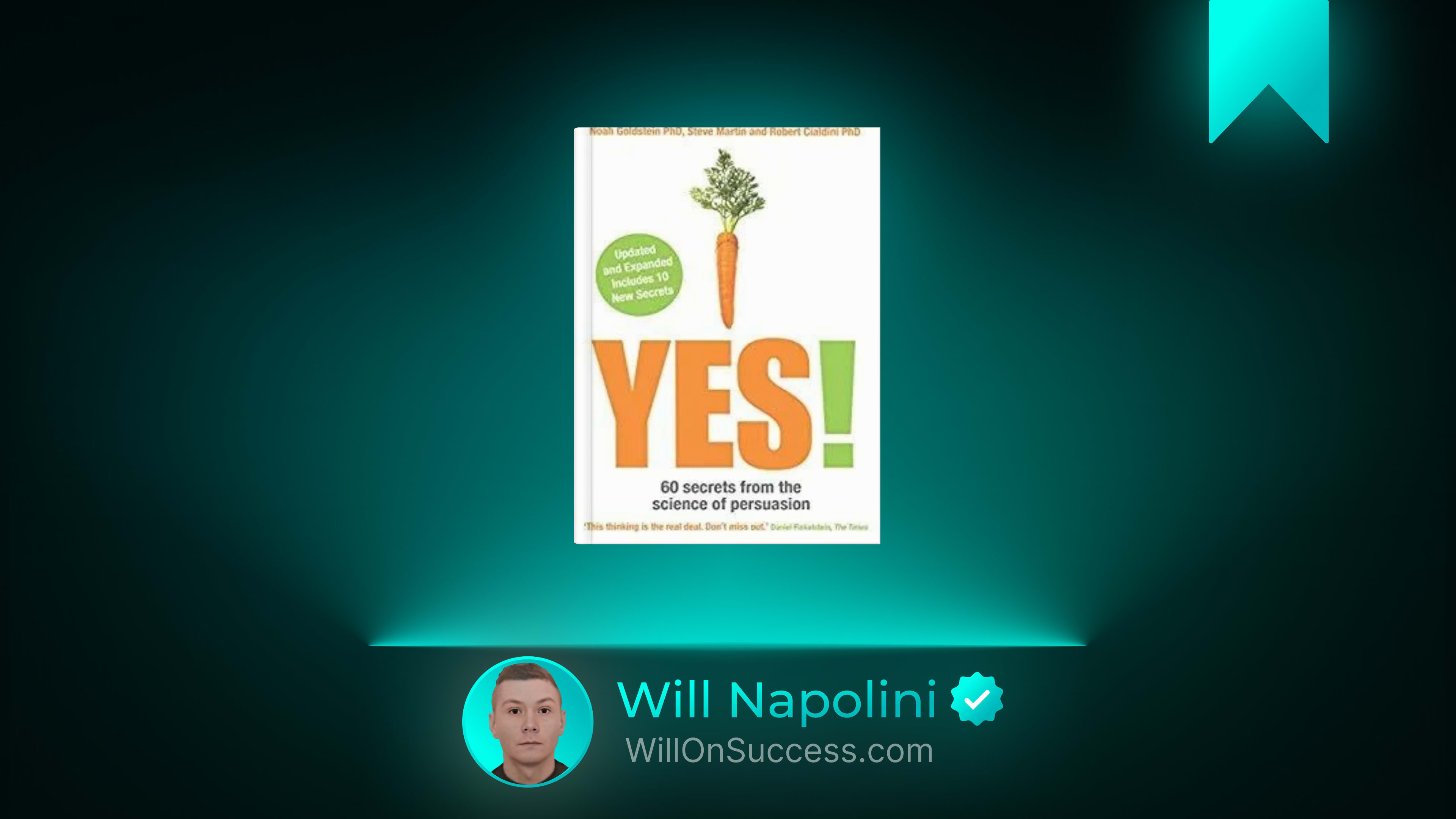
I spent years believing that version of the story. I thought persuasiveness was a trait you were born with, like height or a deep voice. Then I encountered the research collected by Noah Goldstein, Steve Martin, and Robert Cialdini in their book Yes! 50 Scientifically Proven Ways to Be Persuasive, and something shifted in how I understood every conversation, every request, every negotiation I had ever stumbled through.
The shift was this: persuasion is not a personality. It is a set of small, learnable adjustments. And the adjustments are often so modest that they feel almost too simple to matter.
That is exactly why they work.
The Big Idea: Influence Lives in the Details You Overlook
The central argument of Yes! is deceptively straightforward. The authors draw on decades of controlled social-psychology research to show that tiny changes in how you present a request, when you present it, what words you choose, and what context surrounds it can produce dramatically different outcomes. Not because you are manipulating anyone. Because human beings respond to subtle cues in predictable, well-documented ways, and most of us never learn to notice those cues, let alone work with them.
The book is structured as fifty short chapters, each one built around a single research finding. You can read them in an afternoon or stretch them across weeks. What matters is not the volume. What matters is the pattern that emerges once you see enough of these findings side by side: you do not need to become a different person to become more persuasive. You need to become a more attentive one.
If I could sit across the table from you and hand you one idea before anything else, it would be this. The distance between hearing “no” and hearing “yes” is often not a canyon. It is a few carefully chosen words. A slight reordering of information. A small act of generosity offered before the request arrives.
That is not a trick. That is craftsmanship.
The Research Behind the “Yes”
Before we go further, I want to be honest about what this book is and what it is not. Goldstein, Martin, and Cialdini are not offering a collection of personal opinions or motivational slogans. Robert Cialdini spent decades studying influence, most famously in his earlier work Influence: The Psychology of Persuasion, and this book extends that foundation. Each of the fifty chapters points to actual experimental research—studies in which variables were isolated, groups were compared, and results were measured.
That matters because it means the principles are not dependent on charisma, culture, or luck. They describe how human attention, trust, and decision-making actually function under controlled conditions. You can test them. You can adapt them. You can see whether they work in your own life.
The book does not pretend these findings are magic. Context matters. Ethics matter. And the authors are careful to frame persuasion as a tool for honest communication, not deception. That distinction runs through every page, and I think it is one of the reasons the book has held up so well.
Now, let me walk you through the principles I find most useful, the ones I return to again and again.
Give Before You Ask, and Watch the Room Change
One of the most consistently supported findings in persuasion research is reciprocity: when someone does something for us, we feel a genuine, often unconscious pull to respond in kind. The authors explore this in several chapters, and the practical implication is clear. If you want someone to say yes to your request, consider what you can offer first.
Not a bribe. Not a transactional “I’ll scratch your back so you scratch mine.” Something smaller and more human. A useful piece of information. A genuine compliment on their work. Five minutes of your attention on a problem they mentioned last week. A handwritten note instead of an email.
What I have learned is that generosity, even in tiny doses, changes the emotional temperature of an interaction. The other person stops bracing for a demand and starts leaning into a relationship. The request, when it finally comes, lands in softer soil.
Think of it like watering the ground before you plant. You would not drop a seed onto cracked, dry earth and wonder why nothing grows. You prepare the soil first. A small act of giving is how you prepare the soil of a conversation.
Let Others Do the Arguing for You
Social proof is one of the oldest ideas in influence research, and the authors give it fresh, practical angles. The core finding is simple: when people are uncertain, they look to the behavior of others to decide what is correct. If you tell a colleague, “Most of the team has already submitted their feedback,” you are far more likely to get that colleague’s input than if you simply say, “Please submit your feedback.”
But here is where the book adds nuance that many people miss. Social proof works best when the “others” are similar to the person you are trying to reach. A new teacher is more influenced by hearing that other new teachers adopted a strategy than by hearing that veteran teachers did. A small-business owner responds more to what other small-business owners are doing than to what a Fortune 500 company is doing.
The lesson is not to fabricate popularity. It is to make visible the honest, existing behavior of people your listener identifies with. You are not inventing evidence. You are choosing which true evidence to put in front of them.
A small decision about which story you tell becomes a direction for the conversation, and that direction, repeated across enough interactions, becomes the culture of a team, a family, a community.
Shrink the Ask, and You Grow the Yes
Several chapters in the book explore commitment and consistency—the well-documented tendency for people to want their future actions to align with their past ones. The practical takeaway is one I have used more than any other.
If you need someone to agree to something large, do not open with the large thing. Open with a small, easy, almost trivial yes. Get them to agree to a five-minute conversation before you ask for an hour. Ask them to read a one-page summary before you ask them to review a forty-page proposal. Invite them to attend one meeting before you ask them to join a committee.
Once a person says yes to the small version, their self-image shifts slightly. They are now “the kind of person who engages with this.” The next yes becomes more natural, not because you pressured them, but because they want to be consistent with the person they just showed up as.
You start small. You build trust. You let commitment grow at the pace the other person can sustain.
This is not manipulation. It is respect for the fact that people need time to adjust, and that a gentle first step honors their autonomy far more than a sudden, overwhelming demand.
The Words You Choose Are the Frame They See Through
One of the ideas in Yes! that surprised me most when I first encountered it was how dramatically the framing of identical information changes people’s responses. The authors discuss research showing that presenting a choice as a gain versus a loss, as a default versus an exception, or as a personal action versus a group norm can swing decisions significantly.
For example, telling a team “90 percent of projects are submitted on time” produces a different psychological effect than saying “10 percent of projects are late.” Both statements are factually identical. The first one makes on-time submission feel like the norm everyone belongs to. The second one makes lateness feel like a visible, salient problem. The first builds identity. The second triggers defensiveness.
In your daily life, this shows up everywhere. When you ask a friend for help, do you frame it around what they gain by helping, or around what they avoid losing? When you present an idea at work, do you lead with the opportunity or the risk? Neither frame is dishonest. But they activate different parts of the listener’s mind.
Choose your frame the way a carpenter chooses a joint. The wood is the same. The craftsmanship is in how you fit the pieces together.
Too Many Choices Quietly Kill the Yes
The book also touches on a finding that has become well known in behavioral science: when people face too many options, they often choose none at all. The authors connect this to persuasion by showing that simplifying the decision you are asking someone to make increases the likelihood they will actually make it.
If you are asking a client to choose a plan, offering three clear options will almost always outperform offering fifteen. If you are asking a family member to help with weekend plans, proposing one specific time and place will get a faster answer than asking, “So, what do you want to do, whenever?”
Reducing options is not about limiting freedom. It is about reducing the cognitive load that causes people to freeze. You are making it easier for them to act, and ease is one of the most underrated forms of kindness in any interaction.
Why This Matters on an Ordinary Tuesday
You might be thinking, “These are interesting ideas, but when do I actually use them?” The honest answer is: constantly. Every email you send is a small act of persuasion. Every conversation with your children about homework, every negotiation with a vendor, every request you make of a partner after a long day, every proposal you bring to a manager—all of these are moments where a small adjustment in framing, timing, or generosity changes the outcome.
I am not suggesting you turn every interaction into a strategy session. That would be exhausting and, frankly, a little cold. What I am suggesting is that understanding these principles gives you a quieter kind of confidence. You stop feeling like you are guessing. You stop assuming that the only way to get a yes is to be louder, pushier, or more forceful.
Instead, you prepare the soil. You choose your words with a little more care. You offer before you ask. You make the next step small enough that the other person can take it without fear.
And over weeks, months, years, those small adjustments compound. The way a single well-placed stone redirects a stream, a small shift in how you communicate redirects the trajectory of your relationships, your career, your influence.
Who Should Read This Book
If you lead a team, raise children, negotiate with clients, write emails that need responses, or simply want to feel less helpless in conversations where the outcome matters, Yes! will give you practical tools you can use the same day you read them. The chapters are short, research-grounded, and refreshingly free of hype.
The book will be less useful if you are looking for a deep, philosophical exploration of ethics or a comprehensive textbook on behavioral science. It is a practitioner’s field guide, not a treatise. Some of the fifty findings will resonate more than others depending on your context, and that is fine. You do not need all fifty. You need the three or four that fit your life right now.
One honest note: because the book was published in 2008, a few of the cultural references feel dated. The underlying research has not aged, but the examples occasionally will. Read past the specifics and focus on the principle beneath.
A Small Experiment to Start Today
Here is what I would invite you to do, and I mean this gently, not as homework.
Tomorrow, think of one request you need to make. It can be small. Asking a coworker to review a document. Asking your partner to handle a chore. Asking a neighbor for a recommendation.
Before you make the request, do one small thing for that person first. Send them an article related to their interest. Offer a sincere, specific compliment on something they did recently. Spend two minutes helping them with something they mentioned. Do not announce what you are doing. Do not attach conditions. Just give.
Then, when you make your request, frame it as a single, specific, easy-to-say-yes-to action. Not “Can you help me with this project sometime?” but “Would you have ten minutes on Thursday afternoon to look at the first two pages?”
Notice what happens. You do not need to keep score. You just need to pay attention.
The Door Is Open
What Goldstein, Martin, and Cialdini ultimately teach is not a collection of techniques. It is a posture. The posture says: influence is not something that happens to loud people in corner offices. It is something that happens between two human beings when one of them takes the time to understand how the other thinks, feels, and decides.
You do not need to become someone else to be heard. You need to become more attentive to the person in front of you. More generous before you ask. More patient in how you build a yes. More thoughtful about the words that carry your meaning across the table.
The research gives you the map. Your daily conversations are the territory.
And the territory is waiting for you, one small, honest, well-framed question at a time.
Pick one conversation tomorrow. Prepare the soil. Plant the seed gently. Then trust the slow, steady work of growth.