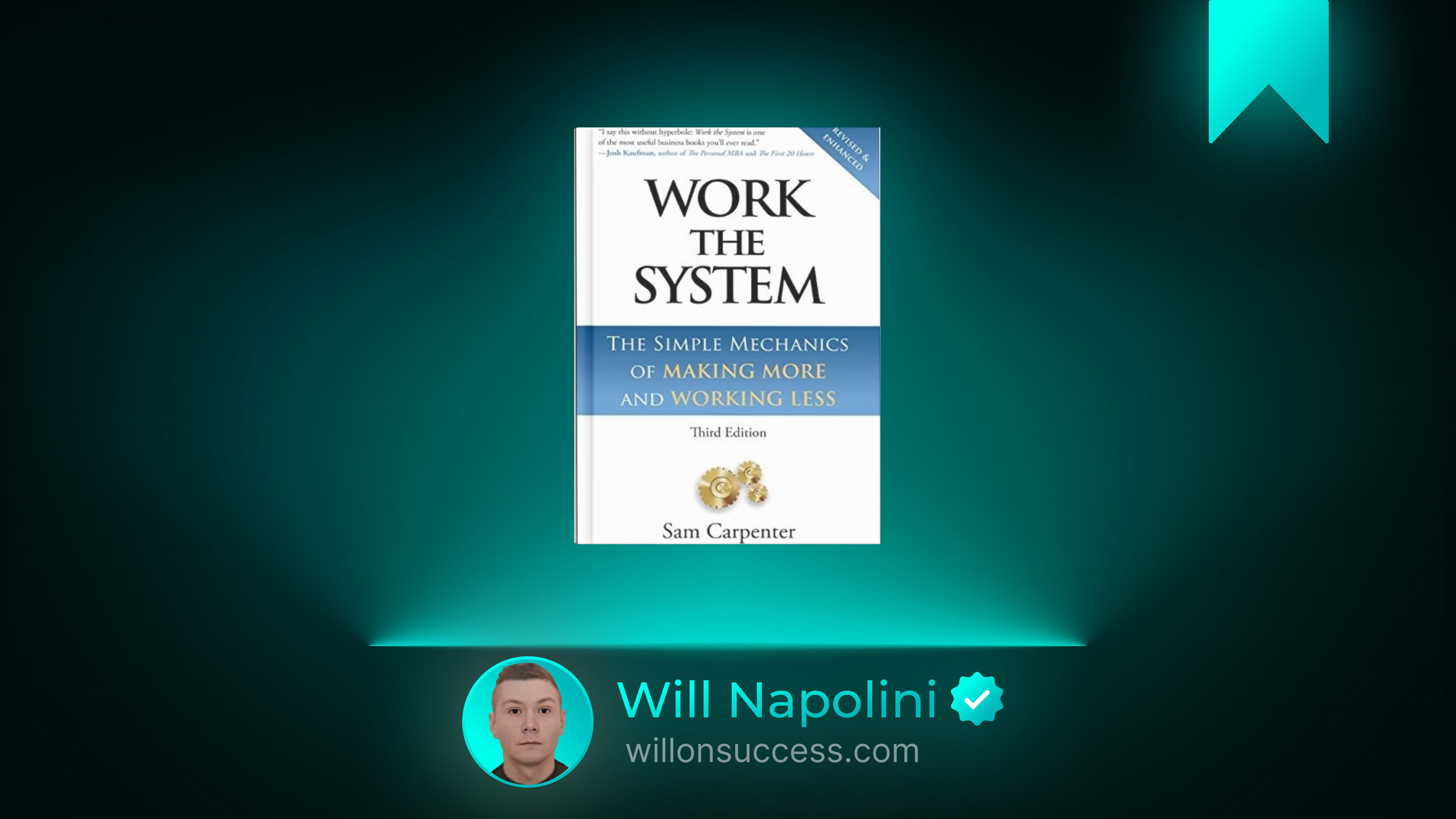
Work the System by Sam Carpenter: How to Stop Fighting Fires and Start Building a Life That Runs Itself
There is a specific kind of exhaustion that sleep cannot fix. It is the exhaustion of the firefighter.
You know the feeling. You spend your entire day reacting. An urgent email arrives, and you pivot. A client complains, and you drop everything to soothe them. A crisis erupts at home, and you scramble to patch it. By the time you collapse into bed, you have worked ten hours, but you cannot point to a single thing you actually built. You just survived another day.
If I could sit across the table from you right now, watching you rub your temples after another long week of putting out fires, I would tell you something that might initially sting: You cannot outwork a broken system.
We are taught that the cure for chaos is more effort. More hustle. More discipline. But what I have learned, and what Sam Carpenter proves in his masterful book Work the System, is that effort applied to a flawed system only produces exhaustion faster. The answer to the overwhelm you are feeling is not to pedal harder. The answer is to step off the bicycle, look at the chain, and realize it is broken.
The Big Idea: The Universe Is Not Random, It Is Mechanical
The central thesis of Work the System is a concept Carpenter calls the “System Perspective.”
Most of us walk through life viewing our days as a random sequence of events. Good things happen by luck; bad things happen by misfortune. When a project fails, we blame the economy. When an employee drops the ball, we blame their work ethic. When our own health declines, we blame our genetics or our stress. We view life as a chaotic storm that we must constantly brace against.
Carpenter asks you to put on a different pair of glasses. He wants you to see the world not as a storm of random events, but as a collection of interacting, linear, and entirely predictable systems.
Your business is a system. Your morning routine is a system. Your finances are a system. Your marriage is a system.
And here is the unyielding law of the universe that Carpenter builds his entire philosophy upon: A system will always produce the exact result it is designed to produce.
If your business is constantly generating emergencies, that is not bad luck. That is the system working perfectly to generate emergencies. If you are constantly running late, that is not a character flaw. That is your morning system functioning exactly as it was built to function.
Once you truly internalize this, the guilt and the blame evaporate. You stop being a victim of circumstance and become an engineer of reality. You realize that if you do not like the output, you do not need to change your personality. You just need to redesign the machine.
The Crucible: From 100-Hour Weeks to Two
To understand the power of this shift, you have to look at where Carpenter found it. He did not discover the System Perspective in a quiet university library. He discovered it in the trenches of near-bankruptcy.
In 1997, Carpenter bought a struggling call center in Bend, Oregon, called Centratel. For the first few years, he lived the nightmare of the typical small business owner. He was working eighty to a hundred hours a week. He was the chief problem-solver, the primary salesperson, and the default janitor. The phone rang at 2:00 a.m. with crises. His health deteriorated. His personal life was in shambles. He was pedaling a bicycle with a broken chain, wondering why he was not moving forward.
Then, the epiphany arrived. He realized that Centratel was not a living, breathing monster that he had to wrestle into submission every day. It was a machine. And the machine was full of stripped gears and missing belts.
He stopped working in the business and started working on the business. He stepped back, analyzed the linear mechanics of every single task, and began to document and optimize them. He did not just ask his team to “be more careful.” He built a system that made carelessness nearly impossible.
The result? Centratel grew to become one of the most profitable call centers in the country. More importantly, Carpenter reclaimed his life. He eventually reduced his workweek to roughly two hours, spending his time on high-level strategy and personal pursuits, while the machine hummed along without him. He did not achieve this through magic. He achieved it through mechanics.
Stop Fighting Fires and Start Building Fireproof Buildings
When you lack the System Perspective, you are a firefighter. You spend your days rushing from one blaze to the next, armed with a hose and a lot of adrenaline. Firefighting feels heroic. It feels productive. But it is a trap.
The systems thinker does not want to be a better firefighter. The systems thinker wants to build a fireproof building.
When a mistake happens in your life or your work, the average person asks, “Who messed up?” or “How do I fix this immediate mess?” The systems thinker asks, “What flaw in our procedure allowed this to happen, and how do I rewrite the procedure so it can never happen again?”
You step back. You observe the mechanics. You redesign the machine.
Every time you fix a root cause instead of just mopping up a symptom, you are laying another brick in a foundation that will eventually support the weight of your freedom. You stop relying on willpower to get things right, and you start relying on architecture.
The Three Documents That Anchor Your Reality
Carpenter argues that you cannot manage a system that exists only in your head. The human brain is a brilliant processor, but it is a terrible hard drive. It forgets. It gets emotional. It takes shortcuts. To make a system reliable, it must be externalized.
For a business, Carpenter prescribes three foundational documents. And I have found that these apply beautifully to families, nonprofits, and personal lives as well.
1. The Strategic Objective (Your True North)
This is a one-page document that defines exactly what the entity is trying to achieve. It is not a fluffy mission statement meant to impress investors or hang in a lobby. It is a pragmatic, ruthless definition of your ultimate goal.
For a business, it might define the exact market position and profit margins required to sustain the owners’ ideal lifestyle. For a family, it might read: “To cultivate a home environment that prioritizes deep connection, physical health, and intellectual curiosity over external achievement.”
When you are faced with a difficult decision, you hold it up against the Strategic Objective. If it does not serve the objective, you discard it.
2. General Operating Principles (Your Rules of the Road)
If the Strategic Objective is your destination, the GOPs are your rules of the road. These are the overarching precepts that guide daily decision-making.
A business GOP might be: “We will never sacrifice long-term stability for short-term revenue.” Or, “We will always communicate bad news to a client before they discover it themselves.”
A family GOP might be: “We do not bring screens to the dinner table.” Or, “We address conflicts directly with each other, never through third parties.”
When your team (or your family) knows the principles, they do not need to ask you for permission to make a decision. They just apply the principle. You scale your judgment without having to be in the room.
3. Working Procedures (Your Step-by-Step Mechanics)
This is where the magic happens. A Working Procedure is the exact, step-by-step, hyper-specific instruction manual for executing a repeating task.
It is not “Answer the phone politely.” It is: “Pick up the receiver before the third ring. Say, ‘Thank you for calling Centratel, this is [Name], how may I direct your call?’”
It is not “Get ready for work.” It is: “At 6:00 AM, put feet on the floor. Walk to the kitchen. Pour one glass of water. Put coffee grounds in the filter.”
When you document the procedure, you remove the variable of human emotion and fatigue from the equation. You are no longer relying on motivation. You are relying on a track that your brain can simply follow.
The 99.9% Standard: Why “Good Enough” is the Enemy of Peace
We live in a culture that celebrates the “grind” and accepts a certain level of messiness as the cost of doing business. Carpenter challenges this entirely. He points to the mechanics of the physical universe. The electrical grid, the telecommunications network, the aviation industry—these systems operate at 99.9% efficiency or higher. If the power grid worked at 98% efficiency, your power would be out for seven days a year. If the aviation industry operated at 99% efficiency, thousands of planes would crash annually.
Why do we accept 90% or 95% efficiency in our own lives and businesses?
When you settle for “good enough,” you are mathematically guaranteeing a steady stream of errors. And every error requires your time, your energy, and your emotional bandwidth to fix. By obsessing over the mechanics and pushing your systems toward 99.9% perfection, you are not being a micromanager. You are buying back your peace of mind. You are eliminating the friction that drains your soul.
Perfection in systems is not about rigidity. It is about reliability. It is the quiet confidence of knowing that when you turn the key, the engine will start. Every single time.
Why This Matters on an Ordinary Tuesday
It is easy to read about call centers and think, “That is great for a business, but my life is not a factory.”
But consider your own life.
Think about your health. If you are constantly battling your weight, you do not have a willpower problem. You have a nutritional and environmental system that is perfectly designed to produce your current weight. The system is working flawlessly to deliver the result you are getting.
Think about your finances. If you are constantly stressed about money at the end of the month, you do not have an income problem. You have a cash-flow system that lacks automated boundaries.
Think about your mornings. If you leave the house every day feeling rushed, irritable, and forgetting your keys, you do not have a personality defect. You have a morning system that is missing a working procedure.
What I discovered when I began applying the System Perspective to my own life was a profound sense of relief. I stopped being angry at myself for failing to magically become a different person. I just looked at the mechanics. I tweaked the inputs. And the outputs changed.
Peace is not the absence of problems; it is the presence of systems that handle them.
A Practical Experiment: The Friction Audit
You do not need to rewrite your entire life this weekend. In fact, if you try, you will fail. Systems are built through iteration, not revolution.
Here is a practical exercise I call the “Friction Audit.”
Think of one recurring task in your life that always causes a low-grade sense of dread or friction. It might be the weekly grocery run, the process of paying your bills, the way you transition from work to family time in the evening, or the way you pack for a business trip.
Step 1: Write down the current system. Do not write how you wish it worked. Write down the exact, messy, flawed steps you actually take right now. Example: Wake up, check phone in bed, rush to shower, realize no clean towel, scramble to find one, forget lunch, leave stressed.
Step 2: Identify the failure point. Where does the system break down? Where do you lose time, money, or patience? Example: The phone in bed drains time. The missing towel creates panic.
Step 3: Rewrite the Working Procedure. Design a new, linear sequence of steps that eliminates the failure point. Add a physical trigger or an environmental constraint. Example: Phone charges in the kitchen overnight. Towel is hung in the bathroom before going to sleep. Lunch ingredients are placed in a designated bin in the fridge on Sunday.
Step 4: Test it. Run the new procedure for two weeks. Tweak it. Refine it.
You are no longer just living your life. You are engineering it.
Who Should Read This Book
If you are an entrepreneur who feels like the sole load-bearing pillar of your company, this book is your escape hatch. It will show you how to build a machine that runs without your constant intervention, allowing you to finally take a vacation without checking your email every ten minutes.
If you are a manager drowning in operational chaos, constantly correcting the same mistakes made by your team, Carpenter’s framework will teach you how to lead through systems rather than through exhaustion.
If you are an individual who feels like life is just a series of random, overwhelming events happening to you, this book will hand you back the steering wheel. It is profoundly empowering for anyone dealing with chronic overwhelm, ADHD, or executive dysfunction, because it externalizes the mental load into physical checklists and environments.
However, if you are looking for a book about “finding your passion” or manifesting your dreams through positive thinking, this will feel too mechanical for you. Carpenter is not interested in your feelings about the work. He is interested in the physics of the work. He is a pragmatist writing for pragmatists.
One Small Step, Right Now
Before you close this article, I want you to identify one small, repeating annoyance in your daily life. The thing that makes you sigh every single time it happens. Maybe it is searching for your keys. Maybe it is the chaotic pile of mail on your kitchen counter. Maybe it is the frantic search for a clean shirt on Tuesday morning.
Do not just complain about it today. Fix the system.
Create a physical home for the keys and put a bowl there. Set up a single inbox tray for the mail. Lay out the shirt on Monday night.
Write down the new procedure. Stick to it.
It seems trivial, I know. But when you fix a small system, you prove to yourself that you have agency over your environment. You prove that you are the engineer, not the victim.
You stop fighting the fire. You start building the house.
And a life built on solid, quiet, well-designed systems is a life that finally has the space to breathe.