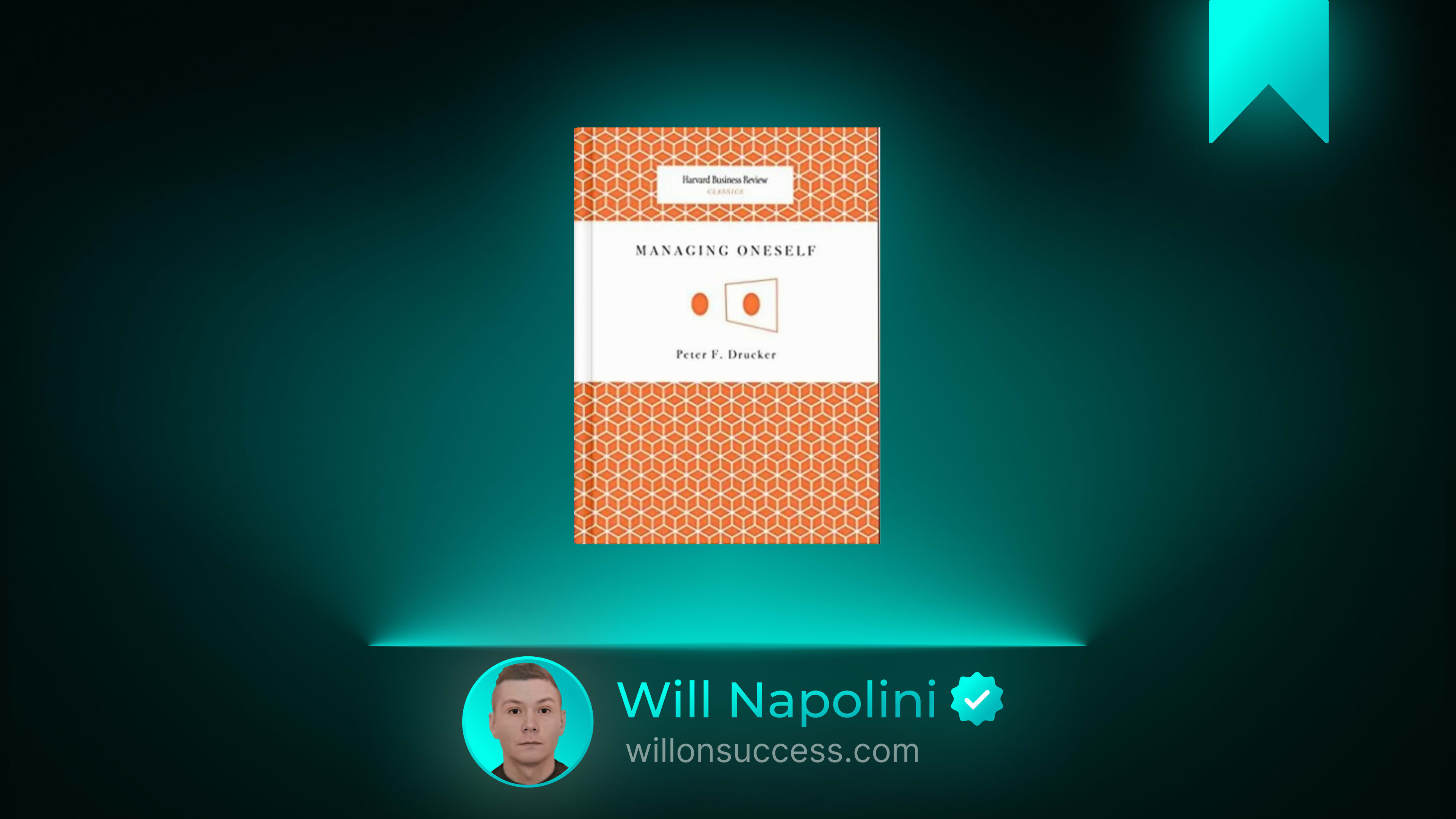
Managing Oneself by Peter Drucker: The Quiet Art of Taking Charge of Your Own Life
For most of human history, you did not have to figure out what to do with your life.
If your father was a blacksmith, you forged iron. If you were born in a quiet farming village, you planted crops. Your path was narrow, predictable, and largely decided for you before you took your first breath. The ceiling was low, but the floor was solid. You knew who you were, where you belonged, and what was expected of you.
Today, that certainty is gone. The walls have been blown off the maze. You can learn any skill, move to any city, pivot into any industry, and reinvent yourself a dozen times before you retire. We live in an age of unprecedented opportunity. But if you have ever sat in your car in the driveway after work, staring at the steering wheel and feeling a quiet, persistent exhaustion from having to constantly decide who you are supposed to be, I want you to know something: you are not failing at life. You are simply experiencing the heavy, unspoken burden of modern freedom.
Peter Drucker, the thinker who essentially invented the modern discipline of management, saw this shift coming decades before the rest of us. In his short, brilliant guide Managing Oneself, he laid out a truth that is as liberating as it is terrifying: in a world of endless choices, no one is coming to manage you. The company will not map your career. The mentor will not hand you your purpose.
You must become the chief executive of your own life. And to do that, you must learn to manage yourself.
The Big Idea: You Cannot Manage What You Do Not Understand
Drucker’s central thesis is deceptively simple. We spend our entire lives trying to manage our time, our money, our teams, and our projects. Yet most of us have never taken the time to systematically manage the only instrument that actually produces results: ourselves.
We operate on assumptions about who we are. We assume we are good communicators because we talk a lot. We assume we are bad at math because we failed a test in high school. We assume we work best under pressure because we always wait until the deadline to start.
Drucker argues that these assumptions are usually wrong. And building a life on false assumptions is like building a house on a sinkhole. It does not matter how hard you work or how beautiful the blueprints are; eventually, the foundation will give way.
Managing Oneself is not a book about finding your passion through vision boards or positive affirmations. It is a pragmatic, unsentimental manual for self-discovery. It asks you to treat yourself as a subject of study. To gather data. To look at the evidence of your own life. And then, to place yourself in environments where your natural design can actually flourish.
The Crucible of the Feedback Analysis
How do you actually find out what you are good at? If I asked you right now to list your top three strengths, you would probably hesitate. We are generally much better at knowing what we are not good at.
Drucker prescribes a tool that is centuries old, yet rarely used: the feedback analysis.
The mechanism is beautifully simple. Whenever you make a key decision or take a significant action, write down what you expect to happen. Nine or twelve months later, compare the actual results with your expectations.
If you take on a new project, write down what success looks like in a year. If you have a difficult conversation with a colleague, write down how you expect the relationship to shift. If you start a new habit, write down how you think it will change your daily energy.
Do this consistently, and within two or three years, a pattern will emerge. The feedback analysis will show you where your true strengths lie. It will show you where you are competent but not exceptional. And, perhaps most painfully, it will show you where you have absolutely no talent at all.
It is unglamorous. It is slow. It requires the humility to let reality correct your ego. But it is the only way to separate your wishes from the evidence.
Stop Trying to Fix Your Weaknesses
One of the hardest lessons I had to learn—and one that Drucker hammers home with relentless logic—is that it takes far more energy to improve from incompetence to mediocrity than it does to improve from first-rate performance to exceptional performance.
Yet, look at how most of us spend our time. We get a performance review that highlights three massive strengths and one glaring weakness. What do we obsess over for the next six months? The weakness. We hire coaches, buy books, and lose sleep trying to turn our clumsiness into adequacy.
Drucker’s advice is radical in its simplicity: stop.
You cannot build a life, a career, or a legacy on the foundation of what you are merely adequate at. Your responsibility is to discover your strengths through the feedback analysis, and then to do the only three things that actually matter:
First, concentrate on your strengths. Place yourself where your strengths can produce results. Second, work on improving those strengths. If you are a good writer, take a masterclass to become a great one. Third, discover where your intellectual arrogance is causing disabling ignorance. If you are a brilliant engineer who dismisses marketing as “fluff,” your arrogance will eventually cap your career. Learn just enough about the other domains to stop them from sabotaging your strengths.
Do not waste your finite energy trying to become a well-rounded, mediocre version of everything. Be exceptionally good at the few things you were built to do, and partner with others for the rest.
Discover How You Actually Perform (Not How You Wish You Did)
Knowing your strengths is only half the equation. The other half is knowing your performance style. How do you actually get things done?
Many people know what they are good at, but they fail because they are trying to do it in a way that goes against their natural grain. Drucker breaks performance down into a few critical distinctions, and understanding them can save you years of quiet frustration.
Are you a reader or a listener? Some people process information best when they read it. Others process it best when they hear it. Drucker points out that very few people are both. If you are a reader, and your boss insists on giving you verbal updates in the hallway, you will miss critical details and look incompetent. If you are a listener, and your team sends you fifty-page slide decks before a meeting, you will be overwhelmed and disengaged. You cannot change how you process information. You must adapt your environment to it. Tell people how you need to receive information.
How do you learn best? Do you learn by writing? (Beethoven left behind massive sketchbooks, not because he needed them to compose, but because the act of writing was how he internalized music.) Do you learn by doing? Do you learn by hearing yourself talk? Stop trying to force yourself into a learning style that feels “professional” but leaves you empty. Use the method that actually gets the knowledge into your brain.
Do you work best alone or with people? Some people are brilliant team members but terrible leaders. Some people are visionaries who need an implementer to actually get things done. Some people need to be the advisor, never the final decision-maker, because the weight of the final call paralyzes them.
There is no moral superiority to any of these styles. The only mistake is refusing to acknowledge which one you are. If you know you perform best as a number two, but you accept a promotion to be the number one because of the title and the pay raise, you are not advancing your career. You are engineering your own misery.
The Mirror Test: Aligning Your Work with Your Values
Eventually, your strengths and your performance style will lead you to a crossroads where logic is not enough. You will face a decision where the math works, the opportunity is lucrative, but something in your gut feels wrong.
This is where values come in.
Drucker proposes the “mirror test.” What kind of person do you want to see when you look in the mirror in the morning?
Values are not the inspirational words a company prints on the lobby wall. Values are the behaviors you tolerate in a crisis. If you value autonomy but work in a micro-managed environment, you will slowly wither. If you value deep, focused creation but work in a culture that rewards constant, reactive availability, you will burn out.
When your work violates your values, the result is not just poor performance. The result is cynicism. And cynicism is the soul’s way of going on strike.
If you find yourself in an environment that fails the mirror test, you must leave. It does not matter how comfortable the salary is. You cannot compromise your values to fit a job; the job will eventually compromise you.
Move from “What Do I Want?” to “What Needs to Be Done?”
When we are young, we are taught to ask, “What do I want to do with my life?” It is a natural question, but Drucker argues it is the wrong one for a mature adult.
The self-centeredness of that question eventually leads to a dead end. The better question—the one that leads to genuine contribution—is: “What needs to be done that only I can do, given my strengths, my performance style, and my values?”
This shifts you from being a consumer of your career to a contributor to your world.
When you ask what needs to be done, you stop looking for the perfect, frictionless path. You start looking at the messy, imperfect reality in front of you and asking where you can be useful. You look at your team, your family, your community, and you identify the gap. Then, you apply your specific strengths to that specific gap.
Contribution requires you to define the result. It is not enough to say, “I am going to work hard on this project.” You must say, “In eighteen months, this project will have achieved X, and people will see Y differently.” When you tie your strengths to a tangible, needed result, you stop being a passenger in your own life. You become the engine.
You Are Responsible for the People Around You
Here is a truth that most people resist: it is not your colleagues’ responsibility to understand you. It is your responsibility to make yourself understood.
Most conflicts in the workplace and in relationships do not stem from malice. They stem from ignorance. People simply do not know how other people work. The brilliant engineer does not know that the marketing director needs to talk out loud to process ideas. The marketing director does not know that the engineer needs three hours of uninterrupted silence to write code. So they clash, and both walk away thinking the other person is difficult.
Managing yourself means taking responsibility for your relationships.
This requires two things. First, you must observe the people around you and ask, “How do they perform? What are their strengths? How do they need to receive information?” Second, you must communicate your own needs clearly and without apology.
Imagine the freedom of simply saying to a colleague, “I am a reader. If you want my best thinking on this, please send me a one-page summary before we meet, rather than trying to explain it to me in the elevator.”
You do not have to guess. You do not have to resent them for not reading your mind. You just have to communicate.
The Second Half of Your Life
One of the most profound sections of Drucker’s work addresses a modern reality that our ancestors never had to face: we are going to live a very long time.
In the past, you worked until you were sixty, and then you stopped. Today, you might work until you are seventy-five or eighty. But here is the problem: you will likely outlive your first career’s ability to challenge you. You will master your field, hit the ceiling, and still have twenty years of working life ahead of you. If you have not prepared for this, the second half of your life will be defined by boredom, irrelevance, and a quiet sense of tragedy.
Drucker advises that you must begin managing the “second half of your life” long before you enter it. He suggests three paths:
- A second career. You start a completely new line of work, often in a different industry or a nonprofit sector, while still maintaining your first career.
- A parallel career. You keep your day job, but you dedicate ten hours a week to a passionate pursuit—running a local charity, teaching a class, writing a book, serving on a board.
- A social venture. You take your accumulated business skills and apply them to a social problem you deeply care about.
The key is to start building this second act in your forties or early fifties. You cannot wait until you are burned out at sixty to suddenly invent a new purpose. Purpose takes time to cultivate. Plant the seeds of your second half while you are still harvesting the fruits of your first.
Who Should Read This Book
If you are a knowledge worker, a manager, a freelancer, or anyone whose primary tool is your own mind, this book is not optional. It is the operating manual for your professional life.
If you are in your twenties or thirties, reading this will save you from a decade of climbing ladders that are leaning against the wrong walls. It will teach you to gather data on yourself early, rather than waking up at forty-five realizing you have optimized for a life you do not actually want.
If you are in your fifties or sixties and feeling a strange, hollow ache despite your outward success, Drucker’s chapters on the “second half of your life” will feel like a lifeline. He gives you permission to pivot, to start over, and to find new meaning without abandoning the wisdom you have already earned.
If you are looking for a quick, five-step hack to double your income by next Tuesday, this book will frustrate you. Drucker does not deal in hacks. He deals in architecture. He asks you to do the slow, unglamorous work of self-observation. But the house you build with his blueprints will stand for the rest of your life.
A Practical Experiment for This Week
I want you to stop reading about managing yourself and actually start doing it. We are going to run a micro-experiment based on Drucker’s concept of the feedback analysis, but we are going to shrink it down to fit into a single week.
Identify one specific, slightly challenging action you are going to take in the next three days. It could be asking for a raise, initiating a difficult conversation with a partner, launching a small side project, or committing to a new morning routine.
Before you take the action, open a notebook or a notes app. Write down the date. Write down the action. And then, write down exactly what you expect to happen as a result. Be specific.
“I expect my manager to say no to the raise, but I expect to feel proud that I asked, and I expect to get specific feedback on what I need to achieve by Q4.”
“I expect the conversation with my partner to be uncomfortable for the first ten minutes, but I expect us to feel closer by the end of the night.”
Then, take the action.
Set a calendar reminder for exactly one month from today. When that reminder goes off, open your note and compare the reality to your expectation. What did you get right? Where was your ego lying to you? What did you learn about how you handle conflict, or negotiation, or discipline?
You start small. You track the results. You let reality speak.
Do this with just one decision this week. If you do, you will have taken the first real step out of the fog of assumptions and into the clear light of self-knowledge.
One Small Step, Right Now
Before you close this page and return to the endless stream of your daily tasks, I want you to take the mirror test.
Think about the primary environment you spend your time in right now—your current job, your current role, or your current daily routine. Ask yourself one simple, honest question: When I engage with this work, do I like the person I see in the mirror?
You do not have to quit your job today if the answer is no. You do not have to blow up your life. But you do have to tell yourself the truth.
If the answer is yes, lean in. Double down on your strengths in that space. If the answer is no, you now have your most important project. You do not need to figure out the entire escape plan tonight. You just need to acknowledge the misalignment.
Write down one thing you can do this month to bring your daily work closer to your values. It might be setting a boundary. It might be delegating a task that drains you. It might be signing up for a class in a field you actually care about.
You are the CEO of your own life. The board of directors is empty. The shareholders are just you.
Stop waiting for someone else to hand you the map. Pick up the pen, look at the evidence of your own life, and draw the next line yourself.