The Body Keeps the Score: Why Healing Trauma Starts Where Thinking Ends
There is a question I have heard people ask themselves in a hundred different ways, and it always sounds something like this: Why can’t I just get over it?
You know the event is in the past. You can describe it clearly, even logically. You understand, intellectually, that you are no longer in danger. And yet something in your chest tightens when you hear a certain tone of voice. Your shoulders climb toward your ears in a crowded room. A smell, a season, the angle of light through a window — and suddenly you are not where you are. You are somewhere else, somewhen else, and your body is reacting as though the threat is happening right now.
If that sounds familiar, I want you to hear something before we go any further. You are not weak. You are not exaggerating. You are not failing to try hard enough.
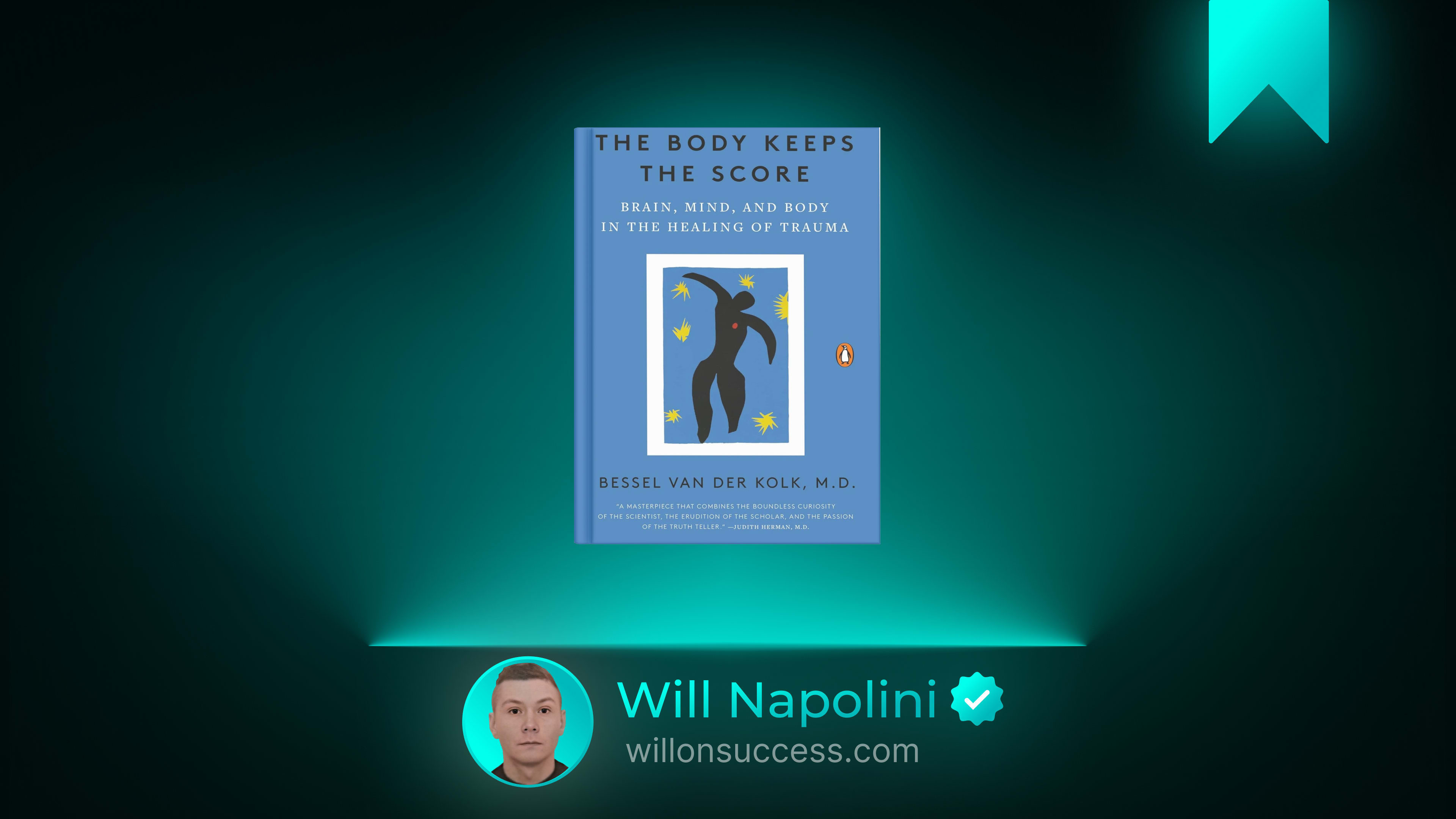
What you are experiencing has a name, a mechanism, and — this is the part that matters most — a path forward. Bessel van der Kolk spent decades studying that path, and he laid it out in a book called The Body Keeps the Score: Brain, Mind, and Body in the Healing of Trauma. It is one of the most important books written on human suffering and recovery, and I want to walk you through its central ideas in a way that meets you where you actually are.
Not in a clinic. Not in a lecture hall. Just here, across the table, where we can talk honestly.

The Idea That Changes Everything
For most of the twentieth century, the dominant approach to emotional pain was essentially cognitive. You talked about what happened. You analyzed it. You reframed it. You tried to think your way into feeling better.
Van der Kolk’s central argument, built on decades of clinical work and research, overturns that assumption. Trauma, he shows, is not a story that happened to you and now lives only in memory. It is an experience that physically reorganizes your nervous system, your brain’s alarm architecture, and the way your body inhabits the present moment. The body does not file the memory away neatly. It holds the score. It keeps rehearsing the threat. It stays braced for a danger that may have passed years ago.
This is why you can understand your history perfectly and still feel hijacked by it. The thinking part of your brain — the prefrontal cortex, the narrator, the part that says that was then and this is now — is not the part running the show when the alarm goes off. Deeper structures, older circuits, are in charge. And they do not respond to logic. They respond to felt safety, to rhythm, to breath, to the body’s own language.
That single insight changes the entire question. The question is no longer Why can’t I think my way out of this? The question becomes How do I speak to my body in a language it actually understands?
What Happens Inside When the Alarm Never Turns Off
Van der Kolk walks the reader through the neuroscience with remarkable clarity, and I want to give you the essential picture without drowning you in terminology.
When you face a genuine threat, your brain’s alarm system — centered around a structure called the amygdala — floods your body with stress hormones. Your heart races. Your muscles prepare to fight or flee. Your senses sharpen. This system evolved to save your life, and it is brilliant at its job.
In ordinary circumstances, once the danger passes, the system resets. The prefrontal cortex comes back online. You orient to the present. You take a breath. The world feels manageable again.
But when the threat is overwhelming, repeated, or occurs in a context where escape is impossible — which is the reality for many people who experience abuse, violence, neglect, or prolonged helplessness — that reset never fully happens. The alarm system recalibrates. It starts treating neutral stimuli as dangerous. A raised voice that is merely enthusiastic registers as a threat. A closed door feels like entrapment. The body remains in a state of vigilance long after the original danger has ended.
Van der Kolk describes how this affects the hippocampus, the structure responsible for placing memories in time and context. When it is disrupted by trauma, memories do not get properly “dated.” They remain raw, immediate, timeless. You do not recall the event the way you recall what you had for breakfast last Tuesday. You relive it. The body reacts as though it is happening now.
This is not a metaphor. This is physiology. And understanding that physiology is, for many people, the first real permission they give themselves to stop blaming their own character for what is actually a survival response.
You Cannot Argue With a Nervous System
One of the most liberating and also most frustrating truths in this book is this: insight alone does not heal trauma.
I have seen people who can narrate their childhood with surgical precision, who understand every dynamic, who have read every book, who can explain exactly why they react the way they do — and still find themselves frozen, flooded, or numb in the moments that matter. Understanding the origin of the wound does not automatically close it.
Van der Kolk is not dismissing talk therapy. He acknowledges its value. But he insists, based on extensive clinical evidence, that approaches which work exclusively through language and cognition often leave the body’s imprint untouched. The body learned its lessons in sensation, in muscle tension, in breath held too long, in a heart that learned to pound at the sound of footsteps. And the body needs to be addressed in that same register.
This is why the book explores a wide range of healing modalities — not as a menu of trendy alternatives, but as pathways that speak to the nervous system directly. Eye Movement Desensitization and Reprocessing (EMDR), which helps the brain reprocess stuck memories. Yoga and mindful movement, which rebuild the capacity to feel safe inside one’s own skin. Neurofeedback, which trains the brain toward calmer baseline states. Theater, rhythm, communal movement, and play — practices that restore a sense of agency, expression, and connection that trauma often strips away.
The common thread across all of these is not the technique itself. It is the principle: healing happens when a person can safely re-inhabit their body, notice what they feel without being overwhelmed by it, and gradually restore a sense of choice and control.
Safety Is Not a Luxury. It Is the Foundation.
If there is one practical truth I would pull from this book and press into your hands, it is this: you cannot heal in a state of constant threat.
This sounds obvious, but consider how often we try to do our deepest emotional work while still living in environments that keep our nervous system activated. We try to process old wounds while sleeping poorly, eating poorly, surrounded by chaos, or in relationships where we do not feel safe. We expect ourselves to heal on a foundation that is still shaking.
Van der Kolk emphasizes that establishing safety — physical safety, relational safety, and the internal sense that you are not about to be overwhelmed — is not a preliminary step you rush through to get to the “real” work. It is the beginning of the real work. It may be the majority of the real work.
For some readers, that means the first and bravest act is leaving a situation that keeps you in survival mode. For others, it means building a small, reliable routine — a regular walk, a consistent bedtime, one person you can call who will not judge you — that whispers to your nervous system, over weeks and months, that not every moment is a threat.
You do not have to fix everything at once. You have to build a floor solid enough to stand on.
The Wound Is Not the Whole Story
I want to pause here, because if you have lived with trauma, or if you love someone who has, you know how easy it is to let the wound become the entire identity. I am the thing that happened to me. I am the damage. I am the reaction.
Van der Kolk pushes back against this gently but firmly. The book is not a catalogue of brokenness. It is a map of recovery. And the map depends on a fact that neuroscience has confirmed beautifully: the brain is plastic. It changes. It reorganizes. What was learned in terror can, over time and with the right conditions, be unlearned — not erased, but integrated, so that it becomes part of your history rather than the governor of your present.
Healing is not the absence of memory. It is the presence of choice. It is the ability to feel the old fear rise and then watch it pass without being swept away. It is the slow, sometimes nonlinear work of teaching your body that the war is over.
And here is what I have learned from watching people do this work over many years: it is not a single breakthrough. It is a thousand small returns. A day you breathe deeply without realizing you were holding your breath. A night you sleep through without the old dream. A conversation where you stay present instead of shutting down. These are not minor victories. They are the architecture of a new life being built on the foundation of the old one.
You start small. You stay patient. You let the body catch up to the truth your mind already knows.
What This Means on an Ordinary Tuesday
Principles are only useful if they change what you do on a regular Wednesday afternoon. So let me bring this down to the ground.
If you recognize yourself in what van der Kolk describes — the hypervigilance, the numbness, the disconnect between what you know and what you feel — here are a few directions worth exploring, gently and at your own pace.
Notice your body before you analyze your mind. The next time you feel a surge of anxiety, anger, or shutdown, resist the urge to immediately narrate or problem-solve. Instead, pause and ask: Where do I feel this? What is happening in my chest, my jaw, my hands, my stomach? Simply naming the physical sensation can begin to create a small gap between you and the reaction. That gap is where choice lives.
Move your body in a way that feels safe. You do not need to train for a marathon. A ten-minute walk outside, a few slow stretches, dancing to one song in your kitchen, floating in a pool — any movement that lets you feel your body as a place you inhabit rather than a thing that happens to you. Van der Kolk’s emphasis on yoga and movement is not about fitness. It is about re-establishing the basic trust between you and your own physical self.
Protect your baseline. Sleep, nutrition, and reducing unnecessary stimulation are not glamorous interventions, but they lower the overall activation level of your nervous system. A body that is rested and nourished has more capacity to handle difficult emotions without tipping into panic or numbness. Treat your basics like the foundation of a house. You cannot renovate the upper floors if the foundation is cracking.
Seek connection that does not require performance. Trauma often teaches people to hide, to manage others’ perceptions, to be “fine.” Healing often begins in the presence of one person — a friend, a partner, a therapist, a support group — with whom you can be honest without having to perform recovery. You do not need an audience. You need a witness.
If you can, work with a professional trained in trauma-informed approaches. This book is a powerful guide to understanding, but it is not a substitute for skilled clinical support when the wounds are deep. Therapies like EMDR, somatic experiencing, and internal family systems exist because some knots cannot be untied by thinking alone. Asking for help is not a concession. It is strategy.
Who This Book Is For — and Who Might Find It Heavy
I want to be honest with you. The Body Keeps the Score is not a light read. Van der Kolk draws on case studies from his clinical practice, and some of the material involves severe abuse, violence, and childhood suffering. If you are currently in a fragile place, if the subject matter is very close to your own experience and you are not yet in a supported or stable position, it is worth approaching this book with care. Perhaps alongside a therapist. Perhaps in small sections rather than all at once. You are allowed to set it down. You are allowed to take breaks. The book will wait for you.
That said, this book is genuinely for anyone who has ever felt that their reactions are disproportionate, inexplicable, or beyond their control. It is for people who grew up in difficult households and still carry the imprint into their adult relationships. It is for veterans, survivors of assault, people who endured medical trauma, anyone who lived through a period of sustained helplessness. It is also for the people who love them — partners, parents, friends, therapists — who want to understand why their loved one cannot “just let it go.”
If you are looking for a quick-fix self-help book with five easy steps, this is not that. It is richer, more complex, and ultimately more respectful of the human experience than that. It asks you to sit with difficulty before it offers a way through. But it does offer a way through. That is what makes it so important.
One Small Step You Can Take Today
I am not going to ask you to overhaul your life before dinner. That is not how this works, and van der Kolk’s entire thesis argues against the idea that cognitive intention alone changes anything.
Here is what I would invite you to do. Just one thing.
Before you go to sleep tonight, lie down or sit comfortably. Place one hand on your chest and one on your belly. Close your eyes. Take five breaths — not forced, not performative — just slow, noticing the air move in and out, feeling your hands rise and fall. As you do, say to yourself, quietly or in your mind: I am here. I am in this room. I am safe in this moment.
That is it. You are not fixing anything tonight. You are simply practicing the act of arriving in your own body, in the present tense, without an alarm sounding. You are speaking to your nervous system in the only language it trusts: breath, rhythm, presence.
Do it for five breaths. Tomorrow, maybe ten. The next day, maybe you add a short walk. The day after that, maybe you call someone.
You do not have to see the whole staircase. You just have to take the next step, and let your body learn, slowly, that the ground will hold you.
The Door Is Open
Van der Kolk wrote a book about wounds, yes. But what I carry with me, what I hope you carry with you, is not the wound. It is the extraordinary stubbornness of the human capacity to heal. The brain rewires. The body relearns. A person who spent years bracing for impact can, with patience and the right support, learn to stand in an open field and feel the wind without flinching.
That does not happen overnight. It does not happen because someone tells you to be strong. It happens because you decide — gently, imperfectly, sometimes with trembling hands — to begin speaking to yourself and your body in a new language. A language of safety instead of vigilance. Of presence instead of escape. Of I am here now instead of I am still back there.
You have carried enough for one lifetime. You are allowed to set some of it down. Not all at once. Not perfectly. But you are allowed.
And the first breath you take with that permission changes everything.