Wolf Totem – Why Taming Your Wild Nature Leaves You Starving in a Desert of Your Own Making
Have you ever noticed how the very things we do to make our lives “safer” and “more predictable” often end up draining the life out of us?
We build rigid routines to save time, but we lose our spontaneity. We accept stable, predictable paths to secure our future, but we quietly surrender our edge. We pave over the wild, unpredictable parts of our days, believing we are creating order, only to find ourselves standing in a desert of our own making, wondering where all our energy went.
I have watched this happen to brilliant, capable people. They work so hard to control their environment, to fence in their risks, and to extract every ounce of productivity from their days. And then, inevitably, they collapse. Not because they lacked discipline, but because they fundamentally misunderstood the nature of the ground they were standing on.
If you have ever felt like you are doing everything “right” but still feel an exhausting emptiness creeping in, I want to talk to you about a book that will change how you see your life.
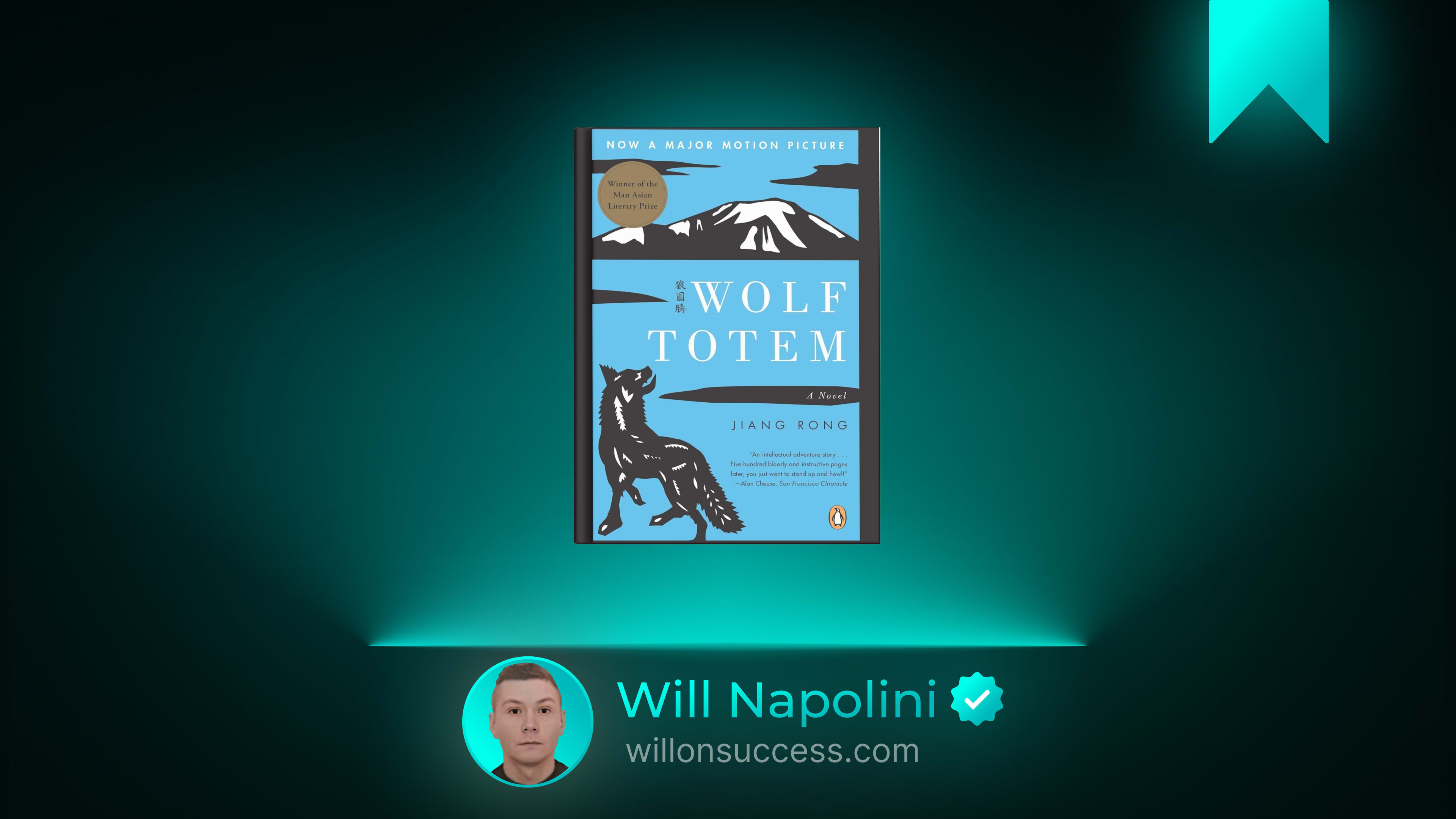
It is not a self-help book. It is a sprawling, epic, and sometimes brutal novel about the Mongolian grasslands during the 1960s. Wolf Totem by Jiang Rong is a story about nomadic herders, terrifying winters, and the wolves that rule the steppe. But beneath the surface of the narrative lies one of the most piercing diagnoses of the human condition I have ever encountered.

The Big Idea: The Ecosystem of Your Life
Here is the principle at the center of this masterpiece, and I want you to let it settle in your mind before we go further:
Life is an intricate, fragile ecosystem. When you try to conquer your environment through rigid control and short-term extraction—ignoring the hidden foundations that sustain you—everything eventually turns to dust.
Jiang Rong contrasts two ways of living in this world. He calls them the “wolf” spirit and the “sheep” mindset.
The wolf spirit relies on strategy, endurance, adaptability, and a deep, almost religious respect for the balance of nature. The sheep mindset, by contrast, seeks to tame, fence in, and extract as much as possible from the land until the soil is dead.
This is not just a book about ecology or history. It is a mirror for how we manage our own lives, our careers, our families, and our inner vitality. The tragedy of the book is not that a harsh winter kills the herd. The tragedy is that human arrogance destroys the very system that kept them alive.
The Steppe, the Wolf, and the Arrogance of Control
To understand the depth of this lesson, I need to take you to the Olonbulag grassland.
The protagonist, Chen Zhen, is a young student from Beijing sent to live with the nomadic Mongolian herders during the Cultural Revolution. He arrives carrying the assumptions of his agrarian upbringing: that nature is a wild beast that must be conquered, fenced, and farmed for maximum yield.
What he finds instead is a breathtakingly complex web of survival. The herders explain that the grass is the absolute foundation of everything. The Mongolian gazelles eat the grass. The wolves hunt the gazelles, keeping their population in check so they do not overgraze and destroy the deep roots of the grass. The horses and the herders depend entirely on this balance.
To the nomadic people, the wolves are not evil pests to be eradicated. They are revered as the sacred guardians of the grassland. They are the enforcers of the ecological law.
Chen Zhen becomes mesmerized by the wolves. He studies their hunting tactics—their incredible patience, their silent coordination, their willingness to endure short-term pain for long-term survival. He even captures and raises a wolf cub, hoping to understand and perhaps tame this fierce, untamable spirit.
But the tragedy of the novel unfolds as agricultural officials arrive from the cities. They look at the vast, open grasslands and see only wasted space. They order the extermination of the wolves to “protect” the herds, and they order the deep plowing of the steppe to plant crops.
Without the wolves to control the herbivores, the gazelles and marmots multiply and eat the grass down to the roots. Without the deep roots holding the soil together, and with the earth torn open by plows, the delicate balance shatters. The grass dies. The fierce winds come. And over the course of a few years, the majestic, ancient grassland turns into a barren desert.
Chen Zhen watches the world he loves die. It does not die out of malice. It dies out of a profound, arrogant misunderstanding of how the system actually works.
Protect the Grass: The Hidden Foundation of Your Vitality
In the book, the Mongolian herders have a strict, unbreakable rule: never destroy the roots of the grass. The grass is the ultimate currency. If the grass dies, the gazelles starve, the wolves leave, the horses weaken, and the people perish. Everything else is secondary.
I want you to translate this directly to your own life. What is the “grass” in your ecosystem?
Your grass is your physical health. It is your mental quiet. It is your capacity for deep, uninterrupted thought. It is the trust in your closest relationships. It is your underlying sense of purpose.
We often act exactly like the agricultural officials in the book. We look at our time, our energy, and our relationships, and we say, “I can extract more from this.” We plow under our rest to get one more project done. We overgraze our attention by scrolling through endless feeds, leaving no quiet space for our minds to recover. We pave over our weekends with obligations because being busy feels productive.
But you cannot extract a harvest from a foundation you have destroyed.
When people burn out, it is rarely because they faced a single, insurmountable challenge. It is because they quietly eroded the hidden roots that sustained them over a long period of time. They forgot that the harvest depends entirely on the health of the soil.
You cannot demand a harvest from soil you have refused to let rest.
The Danger of the “Sheep” Mindset: Reclaiming Your Edge
Jiang Rong uses the metaphor of the “sheep” to describe a mindset of blind obedience, docility, and herd mentality. Sheep follow the grass. They follow the herd. They do not look at the horizon. They are perfectly safe, right up until the winter storm comes, or the predator arrives. Then, they panic and scatter.
The wolf, by contrast, is strategic. A wolf pack will watch a herd of gazelles for days, waiting for the exact right moment. They know the terrain. They communicate without making a sound. They endure the freezing snow because they have built the internal and external resilience to survive it.
In our modern lives, we are heavily incentivized to be sheep. We are taught to be compliant at work, to follow the standard path, to not make waves, and to consume what is placed in front of us. We are told that being “nice” and “predictable” is the ultimate virtue.
But when the environment changes—when the industry shifts, when the crisis hits, when the personal tragedy strikes—the sheep mentality fails. The herd does not know what to do when the grass stops growing.
Reclaiming the “wolf” does not mean becoming cruel, predatory, or aggressive toward others. It means cultivating strategic awareness. It means learning to read the terrain of your career and your life. It means developing the patience to wait for the right opportunity rather than blindly following the herd into a crowded, depleting space. It means being willing to be uncomfortable in the short term to secure your survival in the long term.
Safety in the herd is an illusion that only lasts until the weather changes.
The Tragedy of the Tamed Spirit: What Happens When We Cage Our Nature
One of the most heartbreaking arcs in the novel is Chen Zhen’s attempt to raise his wolf cub in captivity. He loves the cub deeply. He feeds it the best meat, protects it from the harsh elements, and tries to integrate it into the human world. He wants it to be safe.
But a wolf is not a dog. A wolf belongs to the vast, open steppe. As the cub grows in chains and enclosures, it becomes neurotic, aggressive, and ultimately broken. It cannot be a pet, and it has forgotten how to be wild. It loses its spirit, and eventually, its life.
I have sat across the table from so many people who are living the tragedy of the tamed wolf.
You had a wild ambition once. A creative fire. A desire to build something unconventional, to speak a difficult truth, to walk a path that was entirely your own. But the world told you it was too risky. It told you to get a “real” job, to settle down, to fit into the manageable, fenced-in yard of societal expectations.
So you chained your ambition. You built a comfortable enclosure. You traded the terrifying freedom of the steppe for the predictable safety of the cage.
But now, you feel a restless, pacing energy inside you. You feel irritable for no reason. You feel like you are losing your mind in the safety of your own life. You look at your comfortable home, your stable job, your predictable routine, and you wonder why you feel so profoundly empty.
When you try to tame the deepest, most vital parts of your nature just to make them “safe” for the world, you do not get a loyal pet. You get a caged spirit that will eventually tear itself apart trying to get out.
A wild thing in a cage does not become tame; it only becomes a prisoner of its own unspent energy.
Why This Matters on an Ordinary Tuesday
Why does a story about 1960s Mongolia matter to you today?
Because we are all managing ecosystems. Your family is an ecosystem. Your business is an ecosystem. Your mind is an ecosystem.
When we operate from a place of ignorance and short-term extraction, we create deserts. We yell at our children to get better grades (overgrazing) while ignoring the emotional safety of the home (destroying the grass). We push our teams for one more quarter of record profits (extracting the harvest) while burning out our most creative people (killing the wolves that keep the culture healthy). We force our bodies through exhaustion to meet a deadline, borrowing energy from a future we are actively bankrupting.
Understanding the principles of Wolf Totem shifts you from being a blind extractor of your life’s resources to a wise steward of your life’s ecosystem. You begin to ask entirely different questions.
You stop asking, “How much can I get done today?” and you start asking, “What am I destroying to get it done?”
You stop asking, “How can I make this safer?” and you start asking, “How can I make this more resilient?”
Practical Application: Stewarding Your Ecosystem
How do we take this philosophy and turn it into behavior? We must audit our ecosystems and adjust our actions.
Fence off your recovery. The Mongolian herders practiced rotational grazing. They never let their animals eat the grass down to the roots in one spot; they moved on to let the land recover. Look at your calendar. Where are you overgrazing? Is it your evenings? Your weekends? Your mornings? You must deliberately move your attention away from the productive fields and let the soil of your mind rest. If you do not schedule recovery, your body will eventually schedule it for you through illness, injury, or exhaustion.
Study the terrain before you move. The wolf does not run blindly into the tall grass. Before your next major career move, financial decision, or relationship shift, stop and observe. What are the hidden currents? Who are the actual players? What is the long-term cost of this action? Spend a week just watching, reading, and listening before you commit your energy. Strategy is just patience applied to observation.
Give the wolf a place to run. You cannot always be wild in your daily obligations. You have mortgages, responsibilities, aging parents, and duties. But you must find a corridor where your true nature can run free. It might be a physical pursuit like martial arts or long-distance running. It might be an artistic endeavor that you fiercely refuse to monetize. It might be a space where you are allowed to be competitive, bold, and unapologetically yourself. Do not let the cage be the only place you live.
Who Should Read This Book
I want to be honest with you: Wolf Totem is not a light read. It is dense, philosophical, and at times brutally graphic in its depiction of nature, survival, and the harsh realities of the food chain. It spans hundreds of pages and delves deeply into ecological theory and historical tragedy.
It will deeply resonate with you if you are fascinated by systems thinking, ecology, history, or the tension between individual vitality and societal conformity. It is essential reading for leaders, entrepreneurs, and creators who need to understand how fragile systems collapse under the weight of short-term greed.
It may not be for you if you are looking for a quick, uplifting self-help fix, or if you are deeply uncomfortable with the unvarnished realities of animal survival and death.
But if you are willing to sit with its heavy, beautiful, and tragic lessons, it will permanently change how you view the world around you, and the world within you.
One Small Step for Today
I want you to do one specific thing before the sun goes down today.
Identify one area of your life where you have been acting like the agricultural official—trying to force, extract, and control something that actually needs space, patience, and natural rhythm. It might be a creative project you are rushing. It might be a child you are over-scheduling. It might be your own body that you are pushing too hard in the gym. It might be a relationship you are trying to force into a shape it does not want to take.
Stop extracting. Step back. Give that specific area a “rest period” for the next 48 hours. Do not try to improve it. Do not try to optimize it. Do not try to fix it. Just let the grass grow.
The Horizon Awaits
Jiang Rong wrote Wolf Totem as a warning about what happens when we lose our reverence for the wild, complex systems that sustain us. He wanted us to remember that we are part of the ecology, not the masters of it.
The grasslands of Mongolia may have turned to dust in the story, but the grasslands of your life are still here. The roots are still in the soil. There is still time to change how you walk upon the earth.
You do not need to conquer your life. You need to understand it. You need to respect the hidden foundations, cultivate your strategic awareness, and allow your vital nature the space it needs to breathe.
Look at the horizon. Read the wind. Protect your roots.
A caged spirit will always starve in a room full of food. Open the gate, trust the wildness inside you, and remember that you were built for the steppe.