The Power of Positive Thinking by Norman Vincent Peale: Why Your Inner Dialogue Shapes Your Outer Life
There is a quiet conversation you are having with yourself right now, in this very moment, that is shaping what you will attempt tomorrow, what you will avoid next week, and what you will quietly surrender on next year. Most of us never listen to that conversation. We simply let it run, like a radio left on in an empty room, broadcasting doubt, rehearsing failure, narrating our limitations back to us in a voice we have mistaken for truth.
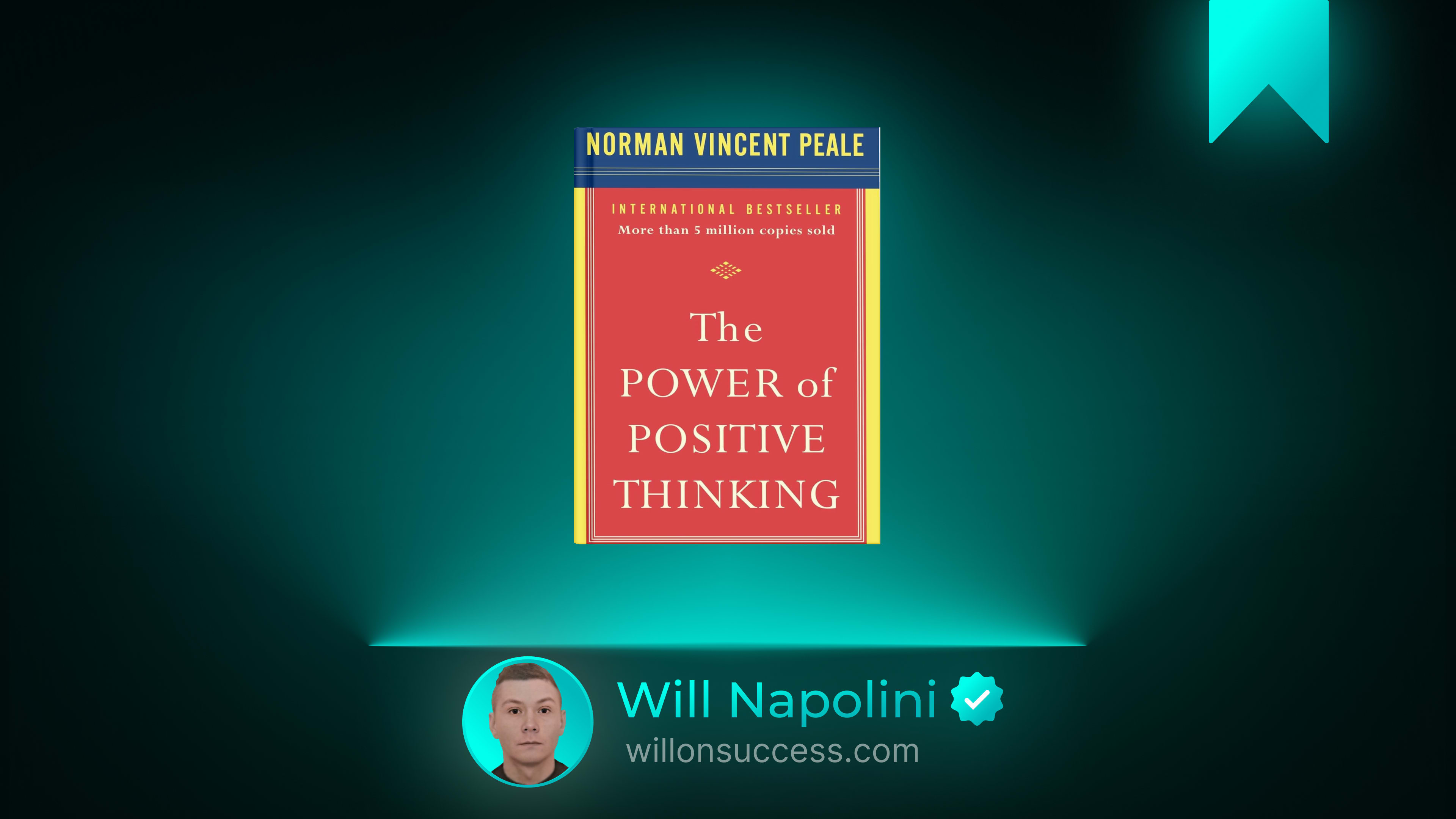
Norman Vincent Peale understood something about that inner radio. In 1952, a minister at Marble Collegiate Church in New York City sat down and wrote a book that would sell millions of copies and change the way an entire generation thought about the relationship between mind and life. The book was called The Power of Positive Thinking, and its argument was almost radical in its simplicity: the thoughts you practice become the life you inhabit.
I want to walk you through what Peale actually taught, because I think we have partly lost the thread. We have reduced “positive thinking” to a slogan, a bumper sticker, a shallow grin pasted over genuine pain. But what Peale was doing was more serious than that, and more useful. He was describing a discipline. And I think you need that discipline more than you know.
The Central Claim: You Are Not Stuck Where Your Thoughts Leave You
Peale’s thesis is not that the universe rearranges itself around your wishes. It is not that hardship will vanish if you smile enough. Read the book carefully and you will find something more grounded: that your mental posture determines how you meet difficulty, whether you act or freeze, whether you see a problem as a wall or as a puzzle.
He argued that most people defeat themselves before circumstances defeat them. They carry an internal narrative of limitation so long that it becomes architecture. They build walls out of old sentences—I’m not smart enough, I always fail, people like me don’t get to have that—and then they live inside those walls and call them reality.
Peale’s invitation is to inspect the walls. To ask whether they are load-bearing or merely habitual.
This matters because you may be working hard, showing up, doing everything right on the surface, and still wondering why nothing shifts. The answer might not be effort. It might be the story running underneath the effort, quietly pulling you back toward the familiar shape of your old self.
Faith as a Practical Force, Not a Vague Feeling
One of the things that distinguishes Peale from later, more secular self-help writing is his insistence on faith. He was a minister, and he wrote openly about prayer, about surrender to a power larger than oneself, about trust in God as a daily operating principle rather than a Sunday obligation.
You do not have to share his specific theology to benefit from the underlying mechanism he describes. What Peale observed, week after week in his congregation, was that people who carried a deep sense of being held—of not being alone in their struggle—could endure more, recover faster, and take braver action than those who felt they had to generate every ounce of strength from their own limited supply.
He called this “the prayer power.” But stripped of denominational language, the principle is this: when you release the need to control every outcome, you free up enormous mental energy for the work actually in front of you. Worry is, in large part, the exhausting labor of trying to control what you cannot. Faith—or trust, or surrender, whatever word fits your life—puts that burden down.
I have seen this in my own experience. The periods where I tried to white-knuckle everything, where I refused to admit I needed help or rest or grace, were the periods where I accomplished the least and felt the most alone. The moment I admitted I cannot do this entirely by myself was not a moment of weakness. It was the moment the work became possible again.
The Discipline of the Morning Mind
Peale placed enormous emphasis on how you begin the day. He recommended that before the noise of the world reaches you—before the phone, the news, the list of obligations—you deliberately set the tone of your inner conversation.
This is not wishful thinking. This is sequence. The first thoughts you entertain in the morning tend to color the next twelve hours. If you wake and immediately rehearse everything that could go wrong, you have handed your nervous system a script, and it will perform that script faithfully all day.
Peale suggested starting with a simple, honest affirmation of capability and purpose. Not a grandiose declaration. Something quiet and steady. Something like: Today I will do what is in front of me. I will not borrow trouble from tomorrow. I am equipped for this day.
The practice sounds almost too small. But small practices, repeated, become foundations. A single morning changes nothing. Three hundred mornings change the architecture of how you meet the world.
Worry Is a Habit, and Habits Can Be Broken
Several chapters of the book are devoted to worry, and Peale treats it not as a character flaw but as a mental habit—a groove worn so deep by repetition that thoughts fall into it automatically. His advice for breaking the worry cycle is practical:
First, name the worry specifically. Vague dread is almost always more paralyzing than a defined problem. Once you can say I am worried about the presentation on Thursday rather than I feel terrible about everything, the problem becomes finite. Finite problems have solutions, or at least next steps.
Second, decide what you can actually do, and do that thing. Peale was adamant that action is the antidote to worry. Not frantic action. Not busyness as anesthesia. But one concrete step that moves you toward resolution.
Third, release what you cannot control. This is where his faith language becomes most practical. He encouraged readers to hand the unresolvable parts of their anxiety over—to God, to time, to the simple fact that some things will resolve in ways you cannot predict or manage. You do not have to carry what you cannot carry.
Fourth, fill the mental space you have cleared. An idle mind returns to its oldest anxieties. Peale encouraged purposeful engagement—work, service, creative effort, physical movement—as a way of giving the mind something constructive to do with the energy worry used to consume.
None of this is complicated. That is part of its power. You do not need a technique you will never remember. You need a simple redirection, practiced until it becomes automatic.
You Are Allowed to Expect Good Things
One of the book’s most quietly radical ideas is this: expecting the best is not naïveté. It is strategy.
Peale argued that expectation shapes attention. If you walk into a room expecting rejection, your eyes will find every frown, every glance away, every silence that confirms your fear. You will miss the three people who were genuinely glad to see you. If you walk in expecting possibility, your attention widens. You notice openings. You take small risks. You speak first.
This is not magic. It is the mechanics of selective attention, described decades before cognitive psychology gave it clinical language. Your expectations act as a filter on reality. They do not create reality, but they determine which version of reality you interact with.
I would gently push back on one point here, because honesty matters. Expecting the best does not mean denying legitimate difficulty. If you are in a genuinely harmful situation—a dangerous relationship, an exploitative job, a health crisis—positive expectation without honest assessment can keep you stuck. Peale’s framework works best as a companion to clear-eyed action, not as a replacement for it. You can hope and still make a hard decision. You can trust and still leave.
Defeat Is an Event, Not an Identity
Peale devoted significant attention to failure—how people internalize a single setback as a permanent verdict. He watched talented, capable people make one mistake, lose one opportunity, hear one “no,” and then quietly retire from trying.
His counsel was direct: refuse to accept defeat as a final statement. A loss is information. It tells you something about your approach, your timing, your preparation. It does not tell you what you are.
He encouraged readers to separate the event from the identity. You failed at something. You are not a failure. Those two sentences contain entirely different futures, and the one you choose to believe determines which future you walk into.
This is perhaps the book’s most enduring contribution. In a culture that often treats one stumble as disqualification, Peale gave people permission to get up, dust off, and try again without shame. He made persistence respectable. He made starting over feel like courage rather than evidence of inadequacy.
Where the Book Is Honest, and Where You Should Read Carefully
I want to be straightforward with you. The Power of Positive Thinking was written in 1952, and it carries some of the assumptions of its era. Peale sometimes writes as though mental attitude is the primary variable in every outcome, and that framing can feel dismissive to someone dealing with systemic barriers, chronic illness, grief, or clinical depression. If you are in a season where the problem is not your thoughts but your circumstances, give yourself permission to set the book down and seek the specific help you need.
That said, the core mechanism Peale describes—that your inner dialogue shapes your choices, your energy, your resilience, and your willingness to keep going—is as true now as it was seventy years ago. Neuroscience has confirmed what he observed pastorally: repeated thought patterns physically alter neural pathways. What you practice thinking becomes easier to think. What you refuse to practice gradually loses its grip.
Read the book as a toolkit, not a gospel. Take what fits your life. Set aside what does not. You are not obligated to agree with every page in order to be changed by the ones that speak to you.
Who This Book Will Serve
If you are someone who tends toward self-doubt, who rehearses worst-case scenarios before bed, who has quietly decided that certain doors are not for you—this book will feel like a hand on your shoulder. Peale writes with the warmth of a pastor who genuinely wants you to stop suffering unnecessarily.
If you are drawn to practical spirituality—the idea that faith is something you do on a Tuesday morning, not just believe on a Sunday—Peale will feel like a kindred voice.
If you are looking for a rigorous psychological framework, or if you need clinical guidance for anxiety or depression, this book will not be enough. It was never meant to be. Treat it as a starting point for mental discipline, not a substitute for professional care when you need it.
What You Can Do Before You Close This Page
I do not want you to finish reading and simply nod and move on. Understanding without action changes nothing.
So here is what I would ask you to do today. Just one thing.
Tonight, before you sleep, notice the last three thoughts you entertain before your eyes close. Do not judge them. Just notice. Are they rehearsals of tomorrow’s problems? Are they replays of today’s failures? Are they quiet sentences about what you lack?
If they are, gently replace them. Not with forced cheer. With one honest, simple sentence about what you will do tomorrow. One task. One small act of progress. Hold that sentence in your mind as you drift off, the way you would hold a single seed in your palm before pressing it into soil.
Do this for seven nights. That is all. One week of deliberately choosing the last thought of the day instead of letting it choose you.
You will be surprised how different the mornings feel.
The Door Is Open
Peale wrote this book for ordinary people in ordinary difficulty. Not for the extraordinary, not for the already-convinced. For the person sitting at the kitchen table at ten p.m., wondering if things can actually be different.
They can. Not because the world is easy, and not because you can think your way around every obstacle. But because the mind you bring to the obstacle determines whether you climb it, go around it, or sit at its base for years telling yourself it cannot be climbed.
You have been carrying a story about yourself for a long time. Some of that story is true. Some of it is simply old. And the old parts—the ones that whisper you can’t, you shouldn’t, you won’t—those parts can be set down. Not in a single dramatic moment. In a hundred small mornings of choosing a different first thought.
A thought becomes a belief. A belief becomes an action. An action, repeated, becomes a life.
The next thought is yours. Choose it carefully. Choose it kindly. And then get up tomorrow and build something with it.