The Power of Moments: Why You Don't Need a Better Life—You Need Better Moments
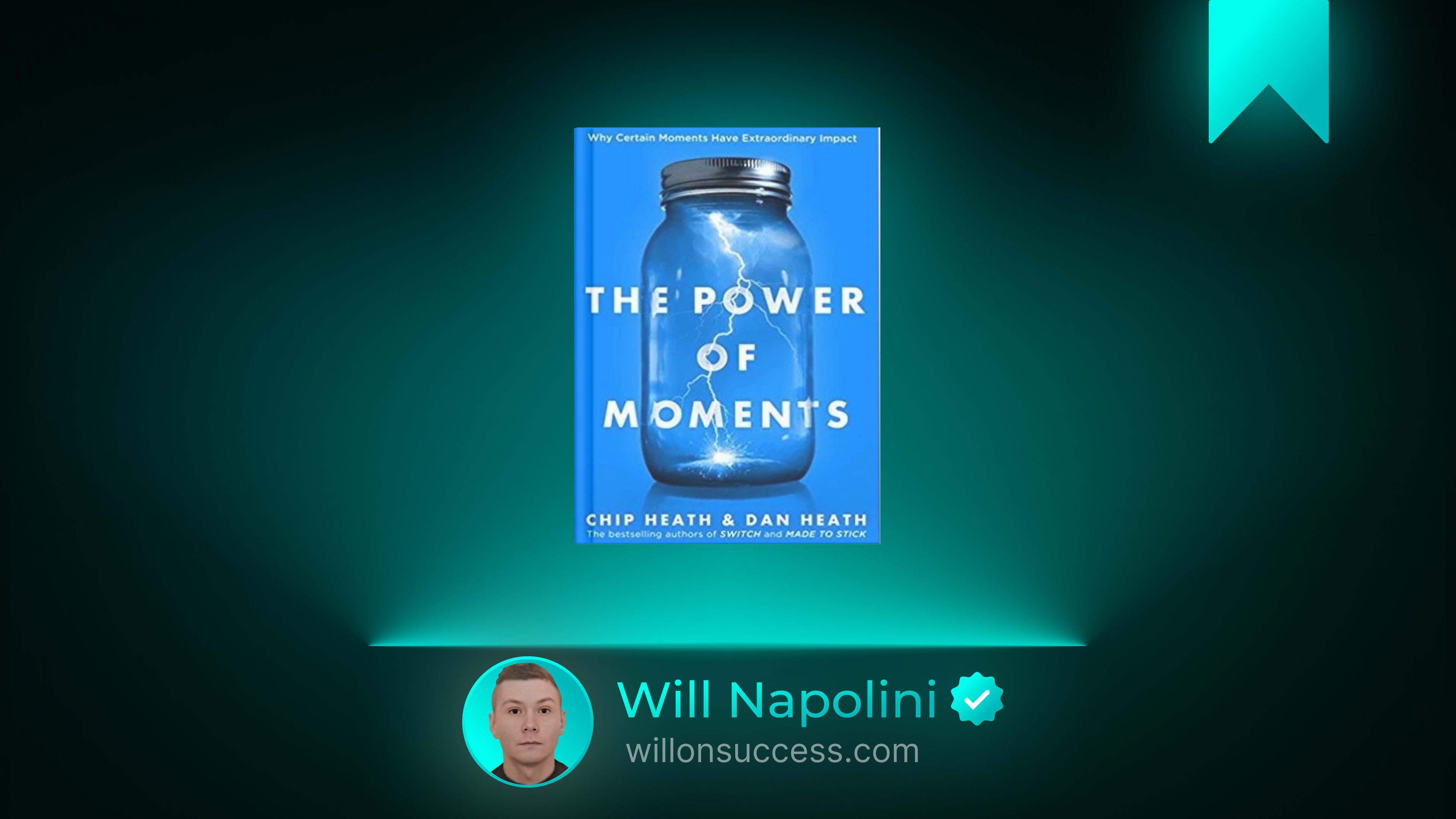
Think about the last year of your life. Not the whole year in sequence. Just the moments that actually stick. Maybe it was a Tuesday afternoon when someone said something that rearranged the way you saw yourself. Maybe it was a Friday night that felt electric because you were surrounded by people who made you feel genuinely known. Maybe it was a small, quiet morning when you crossed a finish line you had been running toward for months.
Now notice what is missing. You do not remember the other three hundred and sixty-four days in the same way. They blurred. They became weather—present while it was happening, invisible once it passed.
This is not a flaw in your memory. It is how human beings construct meaning. And once you understand that mechanism, something remarkable becomes possible: you stop waiting for a good life to happen to you, and you start building it, moment by deliberate moment.
That is the invitation at the heart of The Power of Moments by Chip Heath and Dan Heath. And I want to walk you through it, because I think it is one of the most quietly liberating ideas a person can encounter.
The Big Idea: Your Life Is Not an Average
The Heath brothers build their book on a deceptively simple observation: we do not experience our lives as a steady, continuous stream. We experience them as a collection of moments—short, vivid episodes that carry disproportionate weight in our memories and in our sense of who we are.
Most of us, they argue, live as though every day should be roughly the same quality. We try to raise the average. We optimize our routines, smooth out our schedules, eliminate friction. And none of that is wrong. But an average-focused life produces an average memory. You look back and feel a pleasant, undifferentiated hum. Nothing sharp. Nothing that made you catch your breath.
The alternative is not chaos. It is intentionality about peaks. The Heaths draw on well-established psychological research—particularly what is sometimes called the “peak-end rule”—which shows that when people evaluate an experience afterward, they do not average every second of it. They remember the highest (or lowest) point and the ending. The middle mostly dissolves.
What this means practically is enormous. A single well-crafted moment can reshape how someone remembers an entire season. A first day at a new job. A milestone birthday. The way you say goodbye to a colleague. The way you greet your child after school on an ordinary Wednesday. These are not decorations on the surface of life. They are the life you will remember.
The central argument of the book is this: you can manufacture those moments. They do not have to ambush you. You do not have to wait for tragedy or lottery-level luck to feel that your life contains peaks. You can engineer them, for yourself and for the people around you, using a small set of principles.
Four Ingredients That Make a Moment Land
The Heaths identify four elements that, individually or in combination, transform an ordinary instant into a defining one. They call them Elevation, Insight, Pride, and Connection. You do not need all four at once. But the more you understand how each one works, the more you can stop leaving your most meaningful experiences to chance.
Elevation is the experience of rising above the routine. It is surprise, sensory richness, a break in the script. The Heaths tell the story of the Magic Castle Hotel in Los Angeles—a modest, unglamorous property that consistently earns extraordinary guest reviews. Its secret is not thread count or square footage. It is small, unexpected gestures: a “popsicle hotline” where guests can dial a phone and a pair of white-gloved hands delivers cherry popsicles poolside. A rubber duck waiting on the bathroom counter for families with children. These cost almost nothing. But they interrupt the expected pattern, and the interruption creates delight.
You can do this in your own life. Break the script of a Tuesday. Take the meeting outside. Cook the elaborate dinner on a random Thursday instead of saving it for a holiday. The elevation does not require money. It requires disruption of the predictable.
Insight is the moment a truth lands in your body, not just your mind. The Heaths describe this as “tripping over the truth”—an experience that reorganizes your understanding so quickly that you feel it physically. These moments often come not from being told something new, but from being placed in a situation where you discover something for yourself. A conversation that forces you to confront what you have been avoiding. A project that reveals a capability you did not know you had. You cannot always schedule an insight, but you can create the conditions: new environments, honest conversations, experiences that stretch you past your rehearsed identity.
Pride is the experience of being seen at your best, or of seeing yourself rise to a challenge. The Heaths emphasize how underused recognition is—in workplaces, in families, in friendships. A specific, sincere acknowledgment of someone’s effort or courage can become a moment they carry for years. And pride is not only about external validation. It is also about the private knowledge that you did the hard thing. You ran the race. You had the conversation. You showed up when it would have been easier to hide.
Connection is the experience of sharing a moment with others in a way that deepens the bond. The Heaths point out that most of our most treasured memories are social. The graduation, the wedding, the late-night conversation that went somewhere unexpected. But connection does not require a ceremony. It requires shared presence and a sense of meaning. A team that gathers not just to work but to mark a milestone together. Two friends who decide to take a walk instead of texting. The simple act of saying, “This mattered, and I want you to know that.”
Transitions Are Invisible Unless You Mark Them
One of the ideas in this book that I find most personally convicting is the Heaths’ treatment of transitional moments. We pass through dozens of them: the first day at a job, moving to a new city, a child leaving for school, the end of a project, a retirement, a birthday that crosses a decade.
And most of us walk through them unmarked. We treat them like any other Tuesday.
The Heaths argue that this is a quiet loss. Transitions are natural peaks. They carry emotional weight whether we acknowledge it or not. The question is whether we honor that weight or let it slip by in a blur of logistics.
Think about a first day at work. The Heaths reference research showing that how an organization treats someone in their first hours shapes their engagement, their sense of belonging, and ultimately their performance. Yet most onboarding experiences are a stack of paperwork and a polite email from HR. The contrast is stark: you could hand someone a welcome note from the team, a small meaningful gift, a genuine conversation about why they were chosen. Or you could hand them a form to fill out. Both take roughly the same amount of administrative time. One creates a moment. The other creates a procedure.
The same principle applies at home. A child’s first day of school. The last night before a friend moves away. The evening before you start a new chapter. If you do not mark the transition, it passes through you without leaving a trace. And you lose the anchor.
The Danger of the Flat Line
Here is what I want you to sit with for a moment, because it is the part of this book that challenges me most.
Most of us do not have a bad life. We have a flat one. Not flat in the sense of suffering, but flat in the sense of sameness. The weeks repeat. The routines hold. The days are comfortable and interchangeable. And comfort, the Heaths suggest, is the quiet enemy of meaning.
This is not an argument for reckless disruption. You do not need to quit your job or move to another country to create a peak. What you need is the willingness to interrupt your own script in small, deliberate ways. To choose the slightly harder, slightly more present, slightly more generous version of an ordinary moment.
A flat life is not a failure. But it is a choice, and once you see that it is a choice, you can choose differently.
What This Looks Like on an Ordinary Thursday
Let me bring this down to the ground, because principles without application are just decoration.
Suppose you lead a small team at work. The Heaths’ framework would invite you to ask: When was the last time I created a moment of pride for someone on my team? Not a performance review. Not a quarterly bonus. A specific, personal acknowledgment. “The way you handled that client call on Tuesday—that took real courage, and I want you to know I noticed.” Thirty seconds. Free. Potentially unforgettable.
Suppose you are a parent. A transition is coming: your teenager is about to start high school. Instead of letting the summer dissolve into screens and logistics, you create one marked evening. A dinner where you tell them a story about your own first day of a new school. A letter you hand them, sealed, to open on the morning of day one. You are not solving their anxiety. You are saying, This matters, and you are not walking into it alone. That becomes a moment. They will remember it long after they forget what classes they took.
Suppose you are in a long relationship and the weeks have started to feel like a loop. Elevation does not require a vacation. It requires one break in the script. A walk in a neighborhood you have never explored. A conversation where you ask a question you have never asked before. The point is not the activity. The point is that the pattern cracks open, and something new gets in.
A Small Experiment for This Week
If I could sit across the table from you right now, here is what I would ask you to try. Not a grand overhaul. One experiment.
Choose one transition or one relationship in your life that has been running on autopilot. A weekly meeting. A dinner with your family. A friendship that has become a series of “we should catch up” texts that never materialize.
Now add one element of elevation, pride, insight, or connection to it. Just one.
Write a two-line note of genuine recognition to someone who does not expect it. Change the location of a recurring meeting. Ask one question at dinner that you have never asked before. Mark a small milestone—a project finished, a month of consistency, a quiet personal victory—with a five-minute acknowledgment instead of scrolling past it.
You are not trying to transform your life in a week. You are testing a hypothesis: What happens when I stop treating this moment as interchangeable?
Who Will Benefit Most from This Book
If you are someone who feels that life is passing by in a pleasant but undifferentiated blur, this book will feel like a window opening. If you lead people—teachers, managers, parents, coaches, pastors, team leads—the Heaths give you a framework for creating the kind of experiences people remember for years, often at almost zero financial cost.
If you are in a season of transition—new job, new city, new relationship, grief, recovery—this book will help you see those thresholds as opportunities rather than just disruptions to endure.
I will say honestly: if you are looking for a rigid productivity system or a step-by-step optimization plan, this is not that book. It is more of a lens than a checklist. It changes how you see your days, and the actions flow from the seeing. Some readers who want granular “do this, then this” instructions may find it slightly loose. But for most people, that looseness is the point. The book trusts you to find your own moments.
The One Step You Can Take Before You Close This Page
Here is your small step. Not tomorrow. Today.
Think of one person in your life who has done something in the last month that you admired, appreciated, or noticed—but never said out loud. Maybe it was a colleague who covered for you. A friend who listened without trying to fix anything. A partner who handled a tedious task without being asked. A child who showed unexpected kindness.
Send them a message. Three sentences are enough. Name what they did. Say why it mattered to you. Do not attach a request. Do not make it about something you need. Just let the recognition land.
You are creating a moment of pride for them. And here is what I have learned: you are also creating one for yourself. Because the act of noticing, of pausing long enough to say I saw you, and it mattered—that pulls you out of the flat line. That is a peak. Small, quiet, unglamorous. But real.
You do not need a dramatic life to have a meaningful one. You need the willingness to notice where you are, to honor what is happening, and to reach for one small act of elevation or connection before the moment passes and becomes indistinguishable from the rest.
A life is not built in years. It is built in moments you chose not to waste.
And the next one is always closer than you think.