Navigating the Unknown: What the Bermuda Triangle Teaches Us About Life's Greatest Mysteries
There is a specific kind of terror that comes when you look down at your compass and realize the needle is spinning.
You are out in the open water. The horizon is gone, swallowed by a thick, gray fog. The instruments you trusted to tell you where you are and which way to go have suddenly stopped making sense. In that moment, the ocean does not just feel vast; it feels hostile.
I have learned that we all encounter this exact feeling, even when our feet are firmly on dry land. You may be working hard in your career and suddenly finding that the strategies that got you promoted are no longer working. You may be in a relationship where the unspoken rules have shifted, and you no longer know how to navigate a simple conversation. You may be facing a health crisis, a financial loss, or a sudden change in your circumstances that leaves you entirely disoriented.
You have entered your own Bermuda Triangle. The map you were using has failed. The compass is spinning.
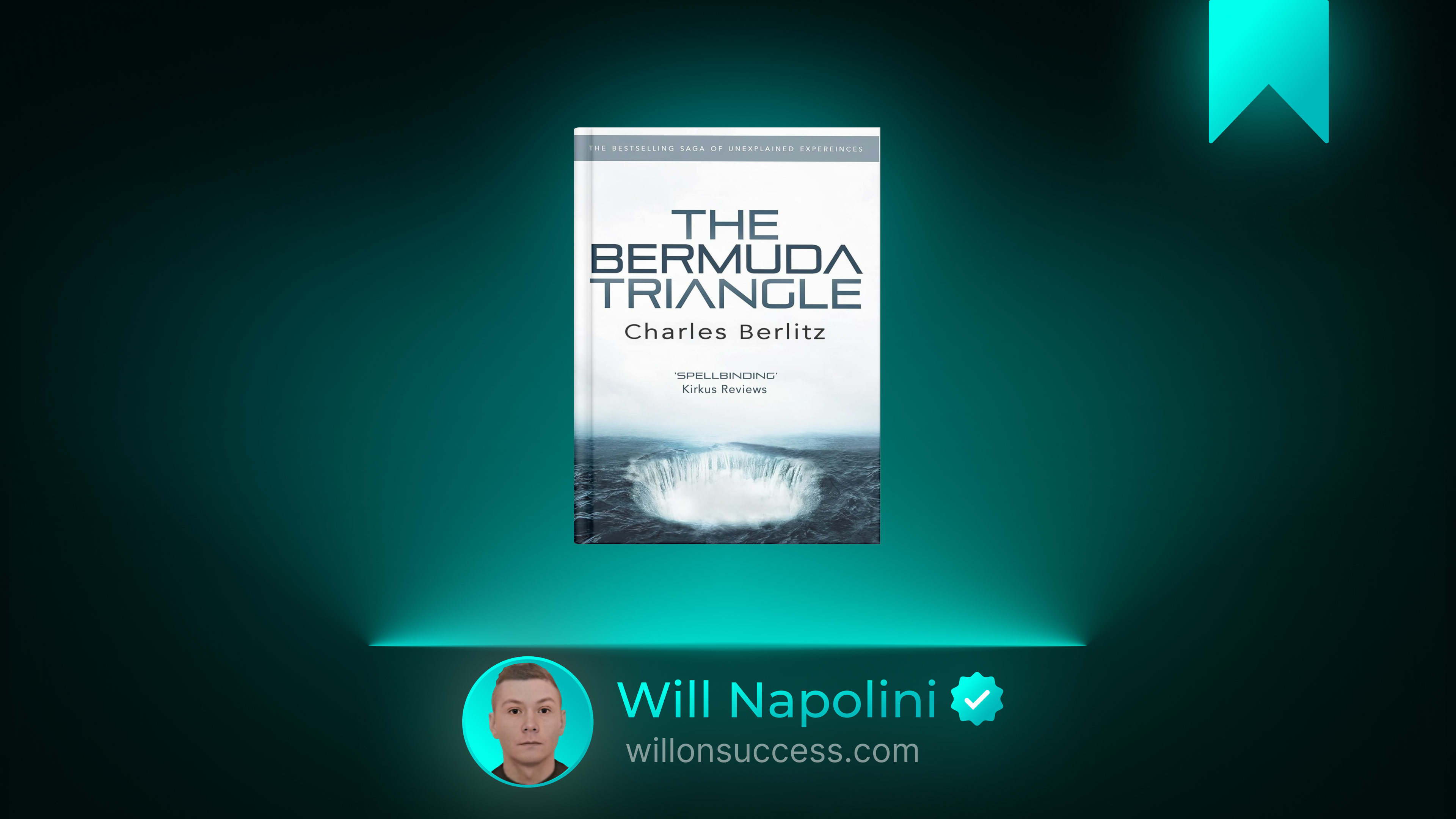
Charles Berlitz’s 1974 book, The Bermuda Triangle, is not a self-help manual. It is a meticulously researched, deeply fascinating exploration of one of the modern world’s most enduring maritime mysteries. He chronicles the vanished ships, the lost planes, and the strange magnetic anomalies that have supposedly claimed hundreds of vessels in the waters between Miami, Bermuda, and Puerto Rico.
But if you read it closely, looking past the vanished vessels and the historical logs, you will find a profound underlying lesson about how human beings navigate the unknown. Berlitz shows us what happens when the normal rules of the world break down. And in doing so, he inadvertently provides a masterclass on how we must handle the unexplained, the unpredictable, and the deeply mysterious seasons of our own lives.
The Big Idea: Navigating the Unexplainable
The central premise of The Bermuda Triangle is that there are forces in our world that defy our neat, logical explanations. Berlitz presents case after case of ships and aircraft that vanished without a trace, often in calm weather, leaving no debris behind. He explores the idea that the environment itself can become fundamentally unpredictable.
The big idea I want to draw from this for your life is simple but difficult to accept: You cannot control the anomalies, but you can control the vessel.
When we face a situation we do not understand, our instinct is to try and force the world to make sense. We want a guarantee. We want a map. But life, like the open ocean, contains zones of deep mystery where our current understanding simply does not apply. The goal of personal growth is not to eliminate the unknown. The goal is to build a character so resilient, and a mindset so grounded in principle, that you can sail through the fog without capsizing.
The Story of Flight 19: The Danger of Disorientation
To understand how we get lost in life, we have to look at the most famous story in Berlitz’s book: the disappearance of Flight 19.
On December 5, 1945, five TBM Avenger torpedo bombers took off from Fort Lauderdale, Florida, for a routine navigation training mission. The pilots were experienced. The planes were in good condition. The weather was clear.
A few hours into the flight, the squadron leader, Lieutenant Charles Taylor, realized he was disoriented. He believed his compasses had failed. He assumed he was over the Florida Keys and that he needed to fly northeast to reach the mainland.
He was wrong. He was actually over the Bahamas, and by flying northeast, he was flying further out into the open Atlantic. As fuel ran low and the sun set, the other pilots in the flight began to question his direction. Some suggested flying west, which would have taken them to land. But Taylor, the commander, insisted on his heading. He relied on his intuition and his assumptions rather than his instruments or the collective judgment of his crew.
All five planes ran out of fuel and ditched in the dark ocean. A rescue plane sent to look for them also vanished. Thirteen men were lost.
The true tragedy of Flight 19 was not a monster in the deep. It was a cascade of disorientation. When the leader lost his bearings, he panicked. And when we panic, we tend to fly further in the wrong direction.
I have seen this happen countless times in my own life and in the lives of those I mentor. When you experience a sudden setback, your internal compass spins. You feel lost. And in that moment of panic, you make a decision based on fear rather than principle. You send an angry email. You quit a job in a huff. You withdraw from the people who love you. You think you are flying toward safety, but you are actually flying deeper into the open water.
We do not drown because the ocean is deep; we drown because we mistake our panic for a compass.
Your Environment Is Quietly Shaping Your Behavior
One of the most compelling aspects of Berlitz’s research is his discussion of the “agonic line”—the point where true north and magnetic north align. In the Bermuda Triangle, the magnetic variation shifts in ways that can confuse a navigator who does not adjust their calculations. The environment itself is playing tricks on the instruments.
This brings us to a vital principle for your own life: You must understand the hidden currents of your environment.
We like to believe that our outcomes are purely the result of our willpower. But just as a ship is pushed by unseen ocean currents, your behavior is pushed by unseen environmental currents.
If you are trying to build a new habit, but your home is filled with distractions, your environment is working against you. If you are trying to grow in your career, but you are surrounded by cynical peers who mock ambition, you are fighting a magnetic variation you haven’t accounted for.
Berlitz shows us that the sea is not a neutral backdrop; it is an active participant in the journey. In your life, your environment is the water you sail on. If you find yourself constantly drifting off course, stop blaming your willpower. Look at the hidden currents. Change the environment, and you change the trajectory.
Beware the Monsters You Invent in the Fog
Because the disappearances in the Bermuda Triangle were so baffling, Berlitz explores a wide array of theories to explain them. He writes about the lost city of Atlantis resting at the bottom of the ocean, using crystal energies to disrupt ships. He discusses time warps, electronic fog, and extraterrestrial intervention.
When human beings are faced with a mystery they cannot solve, we invent monsters to fill the gap in our knowledge. We prefer a terrifying myth to an uncomfortable unknown.
You do this in your own life, too.
When you fail at a diet, you do not just say, “I ate too many calories this week.” You say, “I have no self-control. I am fundamentally broken.” When a business venture fails, you do not say, “The market shifted and my timing was off.” You say, “I am not meant to be an entrepreneur. I will never be successful.”
You are inventing Atlantis. You are creating a massive, supernatural monster in the fog to explain a very normal, very human setback.
A mystery is often just a principle you have not yet learned. When you face a failure, a rejection, or a period of stagnation, resist the urge to invent a monster. Do not catastrophize. Strip away the myth and look for the mechanical reason. What was the actual error in navigation? What was the flaw in the plan?
Fear builds monsters in the fog; principle builds a ship.
Growth Before Achievement: Building a Stronger Vessel
Ultimately, The Bermuda Triangle is a book about the limits of human control. We can build massive aircraft carriers and sophisticated navigation systems, but the ocean is still vast, and the weather is still wild.
This leads to the most important philosophical foundation you can adopt: Character before circumstances.
You cannot control the anomalies in your life. You will face sudden illnesses. You will experience economic downturns. You will encounter people who act in ways that make no logical sense. If your entire strategy for life is based on the assumption that everything will go according to plan, you will eventually be destroyed when the plan falls apart.
The goal of personal development is not to create a life where nothing goes wrong. The goal is to become someone who can handle it when things do go wrong.
It is the difference between trying to calm the ocean and learning to build a better ship.
When you focus on growth—developing your patience, your resilience, your emotional intelligence, your integrity—you are reinforcing the hull of your vessel. You are making sure that when the waves get high, and the compass starts to spin, you do not break apart. You stay afloat. You keep moving forward.
Why This Matters on an Ordinary Tuesday
You might be thinking that this is all very poetic, but how does it apply to an ordinary Tuesday?
It applies because you will face a fog this week.
You will sit down at your desk and realize you have no idea how to solve the problem in front of you. You will look at your bank account and feel a sudden spike of anxiety. You will have a conversation with your partner that suddenly turns hostile, and you will not know how to de-escalate it.
In those moments, the temptation is to let the compass spin. The temptation is to panic, to invent a monster, to assume the worst, and to react purely on emotion.
But if you remember the lesson of the deep water, you will do something different. You will pause. You will take a breath. You will recognize that you are in a zone of uncertainty, and you will refuse to let fear make the decision. You will rely on your principles, not your panic.
Practical Application: The Compass Check
Understanding the unknown is only the first step. You must translate it into behavior. Here is how you can apply these principles immediately.
1. Conduct a “Compass Check” when you feel stuck The next time you feel entirely lost in a project, a relationship, or a personal goal, stop trying to force a solution. Instead, ask yourself three questions:
- What hidden current is pushing me off course? (Is my environment working against me?)
- What monster am I inventing? (Am I catastrophizing the situation?)
- What is the actual, mechanical reason this isn’t working? (Strip away the emotion and look at the data.)
2. Build your “Agnic Line” (Align your actions with your values) In navigation, failing to account for magnetic variation leads to disaster. In life, failing to align your daily actions with your core values leads to burnout and resentment. Write down your top three core values. Then, look at your calendar for the past week. Did your time reflect those values? If not, adjust your heading. Small corrections early prevent massive drift later.
3. Practice the “Pause Before the Pivot” When you feel disoriented in a conversation or a crisis, your instinct will be to do something immediately. Fight it. Implement a mandatory 24-hour pause before making any major decision when you feel emotionally flooded. Let the fog clear before you change your course.
Who Should Read This Book
The Bermuda Triangle is a fascinating read for anyone who loves history, maritime mysteries, and the unexplained. If you enjoy diving into the strange, the eerie, and the historically puzzling, Berlitz’s detailed accounts of vanished ships and strange phenomena will captivate you.
However, if you are looking for a strict, scientifically rigorous debunking of maritime myths, this book may frustrate you. Later researchers have heavily criticized Berlitz for exaggerating facts and ignoring standard weather reports. Read it as an exploration of human curiosity and the power of myth, rather than a definitive scientific text.
More importantly, read it as a mirror. If you are currently going through a season of deep uncertainty, where your plans have vanished and you feel entirely disoriented, this book will remind you that the unknown is a natural part of the human experience. It will help you realize that you are not the first person to sail into the fog, and you will not be the last.
One Small Step
I want to leave you with one action you can take today, before the sun goes down.
Identify one area of your life where you feel “lost” or where your current strategy is failing. It might be your morning routine, your approach to a difficult project, or how you handle stress.
Right now, write down the “monster” you have invented about that situation. Write down the catastrophic story you have been telling yourself about why it isn’t working.
Then, cross it out.
Next to it, write down one small, mechanical adjustment you can make tomorrow. Do not try to solve the whole mystery. Just adjust your heading by one degree.
A small decision becomes a direction, and a direction repeated long enough becomes a life.
The ocean is vast, and the fog will inevitably roll in. But you do not need to see the other side of the water to know how to sail. You just need to trust the ship you have built, hold your course, and keep moving forward.