The Long Game: How to Create Work That Outlasts the Noise
Every week, something goes viral. A song explodes across platforms. A book rockets to the top of a bestseller list. A product sells out in hours. The creator is celebrated, interviewed, held up as proof that if you just find the right formula, the right algorithm, the right moment, success will arrive like a lightning strike.
And then, six months later, no one remembers it existed. The song is buried under ten thousand new releases. The book is remaindered. The product is forgotten. The lightning struck, but nothing was built where it landed.
If I could sit across the table from you right now, I would ask you a question that might sting a little: Are you building fireworks, or are you building a fire?
Fireworks are spectacular. Everyone looks up. Everyone applauds. And then the sky is dark again, and the crowd moves on. A fire, on the other hand, takes longer to build. You have to gather the wood, arrange it carefully, protect the flame while it catches. But once it is burning, it provides warmth for hours. For years. For generations, if you keep tending it.
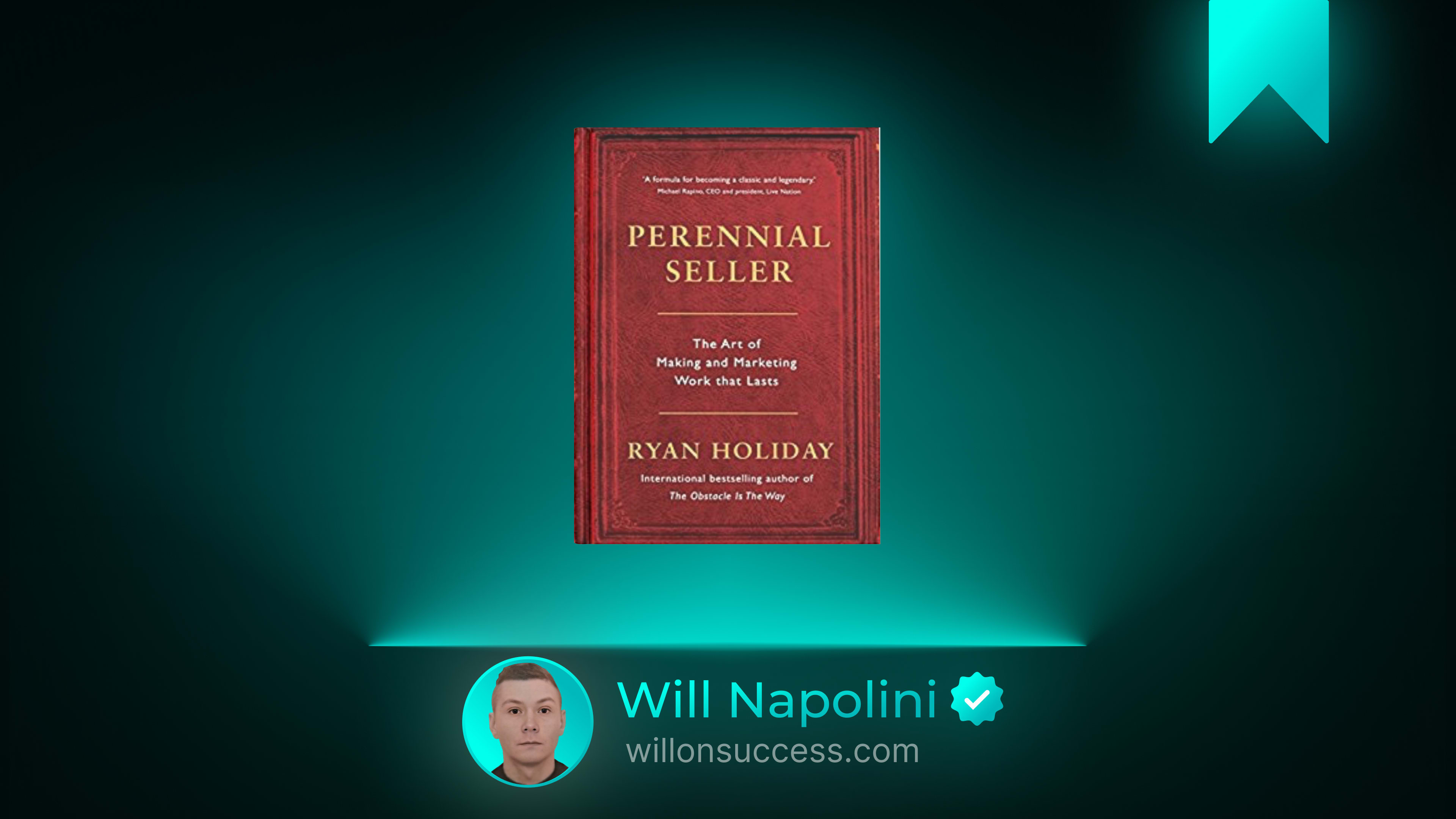
In Perennial Seller: The Art of Making and Marketing Creative Work That Lasts, Ryan Holiday makes the case that the most valuable creative work—the kind that builds a career, sustains a life, and changes a culture—is not the work that explodes on impact. It is the work that burns slowly, steadily, and for a very long time. The perennial seller is not the book that sells a million copies in its first week. It is the book that sells a thousand copies every week for twenty years.
The central thesis of the book is both a comfort and a challenge: there is no hack for longevity. The only reliable path to creating work that lasts is to make something genuinely excellent, position it with clarity, market it through relationships rather than tricks, and build a platform that compounds over time. It is not glamorous. It is not fast. But it is the only path that leads somewhere worth going.
The Film That Flopped and Became Immortal
Holiday opens the book with a story that perfectly illustrates the difference between a flash and a perennial.
The Shawshank Redemption was released in 1994 to modest box office returns. It earned roughly the same amount it cost to make. In theaters, it was, by most commercial measures, a failure. It did not open at number one. It did not generate massive word of mouth in its first weekend. It was, in the language of the industry, a disappointment.
But then something happened that no opening-weekend box office could predict. People rented it on home video. They watched it again. They told their friends. Those friends told other friends. Television networks aired it, and viewers who had missed it in theaters discovered it on a quiet Sunday evening. Slowly, over years, the film accumulated an audience that dwarfed anything it could have reached in a single theatrical run. Today, it is widely regarded as one of the greatest films ever made. It has earned hundreds of millions of dollars in revenue far beyond its initial release.
It did not need a viral moment. It needed time. And it needed to be genuinely, undeniably good.
This is the perennial mindset. You are not optimizing for the first week. You are optimizing for the twentieth year. You are making something that rewards the hundredth viewing, the fifth reading, the tenth listen. You are building for the person who discovers your work not in the noisy launch window, but on a quiet afternoon three years from now, when the hype has faded and only the quality remains.
The Work Must Be Undeniably Good
This is the principle that no one wants to hear, but everyone needs to.
No amount of clever marketing, no growth hack, no social media strategy, no influencer endorsement can save work that is mediocre. You can trick people into buying something once. You cannot trick them into recommending it to a friend. And recommendation is the only marketing engine that compounds over time.
Holiday argues that the creative process itself is the first and most important act of marketing. The decisions you make in the studio, at the desk, in the workshop—these are marketing decisions. When you choose to cut the lazy paragraph, to rewrite the chorus one more time, to test the product with real users before you ship it, you are not just making the work better. You are giving it the structural integrity to survive the years ahead.
I have learned this the hard way. There have been times when I rushed something out because the timing felt right, because the market window was open, because someone else was about to publish something similar. And every single time, the work suffered. It got a small bump of attention and then vanished, because it was not strong enough to hold the weight of time. The work that I labored over, the work that I almost felt embarrassed to release because I had revised it so many times—those are the pieces that people still mention to me years later.
You do not get to skip the craft. You do not get to outsource the quality. The work must be so good that the person who encounters it feels a quiet obligation to tell someone else. That is the foundation. Everything else is built on top of it.
Positioning Is Architecture, Not Advertising
Once the work is made, most people rush to the question: “How do I get people to buy this?” Holiday insists that the more important question comes first: “Who is this for, and why does it matter to them?”
This is positioning. It is not a tagline. It is not a press release. It is the fundamental architectural decision about where your work sits in the landscape of human need.
A perennial seller is not positioned for everyone. It is positioned for a specific person with a specific problem or desire, and it speaks to that person with clarity and respect. The more precisely you define who the work is for, the more powerfully it will resonate with them. And the more powerfully it resonates, the more likely they are to become its advocate.
Holiday points to the example of Robert Greene’s The 48 Laws of Power. The book was not positioned as a gentle self-help guide. It was positioned as a sharp, unflinching manual for people who wanted to understand the mechanics of influence. It was controversial. It was specific. It knew exactly who it was for. And it has sold millions of copies over more than two decades because it never tried to be something it was not.
Positioning also means making decisions about the format, the packaging, the timing, and the context in which your work enters the world. These are not afterthoughts. They are part of the work itself.
Marketing Is a Long Game of Relationships
Here is where Holiday’s thinking diverges most sharply from the conventional playbook.
Most marketing advice is built on the assumption that you have a limited window to grab attention. Launch big. Spend heavily. Create urgency. Drive the spike. And if the spike doesn’t happen, the product is dead.
The perennial mindset inverts this entirely. Your marketing window is not the launch week. Your marketing window is the next ten years. You are not trying to create a spike. You are trying to create a slow, steady accumulation of trust, awareness, and word of mouth.
This means your marketing is not a campaign. It is a practice. It is the ongoing work of finding the right people, one at a time, and giving them a reason to care. It is building relationships with booksellers, podcasters, teachers, community leaders—the people who serve as gatekeepers and guides for specific audiences. It is earning the trust of a champion who will carry your work into rooms you cannot enter yourself.
Holiday emphasizes that word of mouth is the only truly scalable marketing strategy for perennial work. A paid ad can put your book in front of ten thousand people. But if only two of them genuinely love it, the ad has died. Word of mouth, on the other hand, is a living thing. One person tells three friends. Three friends tell nine. Nine tell twenty-seven. The math is slow, but it is exponential, and it is free, and it is built on the most powerful currency in human life: trust.
You cannot manufacture word of mouth. You can only create the conditions for it. You make the work good enough to recommend. You make it easy to find. You make it accessible to the people most likely to love it. And then you wait. You let the slow fire catch.
The Platform Is the Asset That Outlives the Project
The final pillar of the perennial framework is the platform.
A platform is not just a social media following. It is the accumulated relationship you have with an audience over time. It is the email list, the community, the body of work, the reputation you have built through consistent, honest, valuable contribution.
If you publish one book and disappear, you have made a transaction. If you publish ten books over fifteen years, each one building on the last, each one deepening the trust your audience has in you, you have built an asset. The platform is the thing that ensures your next work does not start from zero. It ensures that the slow fire you built with the first project is still burning when the second one arrives.
Holiday draws on the concept of the “body of work” rather than the “single hit.” The artist who releases one viral song and vanishes has built nothing. The artist who releases an album every two years for twenty years, each one a genuine expression of their growth, has built a cathedral. Each new album is not a gamble; it is the next stone in a structure that was always meant to be there.
This principle applies far beyond creative industries. In your career, your reputation is your platform. Every project you deliver, every colleague you support, every problem you solve without being asked—these are deposits into a platform of trust. They compound. And when the opportunity of a lifetime finally appears, it will find you surrounded by people who already believe in you.
Why This Matters in an Age of Noise
We live in the most crowded, most distracted, most algorithmically manipulated creative landscape in human history. The pressure to go viral, to post constantly, to optimize for the metric of the moment, is immense. It whispers that if you are not growing exponentially right now, you are falling behind.
The perennial mindset offers a radical alternative. It says: slow down. Make the thing properly. Serve the audience honestly. Build the relationship patiently. Let the work earn its audience over years, not hours.
This matters because the alternative is exhaustion. If you are optimizing for the spike, you are on a treadmill that never stops. You must manufacture the next spike before the last one fades. You are always performing, always chasing, always terrified of silence.
If you are optimizing for the perennial, you can breathe. You can take the time to do the work right. You can say no to the shortcut that would compromise the quality. You can invest in the relationship that will not pay off for three years. You can trust that the slow fire is enough.
How to Start Building Your Perennial Today
Understanding the philosophy is the beginning. But the perennial mindset only matters if it changes how you work tomorrow morning. Here is where the rubber meets the road.
1. The Quality Audit Look at the project you are currently working on. The book, the product, the presentation, the song. Ask yourself honestly: if I encountered this work for the first time, three years from now, with no context, no hype, no personal connection to the creator—would I recommend it to someone I respect? If the answer is anything less than a full, unhesitating yes, the work is not done. Go back. Fix the thing that is making you hesitate. Do not ship it until the answer is yes.
2. Define Your One Reader Before you create another piece of content, write another chapter, or design another feature, write down the name of one specific person this work is for. Not “my target audience.” One actual human being. What problem do they have? What do they fear? What would make their life genuinely better? Create for them. Speak to them. Let everyone else be a bonus.
3. Build the Relationship Before the Launch Stop thinking of marketing as something that happens after the work is finished. Start building the relationships that will carry the work into the world now. Reach out to one person in your field whose work you admire. Do not pitch them. Do not ask for anything. Offer something genuine—a thoughtful compliment, a useful resource, a connection they might value. Do this consistently. The network you build in the quiet months before you need it will be the network that carries you when the work is ready.
4. Commit to the Body of Work Whatever you are making, decide today that it is not a one-off. It is the first brick in a structure you intend to build over years. Write down what the second project will be. And the third. You do not need to execute them today. But you need to know they are coming. The commitment to a body of work changes how you approach the current project, because you are no longer desperate for it to do everything. It only needs to be one honest, excellent contribution to a larger arc.
Who Should Read This Book
Perennial Seller is essential reading for anyone who creates things and wants those things to matter beyond the launch window. If you are an author, a musician, a filmmaker, an entrepreneur, a designer, or a content creator who is exhausted by the hamster wheel of constant promotion and diminishing returns, this book will give you permission to slow down and build something real.
It is also deeply valuable for anyone in a leadership or professional role who is trying to build a reputation that lasts. The principles of craft, positioning, and platform-building translate directly into how you manage a team, develop a product, or grow a career.
However, if you are looking for a tactical, step-by-step guide to running ad campaigns, optimizing SEO, or gaming social media algorithms, this is not that book. Holiday is not interested in the mechanics of the moment. He is interested in the architecture of the decade. If you need immediate, short-term tactics to hit a quarterly target, you will find this book frustrating. But if you are willing to trade the quick win for the lasting one, it will change how you work.
Your First Step Toward the Long Game
You do not need to abandon your current project and start over. You do not need to build a ten-year plan by Friday. You only need to make one decision that favors the long game over the short one.
Here is what I want you to do today. Identify one area in your current work where you have been tempted to cut a corner because the deadline is tight or the market pressure is high. The paragraph you were going to leave in even though you know it is weak. The feature you were going to ship even though it is not quite right. The conversation you were going to skip because it is uncomfortable but necessary.
Do not cut that corner. Take the extra hour. Have the conversation. Fix the paragraph. Ship it one day late if you must, but do not ship it broken.
That one decision—the choice to protect the quality when every incentive tells you to compromise it—is the seed of the perennial. It is the first piece of wood on the fire. It will not look like much today. But it is the difference between a flash that fades and a flame that endures.
The world does not need more noise. It does not need another clever campaign wrapped around a mediocre idea. It needs the quiet, stubborn, unglamorous work of people who decided to build something that will still be standing when the applause has moved on.
Lay your brick carefully. The cathedral is not built in a day, but it is built one honest brick at a time, and the hands that lay them are the hands that will be remembered.