The Myths We Build and the Past We Refuse to Bury: Life Lessons from Santa Evita
We all carry things that are no longer alive.
It might be a past version of yourself that you are desperately trying to resurrect. It might be a relationship that ended years ago, but whose ghost still sits at your dinner table. It might be a grudge, a failed business, or a narrative about your own inadequacy that you have polished and preserved until it looks as real as the day it was formed.
We drag these things with us, believing that if we just guard them carefully enough, they will somehow protect us.
There is a strange, quiet madness in refusing to let go of something that has already ended. I have seen it in my own life, and if I could sit across the table from you, I would gently suggest that you have seen it in yours. We often mistake the weight of our baggage for the strength of our character.
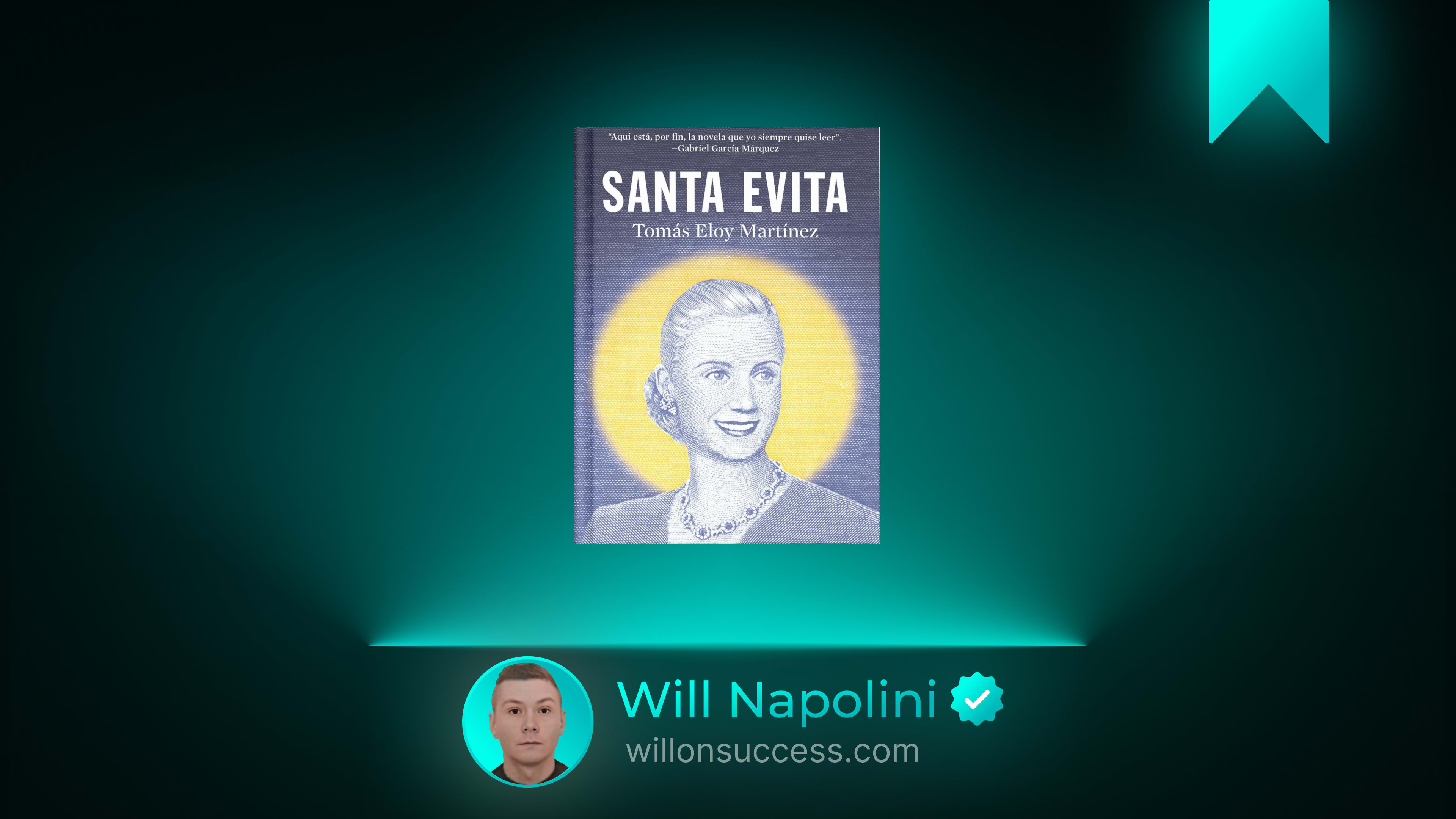
This is the hidden heartbeat of Tomás Eloy Martínez’s masterpiece, Santa Evita. On the surface, it is a sprawling, labyrinthine novel about the bizarre, twenty-year posthumous journey of Eva Perón’s embalmed corpse. But if you read it closely, it is not really about a corpse at all. It is a mirror. It is about how the living use the past, how we manufacture myths to avoid facing reality, and how the things we refuse to bury will eventually bury us.
Let me show you what this extraordinary book can teach us about unburdening our own lives.
The Big Idea: The Stories We Construct Eventually Construct Us
When Eva Perón died of cancer in 1952 at the age of thirty-three, she was already a polarizing figure—worshipped as a saint by the Argentine working class and despised as a tyrant by the military and the elite. Her husband, President Juan Perón, hired a meticulous Italian embalmer, Dr. Pedro Ara, to preserve her body perfectly. He wanted her to look as though she were merely sleeping, so she could be displayed for eternity.
But Perón was soon overthrown in a military coup. The new regime realized that Evita’s body was not just a corpse; it was a relic. It was the physical anchor of a political myth that could spark a revolution. So, they stole it. They hid it. They moved it in the dead of night, eventually smuggling it out of the country and burying it under a fake name in a cemetery in Milan.
They thought that by hiding the body, they could kill the myth. They were entirely wrong. The hiding only fed the legend.
Martínez uses this astonishing true history (blended with fictionalized elements and deep investigative journalism) to explore a central, profound truth: We do not just tell stories. Stories tell us. The military, the embalmer, the politicians, and the devotees in the book all become consumed by the narrative they have built around this woman. They lose their grip on their own lives because they are too busy tending to a myth.
The lesson for us is stark. The narratives you build to explain your life—your victimhood, your past glories, your rigid identity—will eventually demand to be fed. If you are not careful, you will spend your life serving the story, instead of the story serving you.
What You Refuse to Bury Will Eventually Bury You
One of the most tragic figures in the novel is Dr. Ara, the embalmer. He spends years perfecting the preservation of Evita’s body. He becomes obsessed with his creation. Even after the body is stolen from him, he spends the rest of his life haunted by it, traveling the world, giving lectures, desperately trying to maintain his connection to the masterpiece he created. The military officers who guard the body suffer a similar fate; the secret of where it is hidden eats away at their sanity, their marriages, and their peace.
They could not let it go. And because they could not let it go, it destroyed them.
I want you to think about the “unburied” things in your own life.
What are you still guarding? Is it the memory of a time when you were the smartest person in the room? Is it the pain of a betrayal that happened a decade ago, which you still pull out and examine whenever you feel vulnerable? Is it a career path you abandoned, but still secretly believe is your “true” calling?
Holding onto the past feels like loyalty. It feels like honoring what was. But there is a profound difference between honoring the past and being held hostage by it. When you refuse to let a dead thing rest, you drain the life out of your present.
Grief, disappointment, and failure are meant to be processed, integrated, and eventually laid to rest. You do not have to forget them. But you must stop standing guard over them. You cannot build a living future while acting as the caretaker of a beautiful corpse.
The Illusion of Controlling the Narrative
The Argentine military in Santa Evita operate under a fatal assumption: if they control the physical object, they control the meaning. They believe that by hiding the body in obscure locations, changing its name, and restricting access to it, they can dictate how the public remembers Eva Perón.
It is a masterclass in the illusion of control. The more they tried to suppress the story, the more powerful the myth became. The absence of the body only amplified the legend.
How often do we do this in our own lives?
We try to micromanage how others perceive us. We curate our social media, we rehearse our conversations, we hide our struggles, and we carefully construct a personal brand, believing that if we just control the inputs, we can control the output. We exhaust ourselves trying to manage our reputation.
But here is the truth I have learned the hard way: you cannot control the story others tell about you. People will project their own needs, fears, and biases onto you, just as the different factions in Argentina projected their own desires onto Evita. To some, you will be a savior; to others, a villain. Most of the time, you will just be a background character in their own drama.
When you accept that you cannot control the narrative, a massive weight lifts off your shoulders. You can stop managing your image and start managing your character. You can stop trying to convince people you are good, and simply focus on doing good. The former is an exhausting, unwinnable war. The latter is a quiet, sustainable peace.
The Danger of Flattening People into Symbols
Throughout the novel, no one seems to interact with the actual, complex, flawed human being that Eva Perón was. To the working class, she is Santa Evita, a flawless martyr. To the military, she is a demonic whore. To her husband, she is a political instrument. To the embalmer, she is a canvas for his art.
Everyone flattens her into a symbol because symbols are easier to manage than human beings. Symbols do not talk back. Symbols do not change their minds. Symbols do not disappoint you.
We do this constantly in our daily lives, and it is the root of so much relational friction.
We flatten our partners into the role of “provider” or “nurturer,” and then feel betrayed when they exhibit human complexity. We flatten our parents into the role of “authority” or “critic,” missing the nuanced, flawed individuals they actually are. And, perhaps most damaging of all, we flatten ourselves.
We tell ourselves, I am the anxious one. I am the one who is bad with money. I am the one who always ruins relationships. We turn ourselves into two-dimensional symbols to avoid the terrifying, beautiful work of being a dynamic, evolving human being.
If you want to deepen your relationships and your self-compassion, you must practice seeing the complexity in the people around you. When someone hurts you, ask yourself what fear or pain might be driving them, rather than just labeling them “selfish.” When you fail, remind yourself that a single failure is a data point, not an identity. People are not monuments. They are rivers. They are always moving, always changing. Allow them the grace to flow.
A Myth Is Just a Story That Forgot It Was a Story
One of the most chilling aspects of Martínez’s book is watching how a fabricated narrative hardens into absolute truth. The Peronist regime actively manufactured the myth of Evita’s sainthood. They staged events, controlled the press, and built shrines. Over time, the people who participated in the fabrication actually began to believe it. The story forgot it was a story.
This is how our own limiting beliefs are formed.
You experience a failure. You tell yourself a story about it: I am not cut out for this. You repeat the story to a friend. You repeat it in your head when you face a new challenge. You avoid taking a risk because the story tells you that you will fail. Eventually, the story calcifies. It becomes a “fact.” You forget that you invented it in a moment of pain.
If you want to change your life, you have to become a skeptic of your own oldest stories.
Look at the foundational beliefs you hold about your capabilities, your worth, and your future. Ask yourself: Is this an objective truth, or is this a myth I built to protect myself from disappointment ten years ago?
You are allowed to revise the story. You are allowed to say, “That narrative served me when I was surviving, but it is suffocating me now that I am trying to thrive.” Rewriting your internal narrative is not delusion; it is the highest form of taking responsibility for your own mind.
Who Should Read This Book — and Who Might Not Need It
S Santa Evita is a masterpiece of Latin American literature, blending meticulous historical research with the imaginative leaps of a novel. If you are fascinated by the psychology of myth, the intersection of politics and grief, or the way history is shaped by obsession, this book will captivate you. It is rich, atmospheric, and deeply thought-provoking. It will change how you view history, not as a sequence of facts, but as a collision of competing stories.
However, I want to be honest with you: this is not a light read. It is dense, nonlinear, and sometimes deliberately disorienting, mimicking the labyrinthine search for the hidden body.
If you are looking for a straightforward, factual biography of Eva Perón, this will frustrate you, as Martínez freely blends documented history with fictionalized scenes and imagined conversations. If you are in a season of life where you need quick, actionable, step-by-step self-help advice, this book will feel too literary and slow. It is a book for reflection, not for rapid consumption. Read it when you have the time to sit with its shadows and let its questions linger.
Practical Application: The Work of Unburial
Understanding that we carry dead weight is only the first step. The real work is setting it down. Here is how you can translate the lessons of Santa Evita into your life this week.
1. Conduct a “Myth Audit” Take a piece of paper and write down three core beliefs you hold about yourself that feel like absolute facts. (e.g., I am not a natural leader. I always sabotage my success. I am fundamentally unlovable.) Next to each one, write the origin story of that belief. When did you first decide this was true? How old were you? Who was involved? Seeing the origin of the myth often breaks its spell. You realize it was just a story you wrote when you were trying to make sense of a painful moment.
2. Identify Your “Unburied Corpse” What is the one thing from your past that you are still secretly guarding? It might be a resentment, a past identity, or a “what if” scenario. Name it. Acknowledge how much energy it takes to keep it preserved. Then, write a short letter to it, thanking it for whatever protection it offered you, and explicitly giving it permission to rest. You do not have to burn the letter. Just the act of formalizing the release shifts something deep inside your nervous system.
3. Practice “Narrative Detachment” For the next three days, catch yourself every time you try to manage how someone else perceives you. When you send an email, when you speak in a meeting, when you post online—notice the urge to control the outcome. Take a breath and consciously release it. Say to yourself: I control my effort and my integrity. I release the rest. Watch how much energy returns to you when you stop trying to play god with other people’s opinions.
One Small Step
We spend so much of our lives trying to build monuments to who we were, or who we wish we were. We polish the past. We defend our old stories. We stand guard over things that have stopped breathing.
But life is not found in the museum of your history. It is found in the messy, unscripted, unembalmed present.
Here is your one small step for today: Choose one small, dead thing to let go of. It does not have to be a massive life trauma. It can be as simple as an old grievance with a coworker, a lingering embarrassment from a mistake you made last month, or the need to be recognized as the “smart one” in your friend group.
Identify it. Feel the weight of it in your hands. And then, deliberately, open your hands and let it drop.
You do not need to preserve everything you have been through to prove that it happened. Your scars are proof enough. The past is a place to learn from, not a place to live. Step out of the museum. The sun is shining, the air is moving, and there is so much life left to live.
Go live it.