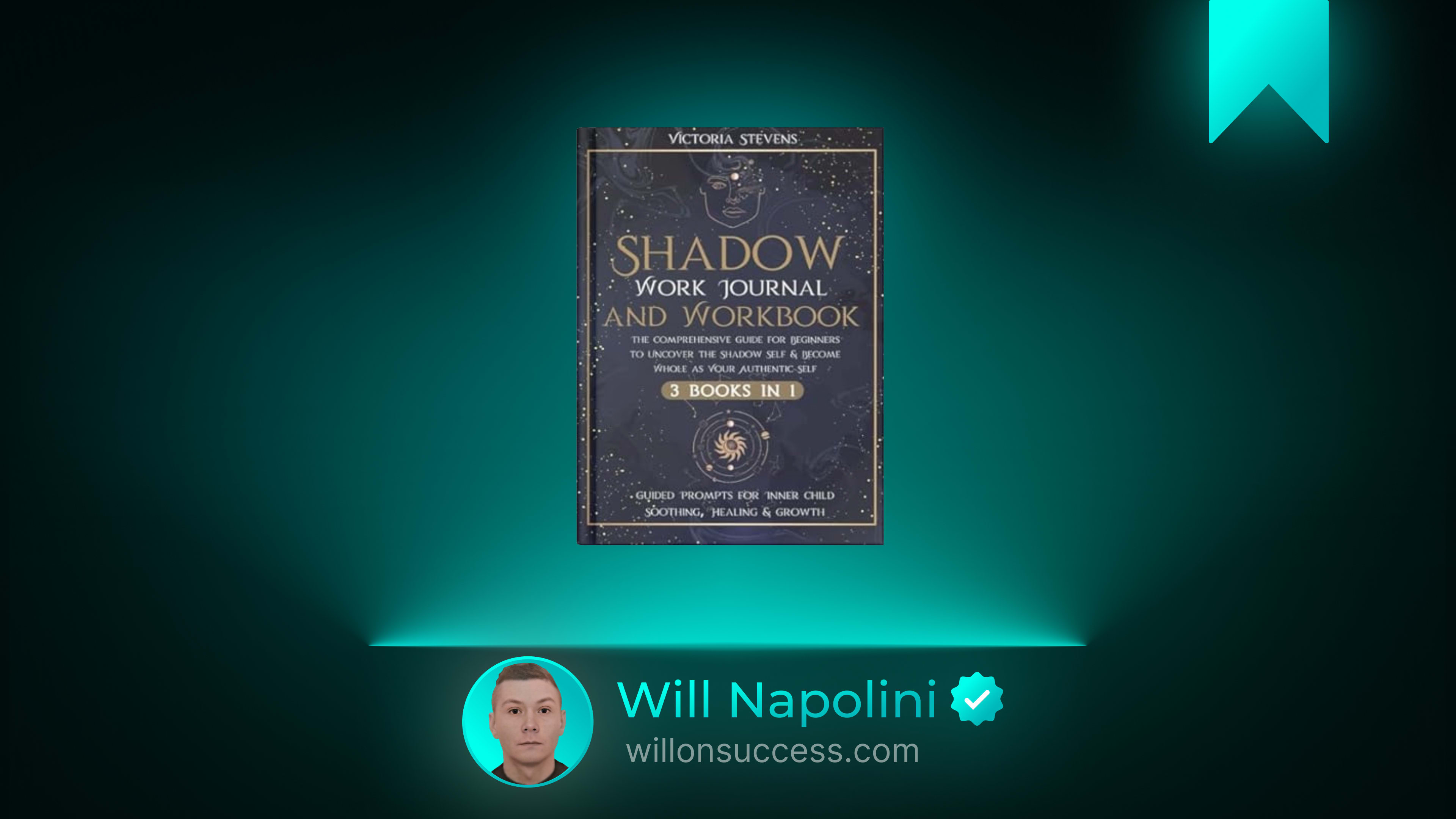
The Courage to Meet Yourself in the Dark: A Mentor's Guide to Victoria Stevens' Shadow Work
Have you ever noticed how the people who irritate you the most are often holding up a mirror to the parts of yourself you refuse to look at?
Think about the last time someone’s behavior made your blood boil. Maybe it was a coworker who was unapologetically arrogant, or a friend who was deeply selfish, or a family member who refused to follow the rules. Your reaction felt entirely justified. They were wrong. You were right.
But what if I told you that your intense emotional reaction was not actually about them? What if it was about you?
We live in a culture that is obsessed with the light. We are told to think positive, to vibrate higher, to curate our feeds, and to protect our peace by cutting out anything that feels heavy or dark. We spend an enormous amount of energy polishing the windows of our lives, trying to present a flawless, sunlit facade to the world.
But you and I both know that you cannot out-affirm a shadow. You cannot positive-think your way out of a subconscious pattern that was wired into your nervous system when you were seven years old.
If you have ever felt like you are self-sabotaging right when you are on the verge of a breakthrough, or if you find yourself repeating the same painful relationship dynamics with different people, the problem is not that you lack motivation. The problem is that you are trying to build a house while ignoring the basement.
Victoria Stevens’ Shadow Work Journal and Workbook is an invitation to finally pick up a flashlight, walk down the stairs, and see what you have been storing in the dark. It is not a book of comforting platitudes. It is a rigorous, deeply honest workbook designed to help you confront the exiled parts of your psyche.
If I could sit across the table from you right now, I would tell you that the work of facing your shadow is not for the faint of heart. It is uncomfortable. It is messy. But it is the only path to a life that is not just performative, but profoundly real.
Let me show you what is waiting for you in the dark, and how you can finally bring it home.
The Big Idea: You Cannot Heal What You Refuse to See
The concept of the “shadow” originates from the Swiss psychiatrist Carl Jung. Jung observed that as we grow up, we learn very quickly which parts of ourselves are acceptable to our parents, our teachers, and our society, and which parts are not.
When we are praised for being quiet, compliant, and helpful, we integrate those traits into our identity. But when we are punished, shamed, or ignored for being loud, angry, selfish, or fiercely independent, we do not simply stop feeling those things. We take those unacceptable parts of ourselves, shove them into an invisible bag, and drag them behind us.
That bag is the shadow.
The central thesis of Stevens’ workbook is this: The shadow does not disappear just because you stop looking at it. In fact, the more you repress it, the denser and more volatile it becomes. It leaks out in passive-aggressive comments. It erupts in disproportionate rage. It manifests as chronic anxiety, imposter syndrome, or a quiet, persistent feeling that you are faking your way through life.
Stevens’ workbook is built on the principle of integration. The goal of shadow work is not to destroy your dark side. You cannot amputate a part of your own soul. The goal is to untie the bag, look at what is inside, and realize that the monsters you have been running from are actually just wounded, misunderstood parts of yourself that are desperately trying to protect you.
The Story of the Basement and the Flood
Imagine your psyche as a large, multi-story house.
The top floor is your Persona. This is the self you show the world. It is polite, professional, well-dressed, and agreeable. You spend most of your waking hours on this floor, making sure the furniture is arranged perfectly and the guests are comfortable.
But down in the basement, behind a heavy, locked door, is the shadow. This is where you threw everything you were told was “bad.” Your anger. Your grief. Your wildness. Your need for boundaries. Your desire to be seen.
For years, you ignore the basement. You pretend the door doesn’t exist. But one day, a pipe bursts down there. The water rises. It seeps through the floorboards and starts ruining the pristine carpets of your top-floor Persona. You panic. You try to mop up the water on the top floor, buying expensive rugs and spraying air freshener, but the water keeps coming.
This is what a psychological trigger is. A trigger is not the person who annoyed you. A trigger is the water rising from the basement.
Stevens’ workbook teaches you to stop mopping the top floor. It hands you the key to the basement door. It asks you to walk down into the damp, uncomfortable dark, find the broken pipe, and fix the leak at its source.
The Architecture of the Shadow
To do this work, you have to understand the mechanics of how the shadow operates in your daily life. Stevens breaks this down into highly practical, journal-based frameworks. Here are the core principles you must grasp before you pick up your pen.
Your Triggers Are Messengers, Not Enemies
We usually view our triggers as external threats. If only my partner would stop doing that, I would be at peace. If only my boss would recognize my worth, I wouldn’t feel so anxious.
Shadow work flips this entirely. It operates on the principle of projection. The things that enrage you in others are often the very things you have forbidden in yourself. If you were taught that anger is dangerous, you will be deeply triggered by people who express anger freely. If you were taught that your needs were a burden, you will secretly resent people who ask for help without apologizing.
When you are triggered, the shadow is handing you a map. It is pointing directly to an unhealed wound. The workbook trains you to stop pointing the finger outward and start asking the terrifying, liberating question: What is this reaction showing me about my own unmet need?
The Shadow Holds Your Gold, Not Just Your Monsters
This is the concept that changes everything, and it is where I see the most profound shifts in the people I mentor. We assume the shadow is entirely made of “bad” things. But that is only half the story.
We also repress our light. Psychologists call this the “Golden Shadow.”
Imagine a child who is naturally brilliant, loud, and creative, but who grows up in a family that values modesty, obedience, and blending in. Every time the child shines, they are told to tone it down. Don’t be so boastful. Don’t draw so much attention to yourself.
To survive, the child takes their brilliance, their leadership, and their fierce creative power, and shoves it into the shadow bag.
As an adult, you might find yourself paralyzed by imposter syndrome, unable to launch your business, or terrified to speak up in a meeting. You think you lack confidence. But shadow work reveals a different truth: you are not lacking confidence; you are repressing your power because your nervous system still believes that shining is dangerous. Reclaiming your golden shadow is how you unlock the ambition and creativity you have been wondering where you lost.
The Inner Child Is Keeping the Score
You cannot separate shadow work from the inner child. The shadow was formed in childhood, and it is guarded by the child you used to be.
When you react with the intense, overwhelming emotion of a toddler to a relatively minor adult inconvenience, it is because the shadow has hijacked your nervous system. The adult you is in the room, but the child you is driving the car.
Stevens’ workbook uses targeted journaling prompts to help you bypass the logical, defensive adult mind and speak directly to the younger parts of you that are still frozen in time. It teaches you to become the compassionate parent to your own inner child that you never had.
Why This Matters on an Ordinary Thursday
Philosophy is beautiful, but it is useless if it does not change how you handle a Thursday evening when you are exhausted and your patience is gone.
Let’s say you come home from work. You are tired. You walk into the kitchen, and your partner has left their dishes in the sink again.
The old pattern—the pattern of the unexamined shadow—flares up. You feel a hot spike of resentment. You might snap at them. You might give them the silent treatment. You might mentally catalogue every other time they have been irresponsible, building a case against them in your head. You feel righteous. You feel like the victim of their laziness.
Now, imagine you have been doing the work in Stevens’ journal.
You walk into the kitchen. You see the dishes. The hot spike of resentment flares. But this time, there is a gap. A half-second of awareness. You recognize the feeling. You realize that the intensity of your anger does not match the crime of a dirty plate.
You pause. You take a breath. You ask yourself: What is this touching inside me?
And the shadow whispers: It touches the belief that I don’t matter. It touches the childhood wound of having to clean up after everyone else to be loved. It touches my terror that I will always be the one carrying the mental load.
The anger doesn’t magically vanish, but it transforms. It is no longer a weapon to use against your partner; it is a signal about your own boundaries. Instead of snapping, you can say, “I am feeling really overwhelmed by the house right now, and I need us to talk about how we handle the kitchen.”
You have moved from unconscious reaction to conscious response. You have stopped projecting your basement onto your partner. That half-second of awareness is the difference between a life of repeating cycles and a life of genuine freedom.
The Practical Architecture: How to Hold the Pen
Victoria Stevens’ book is not a passive read. It is a workbook. It requires you to sit down, open the pages, and physically write.
There is a reason for this. Thinking is abstract; it loops and evades. Speaking is fleeting; it dissipates into the air. But writing is concrete. When you write, you force the chaotic, swirling emotions of the shadow into the linear structure of language. You pin the ghost to the page so you can finally look it in the eye.
If you are going to engage with this workbook, you must approach it with the right architecture. Here is how to set yourself up for success.
1. Create a Container of Safety
Shadow work can be destabilizing. You are unearthing things that were buried for a reason. Do not do this work in a chaotic environment, or when you are already sleep-deprived and emotionally raw. Create a ritual. Light a candle. Make a cup of tea. Put your phone in another room. Signal to your nervous system that you are entering a safe, contained space to do heavy lifting.
2. Practice Radical, Unflinching Honesty
No one is going to read this journal but you. If you are writing what you think you should feel, you are just decorating the top floor again. If you are petty, write it down. If you are jealous, write it down. If you are furious at someone you love, let the ink be angry. The shadow only heals when it is allowed to speak its ugliest, most unvarnished truth without being judged.
3. The “Drop-Down” Journaling Method
When you hit a prompt that brings up a strong emotion, do not just write about the event. Drop down into the body.
- Where do I feel this in my body? (A tight chest? A hot face?)
- How old do I feel right now? (Often, you will realize you feel seven, or twelve, or sixteen).
- What does that younger part of me need to hear right now? Write the response from your wisest, most compassionate adult self to that younger part. This is the mechanics of integration.
Who Should Read This Book — and Who Might Need to Wait
I believe in being deeply honest about what a book can and cannot do. Shadow work is powerful, but it is not a universal panacea, and it is not for every season of life.
Who it is for: If you are someone who has read all the positive psychology books, done the affirmations, and still feels stuck in the same toxic cycles, this workbook is your next step. It is for the high-achiever who feels hollow, the people-pleaser who is secretly boiling with resentment, and the empath who absorbs everyone else’s emotions but has no idea what they actually want. It is for anyone ready to take radical responsibility for their own psychological projections.
Who might need to wait: If you are currently in the midst of acute, unmanaged trauma, severe clinical depression, or active grief, please put this workbook down and seek the guidance of a licensed trauma therapist. Shadow work requires a baseline of nervous system regulation. If your foundation is currently cracking, digging into the basement without a professional guide can cause the house to collapse. Heal the acute wound first. Build the floor. Then, do the shadow work.
One Small Step
You do not need to commit to a three-hour journaling session today. You do not need to unearth your deepest childhood trauma before dinner. You just need to practice catching one projection.
Here is your one small step for today:
Think of one person who mildly irritates you. Not someone who has abused you, just someone whose personality grates on you. Write down the exact trait that bothers you. (e.g., “They are so arrogant and always think they are right.”)
Now, turn the mirror around. Ask yourself: In what area of my life am I not allowing myself to be confident? Where do I shrink my own voice to make others comfortable? Is it possible that I am irritated by them because they are freely doing something I have forbidden myself from doing?
Do not judge the answer. Just let the question sit in your mind. Watch how the irritation softens into curiosity.
The Door Is Already Open
We spend so much of our lives trying to be good. We try to be the perfect partner, the perfect employee, the perfect friend. We carve away the messy, angry, selfish, wild parts of ourselves, hoping that if we can just become a creature of pure light, we will finally be safe. We will finally be loved.
But a creature of pure light is not a human being. It is a ghost. And ghosts do not get to experience the deep, rich, textured reality of a life fully lived.
The invitation of Victoria Stevens’ workbook is not to become perfect. It is to become whole.
It is the courage to look at your jealousy and realize it is just a map pointing toward your unfulfilled desires. It is the courage to look at your anger and realize it is just your boundaries trying to protect you. It is the courage to look at your arrogance and realize it is just your inner child begging to be seen.
You do not need to fear the basement anymore. The things you locked away down there were not monsters. They were just parts of you that were waiting, patiently, in the dark, for you to come back and bring them home.
Pick up the pen. Turn on the light. And meet yourself, exactly as you are.