Why You Never Feel Like You Have Enough — And How to Finally Stop
You have more than any generation in human history.
More food in your kitchen than most kings of the past could have imagined. More information at your fingertips than the greatest libraries of antiquity held. More comfort, more entertainment, more safety, more connection, more stuff piled in closets and drawers and storage units you pay monthly fees to maintain.
And yet.
And yet you lie awake at two in the morning feeling like something is missing. Like you are one promotion, one purchase, one achievement away from finally exhaling. Like everyone else figured out the secret and you are still scrambling, still short, still behind.
I want to show you why that feeling exists. Not because you are broken. Not because you are ungrateful. But because you are running ancient software in a world it was never designed to handle.
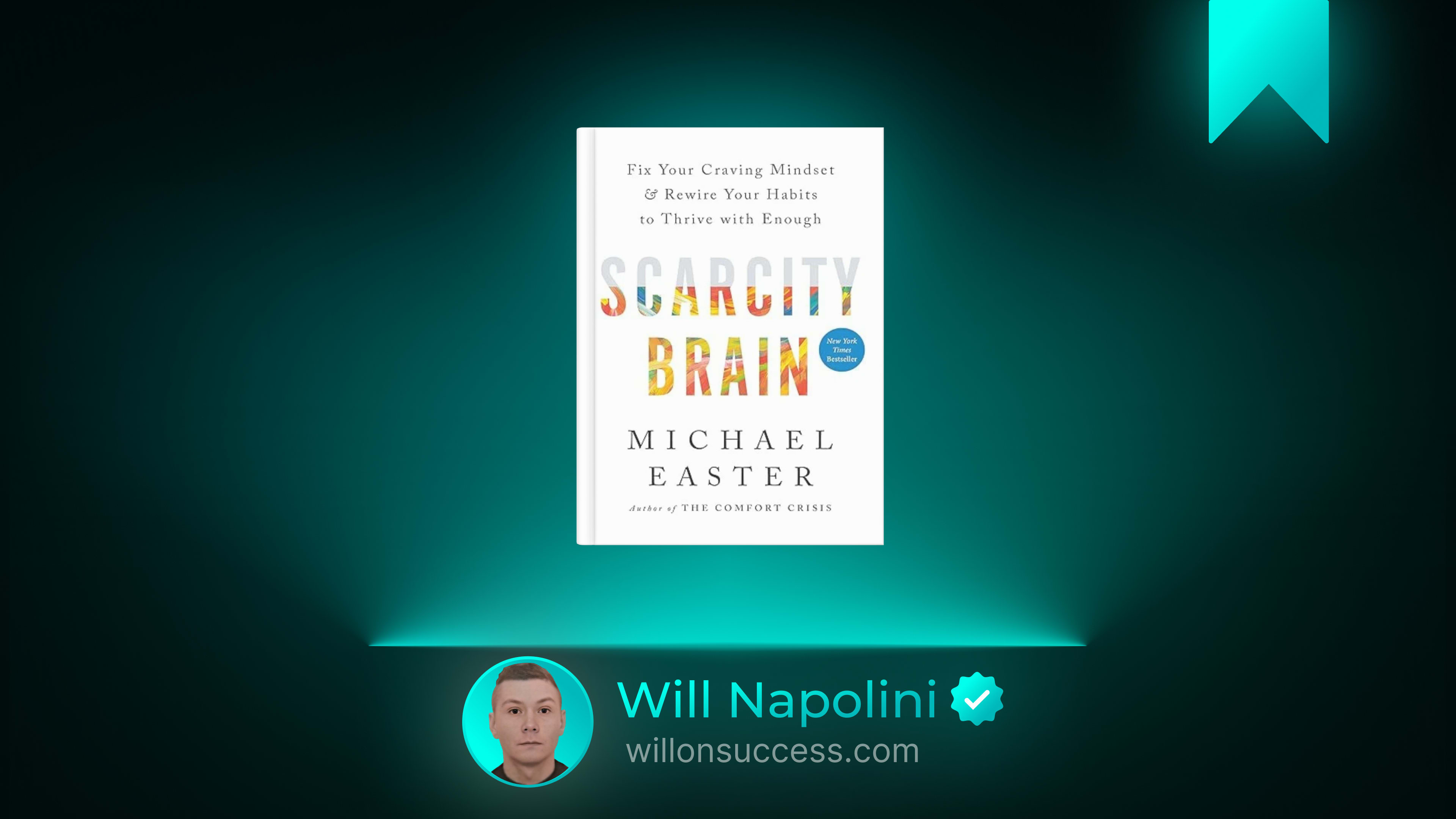
The book that explains this better than anything I have encountered is Scarcity Brain by Michael Easter. And its central argument, once you see it, will change the way you understand almost every anxious, restless, compulsive behavior you have ever had.

The Big Idea: Your Brain Was Built for a World That No Longer Exists
Here is the core of Easter’s argument, stated plainly:
Your brain evolved over hundreds of thousands of years in an environment of constant, genuine scarcity. Food was unpredictable. Shelter was fragile. Threats were everywhere. In that world, the individuals who survived were the ones who could never stop scanning for what was missing, who could never feel satisfied, who always wanted more — more calories, more security, more status, more stuff.
Contentment, in the ancestral environment, was a death sentence. The person who sat down and said, “I have enough” was the person who got eaten, starved, or left behind.
So evolution selected for restless, insatiable, scarcity-obsessed brains. And then, in a geological blink, we built a world of staggering abundance. Grocery stores with forty thousand items. Infinite streaming. Next-day delivery. Climate-controlled homes. Social networks connecting us to millions.
But the brain did not update. It is still scanning for threats. Still hoarding. Still whispering, Not enough. Not yet. You need more before you can relax.
Easter’s insight is that this mismatch is not a minor inconvenience. It is the invisible engine behind much of modern suffering: compulsive spending, overeating, social media addiction, chronic busyness, the feeling that time is always running out, the quiet desperation of comparing your life to curated highlight reels.
You are not weak. You are a survival machine operating in a world that removed the threats but kept the alarm system running at full volume.
The Scarcity Loop: The Engine You Cannot See
The most important framework in the book is what Easter calls the Scarcity Loop. Once you understand its three components, you will see it everywhere — in your phone, in your eating habits, in your shopping cart, in the way you consume news.
The loop has three parts:
One. An opportunity to gain a reward. A notification pops up. A sale appears. A new restaurant opens. A headline promises a secret. The possibility of gaining something lights up your brain.
Two. An unpredictable reward. This is the crucial element. You do not get the reward every time, or you do not know exactly what the reward will be, or you do not know when it will arrive. The unpredictability is what hooks you. A slot machine works because the payout is random. If you won every third pull, you would get bored and walk away. The uncertainty is the drug.
Three. A quick repeat. The cycle restarts immediately. Another pull. Another scroll. Another click. No time to reflect, to assess, to ask whether you actually wanted this. Just repeat.
Easter draws on research into gambling, social media design, and consumer behavior to show that this loop is not an accident. It is deliberately engineered into the environments around you. Slot machine designers study the exact timing of near-misses to keep you pulling. App developers calibrate the unpredictability of likes and comments to keep you refreshing. Retailers design flash sales and limited-time offers to create artificial urgency.
But here is where it gets personal. You do not just run this loop when you gamble or scroll. You run it when you eat past fullness because the next bite might be the best one. You run it when you check your email for the ninth time because the next message might be important. You run it when you buy something you do not need because the acquisition might finally give you the feeling of completeness.
The scarcity loop is not a bug in your character. It is a feature of your neurology, exploited by a world that profits from your restlessness.
You Cannot Fill an Infinite Hole with Finite Things
One of the quieter, more emotionally resonant threads in the book is Easter’s exploration of why “more” never delivers the feeling it promises.
He examines how this plays out across different domains of life. More money, past a certain threshold of security, does not reduce the feeling of financial scarcity. More food does not satisfy the hunger that is actually emotional. More status does not quiet the voice that says you are not enough. More possessions do not fill the space that is actually a need for meaning, connection, or rest.
The problem is not the thing you are reaching for. The problem is that the brain’s scarcity signal is non-specific. It just says lack. And because it says lack without specifying what is actually missing, you try to fill it with whatever is closest. You eat when you are lonely. You shop when you are bored. You scroll when you are anxious. You overwork when you feel unseen.
I have watched this pattern in my own life more times than I can count. The restless evening where nothing feels right, where I open the refrigerator, close it, open a shopping app, close it, pick up my phone, put it down, and still feel that low hum of not enough, not enough, not enough. And what I eventually learned, slowly, is that the hum was not about food or products or information. It was about stillness I was avoiding. It was about a question I was not willing to sit with.
The scarcity brain hates stillness because stillness is where you might realize the hole is not a supply problem. It is a meaning problem. And meaning cannot be delivered next-day.
Time Poverty: The Scarcity That Hides in Plain Sight
Easter spends meaningful time on a form of scarcity that does not involve money or objects at all: the feeling of not having enough time.
This one strikes differently because it carries a moral weight that other scarcities do not. We say “I’m so busy” like a badge. We wear exhaustion like proof of importance. And the more connected and productive our tools make us, the more compressed our sense of available time becomes.
What I found clarifying in Easter’s treatment is the distinction between being objectively time-poor and feeling time-poor. Many people who have genuine leisure hours still feel chronically rushed because their attention is fragmented, because they carry an invisible to-do list that never empties, because they have been trained to treat every unstructured minute as a problem to be solved with another input — a podcast, a video, a text thread.
The scarcity brain treats open time the way it treats open space: something to be filled, immediately, before something is lost. And so we fill it. And the filling makes us feel more empty.
The antidote Easter points toward is not better time management. It is the willingness to leave gaps. To let an afternoon be unstructured. To sit in a room without reaching for stimulation. To treat boredom not as an emergency but as a threshold — the doorway behind which your own thoughts, your own desires, your own actual preferences live.
The Paradox of Abundance: Why More Choice Makes You Feel Poorer
There is a counterintuitive finding Easter weaves through the book that I think matters enormously: abundance, past a certain point, does not increase satisfaction. It decreases it.
When you have three options, choosing is simple. When you have three thousand options, choosing becomes a source of low-grade suffering. You worry you picked wrong. You wonder what you missed. The option you chose feels diminished by the shadow of all the options you did not.
This applies to streaming services with ten thousand titles you will never watch. To restaurant menus with forty pages. To dating apps presenting an endless parade of potential partners. To career paths, investment options, workout programs, parenting philosophies.
The scarcity brain looks at abundance and does not feel rich. It feels overwhelmed, because every unchosen option registers as a tiny loss. And a thousand tiny losses feel like poverty.
Simplification, in this light, is not deprivation. It is relief. Choosing fewer, committing to them fully, and releasing the fantasy that a better option is always one click away — this is how you reclaim the feeling of having enough.
Who Should Read This Book — and Who Might Not Need It
Scarcity Brain sits at the intersection of evolutionary psychology, behavioral economics, and practical self-examination. Easter writes with a journalist’s clarity and a researcher’s respect for evidence. He traveled, interviewed neuroscientists, visited casino floors, studied hunter-gatherer communities, and examined the design choices behind the apps and products that surround us.
Who will benefit most: If you feel chronically restless, if you struggle with compulsive behaviors around food, spending, or screens, if you feel busy but unfulfilled, if you have achieved things and wondered why the satisfaction evaporated within a week — this book will give you language for what is happening inside you. It will help you separate your genuine needs from the manufactured urgency of the scarcity loop.
Who might find it less useful: If you are in genuine, acute material scarcity — if you are struggling to pay rent, to afford food, to keep your job — the book’s emphasis on mindset can feel disconnected from your reality. Easter acknowledges this, but the book is most useful for people whose basic needs are met but who still feel trapped in a cycle of wanting. If you are in survival mode, address survival first. This book is for the next phase.
What makes it worth reading: It does not moralize. It does not call you greedy or ungrateful. It explains the mechanism with compassion and then hands you the wrench to take the mechanism apart.
Practical Application: Breaking the Loop on an Ordinary Tuesday
Understanding the scarcity loop is not enough. You need to interrupt it physically, in the architecture of your day. Here is where to start.
Identify Your Personal Loop
For three days, carry a small notebook or use the notes app. Every time you reach for something compulsively — your phone, a snack, a shopping site, the refrigerator, social media — write down three things: What triggered it? What reward was I hoping for? Was the reward predictable or uncertain?
You will start to see your own patterns. Maybe it is 3 p.m. boredom. Maybe it is the loneliness that hits after dinner. Maybe it is the anxiety spike before a meeting. The loop only has power while it is invisible. Name it, and it loosens its grip.
Introduce One Predictable Reward
The scarcity loop thrives on unpredictability. Counter it with a small, reliable pleasure that you give yourself at a set time. A ten-minute walk after lunch. A specific cup of tea at 4 p.m. A chapter of a novel before bed. Not random. Not contingent on productivity. Just a steady, predictable anchor that tells your nervous system: You will be cared for. You do not need to scramble.
Practice One Act of Deliberate Enough
Once a day, encounter something and consciously say, This is enough. One plate of food. One episode of a show. One conversation. One purchase you consider and then set down. You are not depriving yourself. You are training the brain to recognize the boundary where satisfaction lives, instead of letting it sprint past that boundary into the endless, exhausting territory of more.
Remove One Source of Artificial Urgency
Unsubscribe from three marketing emails this week. Delete one app that runs a scarcity loop you cannot control. Turn off one category of notifications. You do not need to go off the grid. You just need to reduce the number of voices shouting now, now, now, you are missing out into your day. Every voice you silence is a minute of attention you get back.
Let One Hour Be Empty
Choose one hour this week — a Sunday morning, a Wednesday evening — and leave it unstructured. No plan. No podcast. No agenda. Just you, a chair, maybe a window. Let the boredom come. Let it be uncomfortable. Sit inside it for ten minutes and notice what rises underneath. That discomfort is the scarcity brain throwing a tantrum because you are not feeding it. It will pass. And what is left when it passes is often the thing you actually needed.
One Small Step
Do not try to overhaul your relationship with consumption, time, and desire all at once. That is just the scarcity brain disguising itself as ambition.
Here is your one step for today:
Tonight, before you sleep, look around the room you are in. Not at what is missing. Not at what you wish you had. Look at what is already there. The roof. The light. The chair. The fact that you are warm, that you are fed, that you are alive on this particular evening.
Say, quietly, to yourself: This is enough. Right now, in this moment, this is enough.
You do not have to believe it fully. You just have to say it. You just have to let the sentence land in your body for five seconds before the scarcity brain rushes in with its list of what is still lacking.
Five seconds. That is all. But five seconds of genuine enough, repeated daily, will slowly rewire the alarm system. Not because you are tricking yourself. Because you are telling the oldest part of your brain the truth it has been waiting two hundred thousand years to hear: The threat is over. You can rest now.
The Door Is Already Open
You were not built for this world. You were built for a world of genuine lack, where the next meal was uncertain and the next threat was real. And that ancient wiring kept you alive. You owe it your existence.
But you do not owe it your peace.
You are allowed to look at the fullness of your life — the imperfect, ordinary, unremarkable Tuesday of it — and decide that the alarm can be turned down. That the scanning can stop. That you do not need to earn the right to feel sufficient.
The scarcity brain will not go quietly. It will whisper tomorrow morning that you need more. More effort. More achievement. More reassurance. More proof that you matter. And you will hear it, because it is old, and it is loud, and it is afraid.
But you do not have to obey it.
You can set the phone down. You can leave the cart empty. You can let the evening be quiet and unproductive and small. You can look at what you have and call it by its true name.
Enough.
Not someday. Not after the next milestone. Not when you finally fix the thing that feels broken.
Here. Now. With what is already in your hands.
The roots were always deeper than you thought. You just kept looking at the branches, wondering why the tree still felt bare.
Stop looking up. Look down. You have been standing on solid ground this entire time.