Flowers in the Attic by V.C. Andrews: What Surviving Abandonment Teaches You About the Bonds That Hold
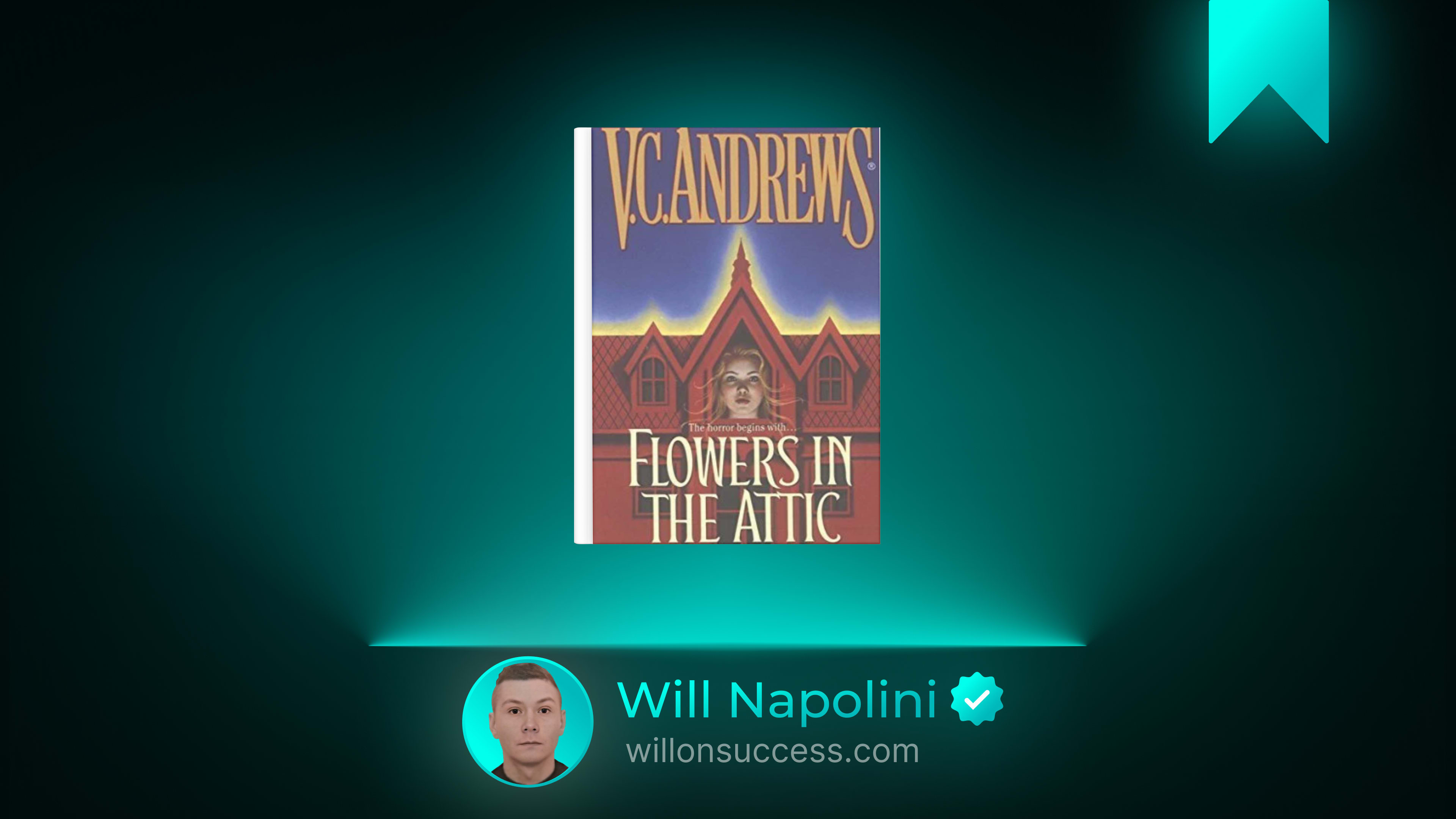
There is a fear that lives deeper than most of us will ever admit. It does not belong to childhood, exactly, though it is born there. It belongs to the part of us that never fully stops being the child who looked up and wondered: Will they come back? Will they choose me? Am I worth the trouble of protecting?
V.C. Andrews built an entire novel around that fear. Then she locked it in an attic for three years and made the reader watch.
Flowers in the Attic, published in 1979, is not a gentle book. It is not a kind book. It is a gothic family saga dressed in melodrama, written in prose that often tips into excess, populated by characters who sometimes feel like archetypes rather than people. And yet it sold millions of copies. It has never fully left print. Readers pass it to one another with the particular urgency of someone handing over a secret.
I think the reason is not the sensationalism, though there is plenty. The reason is that Andrews touched something almost unbearable and made it narrative. She gave shape to the feeling of being trapped by the people who were supposed to set you free. And in doing so, she asked a question that does not let go easily: When the adults fail you completely, what do you become? And what do you hold on to?
The Story
Four children. Cathy, twelve. Chris, thirteen. The twins, Cory and Carrie, five. Their father dies suddenly in a car accident. Their mother, Corrine, devastated and financially desperate, takes them to the vast estate of her estranged parents, Foxworth Hall, hoping to reconcile with her dying father and secure an inheritance.
There is a condition. The grandfather must never know the children exist. Corrine’s marriage, it emerges, violated something in the old man’s rigid moral code. So the children are placed in a bedroom connected to a large attic, told it is temporary, told to stay quiet, told to stay hidden. Their grandmother, a severe and fanatical woman, enforces the rules. Their mother visits less and less.
Days become weeks. Weeks become months. Months become years.
The attic becomes their entire world. They pace its length. They mark time. They create small rituals to keep from unraveling. Cathy and Chris grow from children into adolescents in a space that was never meant to hold a life, while the twins grow up knowing nothing else. The grandmother punishes them with a cold, scripture-quoting cruelty. And Corrine, upstairs, attending parties, wearing beautiful dresses, rebuilding a life that requires her children to remain invisible, slowly stops coming altogether.
Then the food begins to taste wrong. Then Cory grows pale and thin and quiet. And the children discover, in the worst way a child can discover anything, that the person who was supposed to save them has been poisoning them to make the problem disappear.
I will not walk you through every event. Some of what happens in that attic—including a bond that forms between Cathy and Chris under the pressure of total isolation—belongs to the novel’s own telling, and it would be wrong of me to flatten it into summary without the context Andrews gives it. What I want to focus on is what the story means once you close the cover and carry it back into your own life.
The Real Subject: What Happens When the People Meant to Protect You Become the Threat
Strip away the gothic architecture, the locked doors, the powdered sugar on poisoned donuts, and the book’s central question is one that does not require an attic to ask:
What do you do when the person who is supposed to keep you safe becomes the source of your danger?
This is not a rare question. It does not only belong to extreme situations. It belongs to the child whose parent drinks too much and becomes a stranger by evening. To the teenager whose home is technically intact but emotionally vacant, where love is conditional and silence is the price of peace. To the adult who grew up learning that their needs were an inconvenience, that their feelings were too much, that the correct response to their own pain was to make themselves smaller so someone else could be comfortable.
Corrine does not lock the children away because she is a monster. She locks them away because she has decided that her desire for wealth, status, and her father’s approval outweighs their need for sunlight, space, and a mother who sees them. And she tells herself it is temporary. She tells herself they will understand later. She tells herself she is doing what she must.
I have watched people do smaller versions of this their whole lives. Not locking children in attics, but locking parts of themselves away. Locking away the need, the grief, the inconvenient truth, because acknowledging it would require disrupting a structure they depend on. The job they hate but cannot leave. The relationship that diminished them years ago but has become too familiar to exit. The family story that requires everyone to play a role, and woe to the one who breaks character.
The attic is a metaphor long before it is a setting. And most of us have spent some time in one.
What the Siblings Build in the Dark
Here is what I find genuinely worth carrying out of this book, and it is not the horror. It is the response to the horror.
When every adult fails, the children turn to each other. Cathy becomes fierce, protective, angry in a way that keeps the group moving. Chris becomes steady, watchful, the one who holds the structure when Cathy’s fire threatens to consume everything. They care for the twins. They tell them stories. They create games in a space that offers almost nothing. They mark holidays. They keep a fragile, stubborn sense of family alive in a room designed to erase them.
This is not sentimentality. This is survival. And it reveals something I believe with my whole chest: when the world strips away every external support, the bonds you have built with other people become the architecture that keeps you upright. Not the institution. Not the title. Not the blood relation in name only. The actual, daily, chosen act of showing up for someone when showing up costs you.
Cathy and Chris do not save each other because it is easy. They save each other because the alternative is to disappear. And in that mutual refusal to let the other disappear, they build something the adults in their lives never managed to build: a loyalty that does not require permission.
If you have ever been in a season where the people who should have been there were not—if you have ever had to become your own family, or found an unexpected family in friends, in a community, in a single person who said I see you, and I am not leaving—then you know what this means. The bond that forms in shared difficulty is not lesser than the bond that forms in comfort. Sometimes it is stronger, because it was chosen under pressure, not inherited in ease.
The Long Shadow: What Captivity Does to a Person’s Sense of Normal
One of the most quietly disturbing elements of the book is how the children adapt. They begin to treat the attic as normal. They structure their days around its limits. They stop expecting the door to open. The abnormal becomes the architecture of their lives, and they build within it because the alternative—sustaining the belief that this is temporary, that rescue is coming, that the world outside still belongs to them—becomes too exhausting to maintain.
I have seen this happen outside of fiction. I have seen it in myself.
You stay in the job that drains you for so long that you forget what work could feel like if it did not cost you your evenings, your weekends, your sense of self. You stay in the relationship that made you small for so long that smallness starts to feel like your actual size. You grow up in a house where your emotions were punished, and you build an adult life in which you do not feel safe feeling anything at all, and you call it maturity.
The attic reshapes you. And the most dangerous part is not the captivity. It is the moment you stop noticing the walls.
Andrews does not resolve this cleanly. The children escape, but they do not escape whole. They carry the attic in them. The fear. The suspicion. The knowledge of what a parent is capable of. And that, too, is honest. Healing is not a door you walk through. It is a long, uneven walk, and some days the road goes back through the dark before it finds the light again.
What This Means for You, Practically
I am not going to pretend that reading a gothic novel will fix a wound. But I think the book can function as a mirror, and I want to offer you a few questions to hold up to it.
Where in your life have you adapted to a space that was never meant to hold you? Not literally. Emotionally. Professionally. Relationally. Where have you made yourself small enough to fit inside someone else’s comfort, and called it peace?
Who is your person? When the structures fail—when the family, the institution, the plan falls apart—who do you turn toward? And are you that person for someone else? The siblings in this book survive because they are not alone in the dark. If you are in your own version of that dark, the single most important thing you can do is refuse to be in it by yourself. Not because someone will fix it. Because the act of telling another person this is where I am breaks the seal on the room.
And if you grew up in a house that failed you in ways you are still untangling: you are not broken because it shaped you. You are not obligated to forgive on a timeline that is not yours. You are allowed to grieve what you should have had and still build what you can have now. Those two things are not contradictions. You can hold the anger and the tenderness in the same hand.
Who Should Read This Book
Flowers in the Attic will appeal to readers drawn to gothic family sagas, to stories of survival under extreme pressure, and to narratives that do not look away from the darker capacities of human beings. It reads quickly. The momentum is relentless once you are inside it.
It is not for everyone. The content is heavy: child endangerment, emotional and physical cruelty, death, and themes of incest that are presented within the specific context of the children’s isolation and trauma. The prose is sometimes overwrought. The villains can feel one-dimensional. The book leans into shock, and not every reader wants that.
But if you have ever felt trapped by a family system, if you have ever been the child—or the adult—who learned too early that the people in charge were not going to save you, there is a recognition here that can feel almost physical. And recognition, even painful recognition, is a form of being seen. And being seen is where healing starts.
One Small Step
If this book stirred something in you, here is what I would ask you to do today. Not a grand gesture. A small, honest one.
Find a piece of paper. Write down the name of the attic. Not a literal attic. The metaphorical one. The situation, the relationship, the role, the belief about yourself, that you have been living inside for so long that it has started to feel like the whole world. Name it. One sentence. My attic is ______.
You do not have to solve it today. You do not have to break out tonight. You only have to name it. Because the walls only hold their power as long as you have stopped noticing them. And the moment you say this is a room, and I am in it, and I did not choose it—you have already begun to find the door.
You do not have to be rescued. You were never meant to wait for someone to come. You are allowed to look at the lock, study its shape, and begin, quietly, to work it open.
And if the twins in you—the small, frightened, five-year-old part that just wants someone to come and say you can come out now—if that part of you needs to grieve before it can walk, let it grieve. You can carry it and still move forward. You can be the one who opens the door.
You have survived every attic so far. This one will not be the last room you walk through. But it does not have to be the one you stay in.