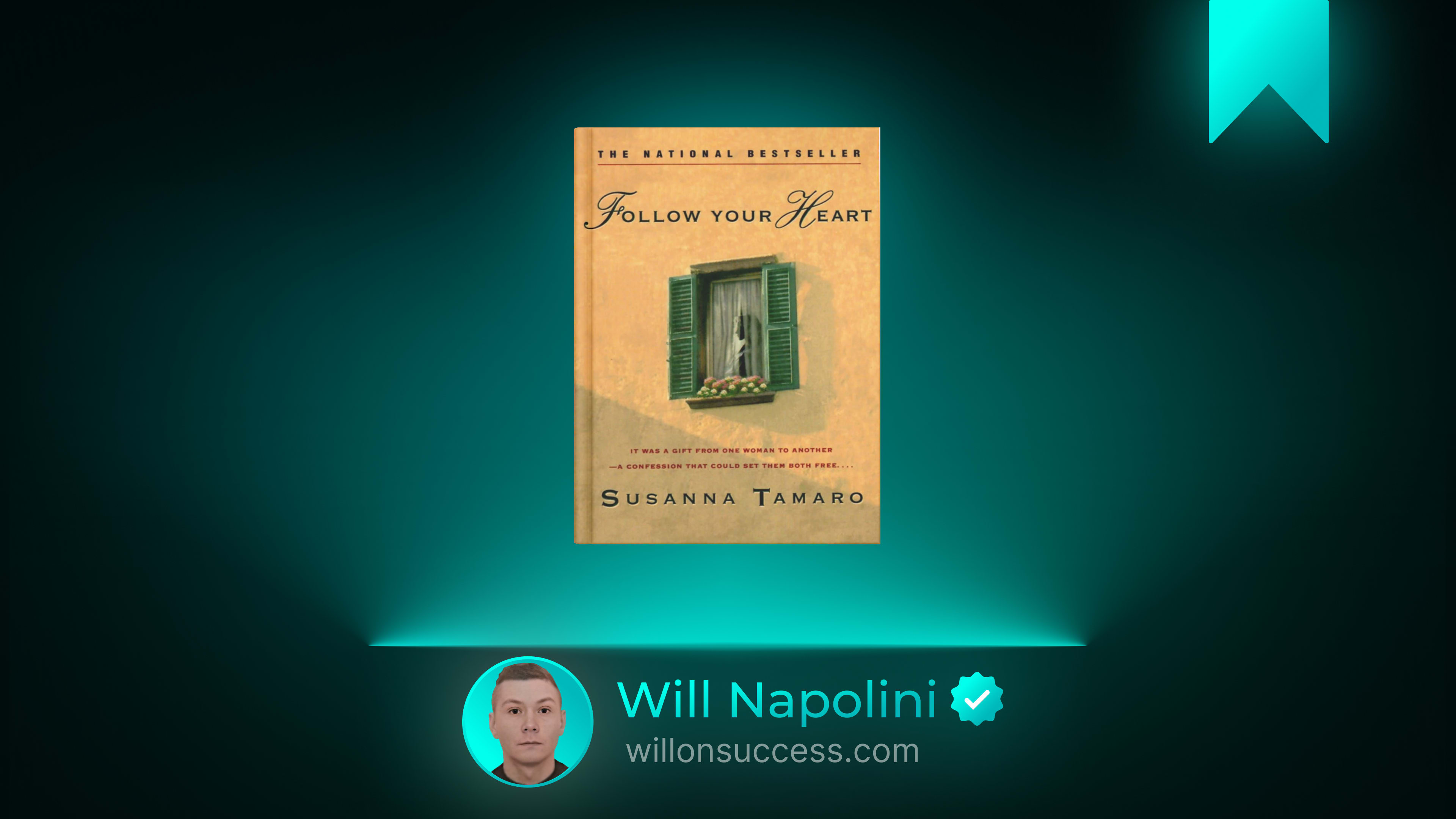
Follow Your Heart by Susanna Tamaro: Why the Hardest Journey Is the One Back to Yourself
There is a specific kind of silence that grows inside families. It is not the peaceful quiet of two people reading in the same room. It is a heavy, architectural silence. It is the space between a mother and a daughter, or a grandparent and a grandchild, where love exists but the words to express it have somehow been lost, buried under years of misunderstanding, pride, or inherited grief.
If you have ever sat across from someone you love and felt an ocean between you, you understand the terrain of Susanna Tamaro’s 1994 novel, Follow Your Heart.
In modern culture, the phrase “follow your heart” is often reduced to a bumper sticker. We use it to justify quitting a job on a whim, chasing a fleeting romance, or buying something we cannot afford. We equate the heart with impulse. We treat it like a compass that always points toward whatever feels good in the moment.
Tamaro asks us to abandon that shallow definition. In her work, the heart is not a playground of momentary desires. It is the deepest, most uncorrupted core of your being. Following it is not an act of indulgence; it is an act of profound, sometimes agonizing, courage. It requires you to confront the shadows of your own history, to name the unnamable, and to reclaim your authentic self from the expectations of those who came before you.
The Story: A Letter Across the Ocean
The novel takes the form of an epistolary confession. Olga, an elderly woman living in Trieste, Italy, is facing a terminal illness and realizes she does not have much time left. Her granddaughter, Marta, has moved to America, and over the years, a vast emotional and physical distance has grown between them.
Marta was raised by Olga in that very house in Trieste after her mother, Ilaria, died tragically in a car accident when Marta was only a child. Olga, grieving and rigid, raised Marta the best she knew how, but the love between them became tangled in unspoken sorrow and the ghost of the woman who connected them.
Now, facing the end of her life, Olga sits down to write a long, unbroken letter to Marta. It is a testament. She writes to explain the choices she made, the mistakes she carried, the secret history of their family, and the complicated truth about Ilaria. She writes to bridge the ocean before she dies.
Through Olga’s memories, we see how the women in this family have loved each other fiercely but failed to understand one another completely. We see the quiet resentments, the protective lies, and the desperate, clumsy attempts to shield the next generation from pain—which usually just results in passing the pain down in a different form.
The Architecture of Inherited Silence
One of the most striking things I have noticed about family systems is how trauma and coping mechanisms flow through generations like underground rivers. You cannot see them on the surface, but they shape the landscape of your life.
Olga realizes that she did not just pass down her love to Marta; she passed down her defenses. When we are hurt and do not know how to process it, we build walls. We call those walls “boundaries” or “standards” or “toughness.” But to the children standing on the other side, they just feel like cold stone.
The book illustrates that the most dangerous inheritance is not a lack of money or a flawed genetic trait. It is silence. When a family refuses to speak its truth—when grief is swallowed, when mistakes are swept under rugs, when the reality of a person’s struggle is ignored to maintain a polite facade—the next generation is left to navigate a maze without a map.
You may be living out a script written by a parent who was too afraid to pursue their own dreams, and so they unconsciously tasked you with fulfilling theirs. You might be repeating a pattern of emotional withdrawal because you never saw what secure, vocal love looked like in your childhood home. If you do not examine the architecture of your inheritance, you will mistake it for your own personality. You will think you are just “a private person” or “someone who doesn’t need much from others,” when in reality, you are just reenacting a survival strategy that was handed to you three generations ago.
The Heart as a Moral Compass, Not a Whim
When Tamaro’s Olga urges Marta to follow her heart, she is not telling her to do whatever feels good on a Tuesday afternoon. She is telling her to seek deep self-knowledge.
To follow your heart, in this sense, means to align your outward life with your inner truth, even when it costs you. It means having the courage to look at the “wrong” things in your life and change them into “right” things, as Olga reflects on the moral imperative of growing up. It is the willingness to say, This is who I actually am, even if it disappoints the people who thought they knew me.
The heart does not always point toward comfort. Often, it points toward the difficult conversation you have been avoiding. It points toward the grief you need to finally sit with. It points toward the boundary you must draw, knowing it will cause temporary friction.
I have mentored people who spent decades running from their own hearts because they were taught that their true desires were selfish, inconvenient, or dangerous. But a life lived in opposition to your own core is exhausting. It is like trying to hold a beach ball underwater. You can do it for a while, but it requires constant, draining effort. Following your heart is simply the act of letting the ball rise to the surface.
The Urgency of the Unsent Letter
There is a ticking clock in this book, and it is the most relatable clock in the human experience: mortality. Olga writes because she knows the hourglass is almost empty.
I have seen this urgency play out in the lives of people I know. We operate under the dangerous illusion that there will always be a tomorrow to clarify, to apologize, to say I love you without a caveat, to explain why I was the way I was. We hoard our truths, thinking we are protecting the other person, when in reality, we are just hoarding them.
Olga’s letter teaches us that love, to be fully realized, must be spoken. A confession is not a weakness; it is a bridge. When an older person finally drops their armor and says, “I was frightened, and I made mistakes,” it does not diminish them. It frees the person standing across from them. It allows the younger person to stop carrying the weight of the older person’s unexpressed guilt.
The Courage to Forgive the Dead
As Olga traces the lineage of her family’s pain, she arrives at a profound realization about forgiveness. She must forgive her own mother for her coldness, and she must ask Marta to forgive her for the same.
This is perhaps the hardest lesson in the book: the people who hurt us were often just wounded children themselves, operating with the limited tools they were given. This realization does not excuse the damage. It does not erase the scars. But it releases the debt.
You do not forgive people because they deserve it. You forgive them because you are tired of carrying their ghosts in your pockets. You forgive them so that you can finally put the heavy luggage down and walk forward with your hands free. Forgiveness is not a gift you give to the person who wronged you; it is a gift you give to your own future.
Why This Matters on an Ordinary Tuesday
You might be wondering how a story about an elderly Italian woman and her distant granddaughter applies to your life right now.
It applies every time you feel a sudden wave of resentment toward a family member and don’t know why. It applies every time you self-sabotage right at the edge of a breakthrough, because deep down, your family system never modeled what it looks like to succeed and be loved at the same time. It applies every time you choose the path of least resistance instead of the path of the heart, because you are afraid of disrupting the fragile peace of your environment.
What changes when you apply this? You stop treating your emotional reactions as random weather and start treating them as data. You stop expecting people who are emotionally starved to feed you. You start taking responsibility for the silence you are contributing to, and you begin the slow, deliberate work of speaking your truth.
Who Should Read This Book
This novel will resonate deeply with you if you are navigating a complex relationship with a parent or grandparent, particularly if there is a history of emotional distance, unspoken grief, or the “mother wound.” It is a quiet, introspective read that moves at the pace of a long, thoughtful walk.
It may not be the right fit if you are looking for a fast-paced plot or external action. The entire novel essentially takes place inside one room and one mind. It requires a reader who is willing to sit with melancholy, memory, and the slow unfolding of a lifetime of regrets.
But if you have ever wished you could sit down with an older relative and ask them, Who were you, really, before you became the person I knew? this book will feel like a mirror. It is also a profound read for anyone who is trying to break generational cycles and wants to understand the invisible forces they are pushing against.
Practical Application: Mapping Your Emotional Geography
How do you actually do this? You start by mapping the emotional geography of your family.
Take out a piece of paper and draw a simple line representing your family tree—just you, your parents, and your grandparents. Next to each person, write down one word that describes the “weather” of their emotional life. Was your father a storm? Was your grandmother a drought? Was your mother a constant, overcast fog?
Then, look at your own word. Is it the same?
If you realize you are carrying weather that does not belong to you, you have found the starting line. The work of following your heart begins the moment you say, I love them, but I will not carry their storm anymore. I am going to find my own sun.
One Small Step
You do not need to write a sprawling, multi-generational confession today. But I want you to take one small step toward breaking the silence.
Think of one person in your life—living or departed—with whom there is a heavy, unspoken truth. It could be an apology you owe them. It could be a boundary you need to explain. It could simply be an expression of love that has always gotten stuck in your throat.
Open the notes app on your phone, or take out a blank sheet of paper, and write just the first sentence.
“I have been wanting to tell you…” “I am sorry that I…” “When I was younger, I felt…”
You do not have to send it. You do not have to finish it. But the moment you write that first sentence, you stop hoarding the truth. You let it out of the dark. And that is the first, most vital step in the long, beautiful journey back to your own heart.
The heart knows the way, but it will not drag you there. You have to be willing to walk.