The End of Innocence: How to Stand Tall When Life Forces You Into the Arena
There is a specific, quiet moment in every human life when the safety net vanishes.
It rarely happens with a dramatic announcement. It usually happens on an ordinary Tuesday. You realize, with a sudden drop in your stomach, that the adults cannot protect you anymore. The rules you thought governed the world have been suspended, and you are suddenly standing in an arena you did not choose, facing a trial you did not ask for, with no guarantee that you will walk away unharmed.
If I could sit across the table from you, I would tell you that this moment is terrifying. But it is also the exact moment you begin to become who you were meant to be.
We spend our early years believing that if we follow the rules, stay out of trouble, and do our homework, we will be safe. But life eventually shatters that illusion. The question is not how to avoid the shattering. The question is what you will do when the pieces are on the floor.
The Big Idea
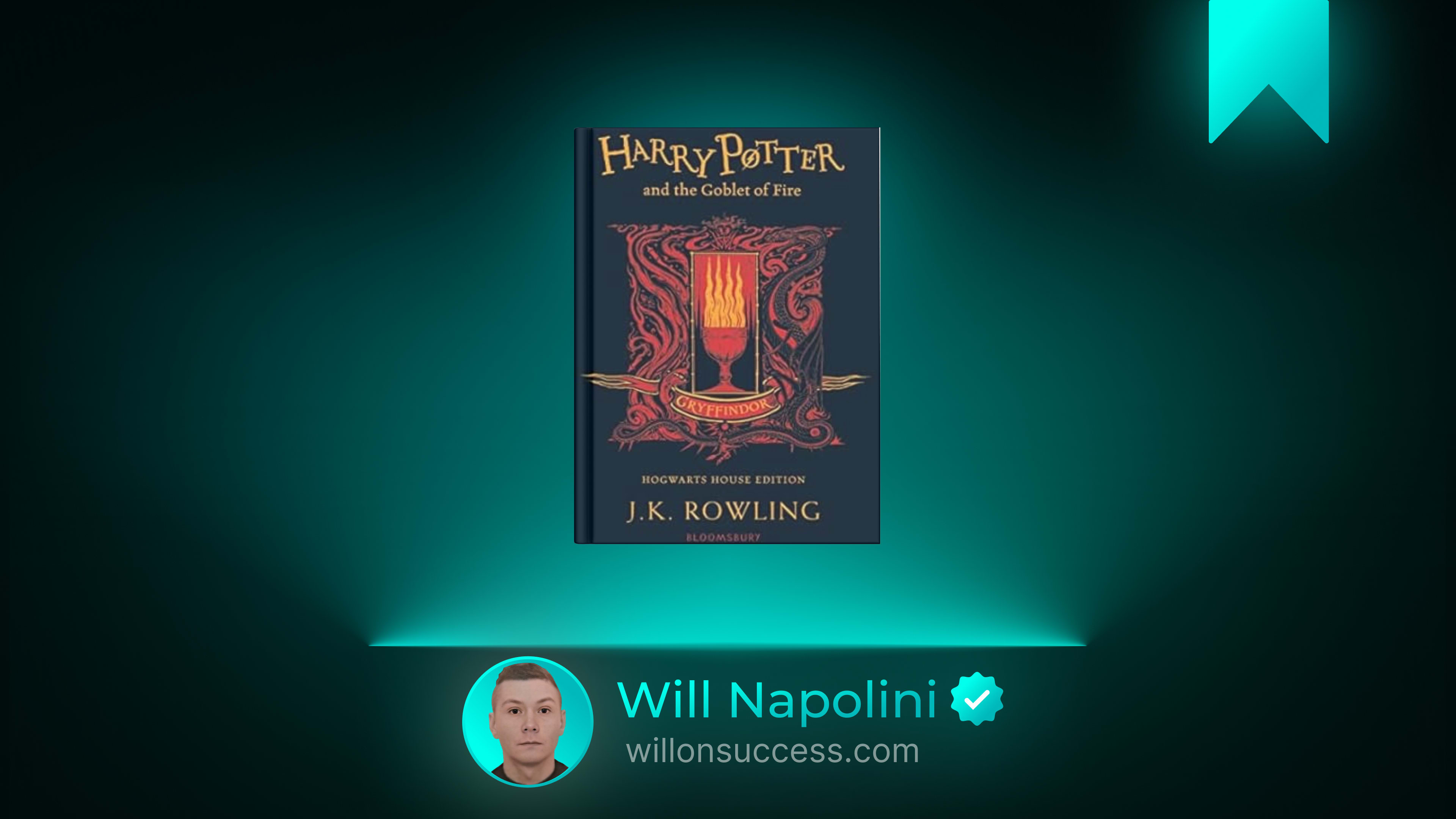
J.K. Rowling’s Harry Potter and the Goblet of Fire is widely remembered for its dragons, its merpeople, and its dazzling magical tournaments. But beneath the spectacle, it is the definitive story about the death of childhood innocence and the heavy, unavoidable arrival of adulthood.
The central thesis of this book is that true maturity begins the moment you accept that life will hand you unfair trials, and you must choose to fight for what is right, rather than what is easy. It teaches us that we do not get to choose the arenas we are thrown into, but we always, always choose how we stand once we are inside them.
The Story and the Concept
The story opens with the illusion of safety. Harry Potter is fourteen, entering his fourth year at Hogwarts, expecting a normal year of classes and Quidditch. But the school is hosting the Triwizard Tournament, a legendary and dangerous competition between three magical schools. The rules are absolute: you must be seventeen to enter, and the magical Goblet of Fire selects only one champion per school.
Then, the unthinkable happens. The Goblet spits out a fourth name. Harry’s name.
He is fourteen. He did not enter his name. He does not want to compete. But the magical contract is binding. He is forced into a deadly tournament against older, more experienced students. Instantly, the world turns against him. The media paints him as an attention-seeking liar. The other schools accuse him of cheating. Worst of all, his best friend, Ron, consumed by jealousy and feelings of inadequacy, abandons him.
Harry must survive three increasingly lethal tasks: outsmarting a fire-breathing dragon, rescuing his friends from the bottom of a frozen lake, and navigating a massive, monster-filled maze. But the final task is a trap. The maze leads not to a trophy, but to a graveyard. There, the dark wizard Lord Voldemort is resurrected, and a fellow student, Cedric Diggory, is murdered in front of Harry’s eyes.
Harry barely escapes with his life and Cedric’s body. When he returns, the authorities refuse to believe him. The safety of the school is permanently broken. The war has begun.
The Arena You Did Not Choose
When Harry’s name comes out of the Goblet, his first instinct is confusion, followed quickly by a desperate desire to be believed. But the crowd does not believe him. The Daily Prophet, represented by the vicious journalist Rita Skeeter, twists his words and mocks him. Even his teachers look at him with suspicion.
He is trapped in a nightmare of public misunderstanding and unfair expectations.
I have seen this happen in the lives of so many good people. You are thrust into an arena you did not ask for. A sudden illness. A brutal divorce. A company downsizing that leaves you holding the weight of a failing department. A public accusation that is entirely false.
When life forces you into an unfair arena, the human ego screams for justice. We want to pause the game, point at the scoreboard, and demand that the universe acknowledge the mistake. We waste precious energy trying to convince the crowd that we don’t belong there.
But the crowd rarely listens. And the dragon is still waiting in the next room.
Harry’s greatest triumph in the first half of the book is not his magic; it is his emotional endurance. He learns, painfully, that you cannot control the narrative the world builds around you. You can only control your preparation for the task immediately in front of you.
Character before circumstances means doing the work even when the crowd is booing. It means studying the dragon’s habits while the newspapers call you a liar. It means realizing that your survival does not depend on being understood; it depends on being prepared. The world will not always ask if you are ready before it throws you into the fire. You must learn to forge your armor while the flames are already licking at your feet.
The Quiet Poison of Comparison
While Harry is fighting for his life, his best friend Ron is fighting a different, entirely internal battle.
Ron comes from a large, poor family. He wears hand-me-down robes. He is the youngest of six highly successful brothers. And now, his best friend is the most famous boy in the world, competing in a glorious tournament while Ron is forced to watch from the stands.
Ron’s jealousy is not born of malice; it is born of a deep, aching feeling of invisibility. He feels left behind. And so, he punishes the person he loves most. He gives Harry the silent treatment. He sneers. He isolates himself.
If we are honest, we have all been Ron.
We have sat in the pews at a wedding, smiling while our chest tightened with envy. We have scrolled past a colleague’s promotion on LinkedIn and felt a bitter sting of resentment. We have watched a sibling or a friend achieve the exact milestone we have been praying for, and instead of feeling joy, we felt a profound sense of our own inadequacy.
Comparison is the quiet poison of human connection. It tricks you into believing that someone else’s victory is your defeat. It convinces you that success is a finite pie, and if your friend gets a slice, you will starve.
But growth before achievement requires us to dismantle this lie. Ron’s arc in the book is the painful journey back to reality. It takes a life-threatening event—the second task of the tournament, where Harry nearly drowns— for Ron to realize how foolish his jealousy was. When Harry finally pulls Ron from the freezing water, the silence breaks. Ron apologizes, and the friendship is restored.
Your friend’s success is not a mirror reflecting your failure. It is simply a reminder of what is possible. When you can look at the people you love and celebrate their light without feeling like it casts you in shadow, you have achieved a level of emotional maturity that will serve you for the rest of your life.
The Myth of the Solo Hero
There is a persistent myth in our culture that true strength means doing it all yourself. We glorify the lone genius, the self-made millionaire, the solitary hero who needs no one.
The Goblet of Fire systematically dismantles this myth.
Harry is incredibly talented, but he cannot survive the tournament alone. When he is stuck on how to decipher the screeching clue of the golden egg, he cannot figure it out in isolation. He needs Cedric Diggory to point him toward the prefects’ bathroom. He needs Moaning Myrtle to give him a hint about the lake. When he realizes he needs to breathe underwater, he cannot brew the complex potion himself; he relies on Dobby and Neville to bring him Gillyweed. When he needs to summon his broomstick to face the dragon, he relies on Hermione to help him practice the Summoning Charm until his arms ache.
Harry survives because he is willing to be helped.
Independence is a beautiful ideal, but it is a terrible strategy for complex problems. The most capable people I know are not the ones who refuse to ask for help; they are the ones who know exactly what they do not know, and they are humble enough to seek out those who do.
When you are facing a massive project, a struggling marriage, or a new business venture, your ego will tell you to hide your confusion. It will tell you that asking for help is an admission of weakness.
Do not listen to it.
Asking for the “Gillyweed” is not a sign of defeat. It is a strategic necessity. Build a network of mentors, peers, and friends. Be willing to say, “I do not know how to do this. Can you show me?” The person who tries to carry the world alone will eventually be crushed by its weight. The person who shares the load will move mountains.
The Choice Between What Is Right and What Is Easy
The climax of the book is not a glorious victory. It is a tragedy.
In the center of the maze, Harry and Cedric grab the Triwizard Cup at the same time, agreeing to tie for the win. But the cup is a trap. It transports them to a graveyard, where Voldemort is waiting. In a matter of seconds, Cedric is murdered. Harry is tortured, forced to duel a fully resurrected dark lord, and barely escapes with his life, clutching the body of his dead friend.
When Harry returns to the safety of the castle, he is traumatized. He is bleeding, shaking, and carrying a truth that the world is not ready to hear. The Ministry of Magic, representing the established authority, chooses to deny the truth. They choose to call Harry a liar and Dumbledore a fool, because acknowledging the return of Voldemort would mean acknowledging a terrifying, world-altering reality. They choose what is easy.
But Dumbledore stands by Harry. And at the end-of-year feast, Dumbledore gives a speech that serves as the philosophical anchor for the rest of the series. He tells the students that dark times are coming, and soon they will all face a choice between what is right and what is easy.
This is the ultimate threshold of adulthood.
Childhood is protected by the easy choices. Adults make the hard ones for you. But adulthood is the moment you look at the dark, terrifying reality of the world and refuse to blink.
It is easy to look away from the suffering in your community. It is easy to stay quiet when your boss makes an unethical decision. It is easy to stay in a comfortable but dead-end job, or a polite but loveless marriage, because the alternative requires a terrifying amount of disruption.
But a life built entirely on easy choices eventually collapses under the weight of its own compromises.
Choosing what is right will often cost you. It cost Harry his reputation for the entirety of the next year. It cost him his peace of mind. But it preserved his soul. It kept his character intact. When you choose what is right, you are telling the world—and more importantly, yourself—that your integrity is not for sale, and your courage is not conditional on the weather being fair.
Why This Matters in Your Life
You might be reading this and thinking, I am not fighting dragons, and I am not facing dark wizards.
But you have your own graveyard moments.
You have had the moment where the phone rang, and the doctor delivered news that shattered your understanding of the future. You have had the moment where the business you poured your heart into failed, taking your savings with it. You have had the moment where you realized the person you trusted most was not who you thought they were.
These moments strip away the illusion that we are in control. They force us to confront our own mortality, our own fragility, and the undeniable reality that the world can be deeply unfair.
If you try to navigate these moments with the mindset of a child—demanding fairness, waiting for an adult to fix it, or hiding your eyes from the scary parts—you will be crushed by the weight of your own disillusionment.
But if you step into these moments with the mindset of a mature adult, you transform the tragedy into a forge. You learn to grieve without being destroyed. You learn to stand up for the truth even when the crowd calls you crazy. You learn to look at the scars you have accumulated and realize they are not signs of your defeat; they are proof of your survival.
In your career, this maturity makes you a leader who can navigate crisis without panicking. In your relationships, it allows you to love people through their flaws and forgive them when they fail you. In your personal growth, it means you stop waiting for the world to become safe, and you start building the internal fortress that allows you to thrive in a dangerous world.
Practical Application
Understanding the transition from innocence to experience is profound, but understanding without action changes nothing. If you want to build the resilience required for the arenas of your life, here is how you begin.
Audit Your “Easy” Choices Take out a piece of paper and draw a line down the middle. On the left side, write “What is Easy.” On the right side, write “What is Right.” Look at your current life. Are you avoiding a difficult conversation with your spouse because it is easier to keep the peace? Are you ignoring a health symptom because it is easier to pretend it isn’t there? Are you staying silent in a meeting because it is easier to conform? Identify one area where you are choosing the easy path, and commit to taking the first step toward the right path this week.
Drop the Resentment Think of someone in your life whose success has triggered a quiet, uncomfortable jealousy in you. Consciously interrupt the narrative. The next time you see them, send them a genuine message of congratulations. Force your behavior to lead your emotions. By actively celebrating their win, you break the poison of comparison and free up your own energy to focus on your path.
Ask for the “Gillyweed” Identify the single biggest bottleneck in your current project or personal goal. What is the specific thing you do not know how to do? Now, identify one person who possesses that knowledge. Reach out to them today. Do not try to figure it out alone. Ask for the tool, the advice, or the introduction you need to breathe underwater.
Focus on the Next Task When you are overwhelmed by the sheer unfairness of your current circumstances, your mind will try to solve the entire tournament at once. Stop. You cannot fight the dragon, the merpeople, and the maze on the same day. What is the very next task? What is the one phone call you need to make? The one page you need to write? The one meal you need to cook? Shrink your world down to the next immediate action, and execute it.
Who Should Read This Book
Harry Potter and the Goblet of Fire is essential reading for anyone standing on the precipice of a major life transition. It is for the young adult realizing the world is not what they were promised. It is for the mid-career professional who has just been handed a crisis they did not create. It is for anyone who has experienced a sudden loss of innocence and is struggling to reconcile the world as it is with the world as they wished it to be.
While it is a fantasy novel, its psychological depth regarding jealousy, trauma, and public perception is staggering. If you are looking for a tactical manual on time management, this is not it. But if you need a story that will validate your grief, challenge your courage, and remind you that your choices define you far more than your circumstances, this book will be a lifelong companion.
One Small Step
Today, I want you to identify one small truth you have been avoiding.
Maybe it is the truth that a project is failing. Maybe it is the truth that you are unhappy in your current routine. Maybe it is the truth that you need to apologize to someone you wronged.
Do not wait for the perfect moment. Do not wait until you feel brave. Speak the truth, write the truth, or act on the truth today.
You do not need the world to be fair to live a meaningful life. You do not need the crowd to understand you to do the right thing. You just need the courage to stand in the arena, look at the task in front of you, and take the first step.
The fire will not forge you if you refuse to step into the flame.