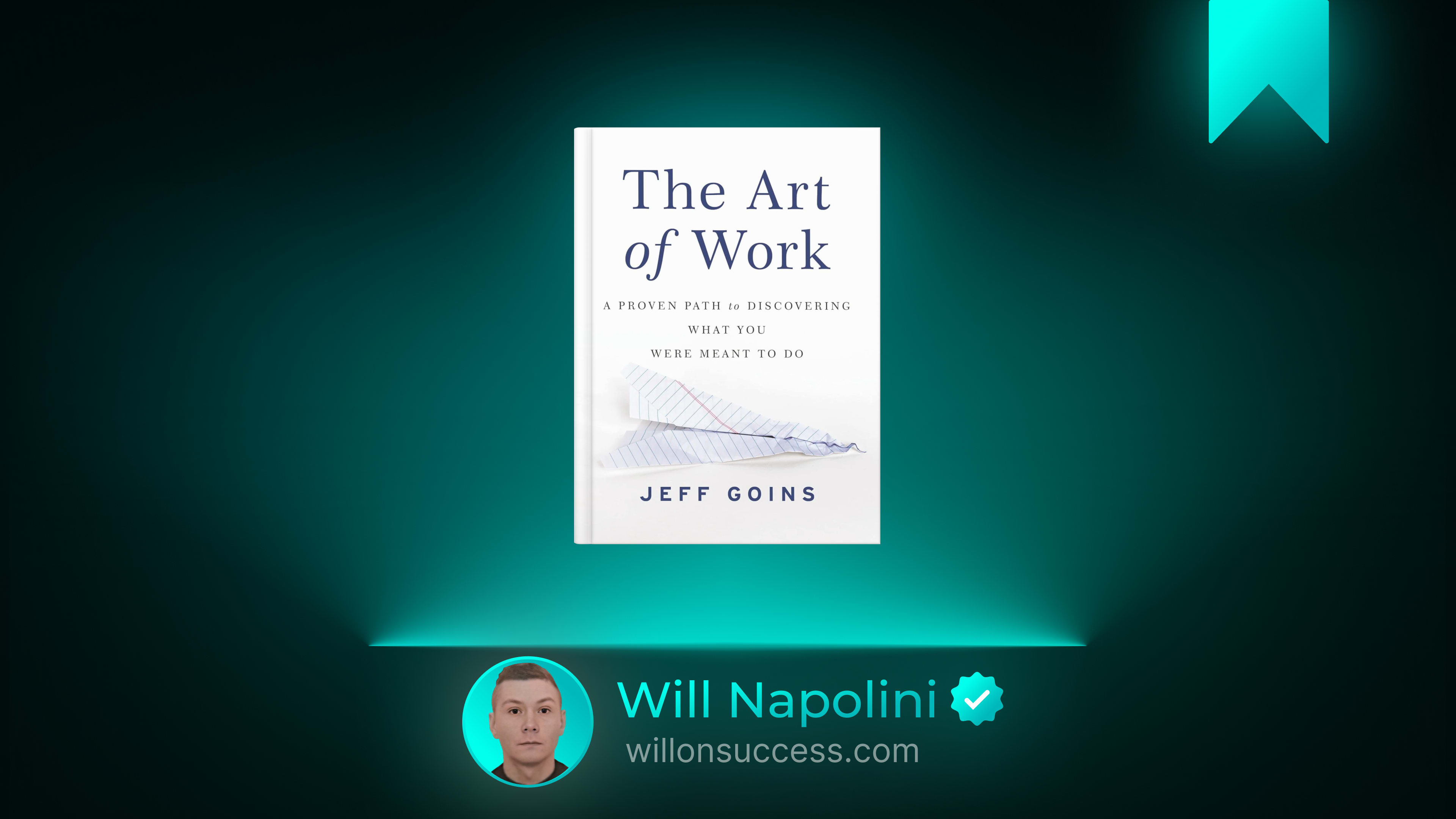
The Art of Work by Jeff Goins: Why Your Calling is Built, Not Found
You are waiting for a lightning bolt.
You are waiting for the moment of absolute clarity when the clouds part, a voice speaks from the heavens, and you finally know, with unshakable certainty, exactly what you are meant to do with your life. Until that moment arrives, you feel stuck. You feel like an imposter. You look at others who seem to have it all figured out and wonder what is wrong with you.
If I could sit across the table from you right now, I would tell you to stop waiting.
The lightning bolt is a myth. The idea that your “true calling” is a hidden treasure map waiting to be discovered is one of the most paralyzing lies we tell ourselves about work and purpose.
In The Art of Work, Jeff Goins dismantles this romanticized view of success. Drawing on his own messy transition from a comfortable, predictable corporate job to a life of writing and creative entrepreneurship, Goins reveals a much more grounded, and ultimately much more hopeful, truth.
You do not find your calling. You forge it.
True work is not a destination you stumble upon. It is a non-linear, often frustrating, deeply rewarding journey of practice, apprenticeship, and gradual mastery. The goal is not to magically discover what you are supposed to do. The goal is to become the kind of person who can do the work that matters.
The Big Lie That Keeps You Stuck
Goins identifies a psychological trap he calls “The Big Lie.” This is the deeply ingrained belief that you should already know what you want to do with your life, and if you do not, you are broken, behind, or failing.
We absorb this lie from movies, from social media highlight reels, and from a culture that worships overnight success. We see the author on the bestseller list, but we do not see the ten years of rejected manuscripts. We see the entrepreneur ringing the opening bell, but we do not see the nights they spent wondering if they would make payroll.
When you believe The Big Lie, confusion feels like a crisis. You interpret your uncertainty as a sign that you are on the wrong path, so you quit and start over, or worse, you freeze entirely.
Here is what I have learned from my own seasons of uncertainty, and what Goins confirms: confusion is not a sign of failure. It is a normal, necessary stage of growth. You are not supposed to have the entire map when you are standing at the edge of the forest. You only need to see the next three feet of the trail.
Releasing The Big Lie is the first step toward freedom. It allows you to stop judging yourself for not knowing the end of the story, and start paying attention to the work right in front of you.
The Practice Precedes the Passion
We have been taught to follow our passion. We are told to find what we love, and the money and mastery will naturally follow.
Goins flips this script entirely. He argues that passion is not the spark that starts the fire; it is the warmth that comes after you have done the hard work of building it.
Think of a river carving through stone. The water does not passionately decide to become a canyon. It simply shows up, day after day, and applies consistent pressure to the same spot. Over time, the impossible becomes inevitable.
In The Art of Work, “The Practice” is the stage where you commit to the unglamorous, repetitive, and often boring work of building a skill. You do not wait until you feel inspired to write, to code, to lead, or to create. You do the work, and the inspiration meets you there.
Competence breeds confidence. And confidence, over time, breeds passion. When you get good at something, you begin to enjoy it. You begin to care about the nuances. You start to see the beauty in the craft. But you cannot access that passion until you have put in the reps.
You do not need more motivation. You need a system that makes the right action easier, and the discipline to do it even when you do not feel like it.
The Apprenticeship is Non-Negotiable
Once you have committed to the practice, you enter what Goins calls “The Apprenticeship.” This is perhaps the most humbling, yet most vital, phase of the journey.
An apprenticeship is a season of learning under pressure, often for little recognition or financial reward. It is the time when you say “yes” to small, stretching opportunities. It is the time when you work for a mentor, take on the projects no one else wants, and focus entirely on absorbing knowledge rather than building a personal brand.
In our modern economy, we are obsessed with hacking our way to the top. We want the title without the tenure. We want the authority without the apprenticeship.
But you cannot build a skyscraper on a foundation of sand.
I have seen countless talented people sabotage their own potential because they refused to be beginners. They wanted to be the master on day one. When the work got hard, or when they were asked to do something beneath their perceived status, they walked away.
True apprentices embrace the grind. They understand that every master was once a disaster. They ask questions. They accept harsh feedback without taking it personally. They recognize that the privilege of learning from someone who has already walked the path is worth far more than a temporary boost to their ego.
The Breakthrough is a Choice, Not an Accident
After years of practice and apprenticeship, a shift occurs. You are no longer just learning the rules; you are beginning to master them. You have built a foundation of skill, relationships, and credibility.
This leads to “The Breakthrough.”
Many people believe a breakthrough is a lucky accident. They think it is the result of being in the right place at the right time. But Goins makes it clear: a breakthrough is a choice.
It is the moment you decide to step out of the safety of the apprenticeship and claim your own voice. It is the decision to launch the business, publish the book, ask for the promotion, or pivot your career, even though you will never feel 100% ready.
The breakthrough requires risk. It requires you to leave behind the comfort of being a perpetual student and accept the responsibility of being a practitioner. It is terrifying. But it is also the only way to transition from doing the work to owning the work.
Why This Matters on an Ordinary Tuesday
You might be reading this and thinking, “This is a beautiful framework, but I have a mortgage, a demanding job, and two kids. I do not have the luxury of a romantic apprenticeship.”
I hear you. And this is exactly why Goins’ framework is so practical.
The Art of Work is not a prescription to quit your job tomorrow and move to a cabin in the woods to “find yourself.” It is a guide to transforming the life you already have.
You can practice the principles of a calling right where you are.
- You can bring a craftsman’s attention to detail to the reports you write.
- You can treat your current manager or clients as mentors, actively seeking to learn from their strengths.
- You can spend thirty minutes every evening practicing the skill you want to be known for in five years.
Your current job does not have to be your forever work for it to be a valuable part of your journey. It can be the training ground. It can be the place where you build the discipline, the financial runway, and the professional network that will eventually fund your breakthrough.
A small decision becomes a direction, and a direction repeated long enough becomes a life. You do not have to change everything today. You just have to change what you do next.
How to Actually Apply This Tomorrow
Understanding the stages of a calling is only valuable if it changes your behavior. Here is how you can put these principles into action this week.
1. Name Your Current Stage Stop fighting where you are. Look at Goins’ framework and honestly assess your current season. Are you trapped in The Big Lie, paralyzed by the need to know everything? Are you in The Practice, needing to commit to daily reps? Are you in The Apprenticeship, needing to humble yourself and learn? Naming the stage removes the shame and gives you a clear objective.
2. Commit to a 30-Day Practice Identify one micro-skill related to the work you want to do. If you want to be a leader, practice active listening. If you want to be a writer, practice writing 200 words a day. Commit to this single, unglamorous practice for 30 days. Do not judge the outcome. Just log the hours. Let consistency do the heavy lifting.
3. Seek a Micro-Apprenticeship You do not need to move to another city to find a mentor. Look at your current environment. Identify someone who is slightly ahead of you in a skill you admire. Ask them for fifteen minutes of their time. Do not ask them for a job. Ask them a specific, thoughtful question about how they solved a problem you are currently facing. Show them you are willing to do the work.
4. Redefine Your Metrics of Success Stop measuring your day by external validation (likes, praise, promotions). Start measuring it by internal integrity. Did I do the practice today? Did I embrace the discomfort of learning? Did I show up with a craftsman’s mindset? When you control the inputs, the outputs eventually take care of themselves.
Who Should Read This Book
The Art of Work is a deeply comforting yet challenging book. It is essential reading for anyone who feels stuck in their career, creatives who are paralyzed by the “messy middle” of a project, and young professionals who feel the crushing weight of needing to figure out their entire lives by age thirty.
It is also highly valuable for seasoned professionals who have achieved external success but feel an internal void, helping them reconnect with the foundational joy of the craft.
However, if you are looking for a quick, five-step corporate ladder hack, or if you believe that your dream job should always feel easy, fun, and frictionless, this book will frustrate you. Goins does not offer shortcuts. He offers a map of the terrain, complete with its swamps, steep climbs, and necessary detours.
One Small Step
The journey of a thousand miles does not begin with a grand, sweeping declaration. It begins with a single, unglamorous step.
Right now, identify the “true work” or the skill you have been dreaming about but avoiding because it feels too big. Break it down into the smallest possible action.
Not “write a book.” Write one paragraph. Not “start a business.” Register the domain name. Not “become a great leader.” Send one email thanking a colleague for their specific help today.
Do that one small thing before the day is over.
You do not need to see the whole staircase to take the first step. You just need to trust that the act of building is what eventually reveals the path. Start where you are. Use what you have. Do the work.