The Lazy Genius Kitchen by Kendra Adachi: A System for Feeding Yourself Without Losing Your Mind
You open the refrigerator at five-thirty in the afternoon. You stare at the shelves. Something about the leftover rice, the half-bag of spinach going soft, and the mysterious container from Thursday creates a small, familiar dread. You close the door. You open it again. You consider ordering takeout. You feel guilty for considering takeout. You close the door a third time.
If that scene sounds like your Tuesday, I want you to hear me clearly: nothing is wrong with you. What is wrong is that you have been handed a story about what cooking and feeding yourself should look like, and that story was never built for a real, tired, complicated human life.
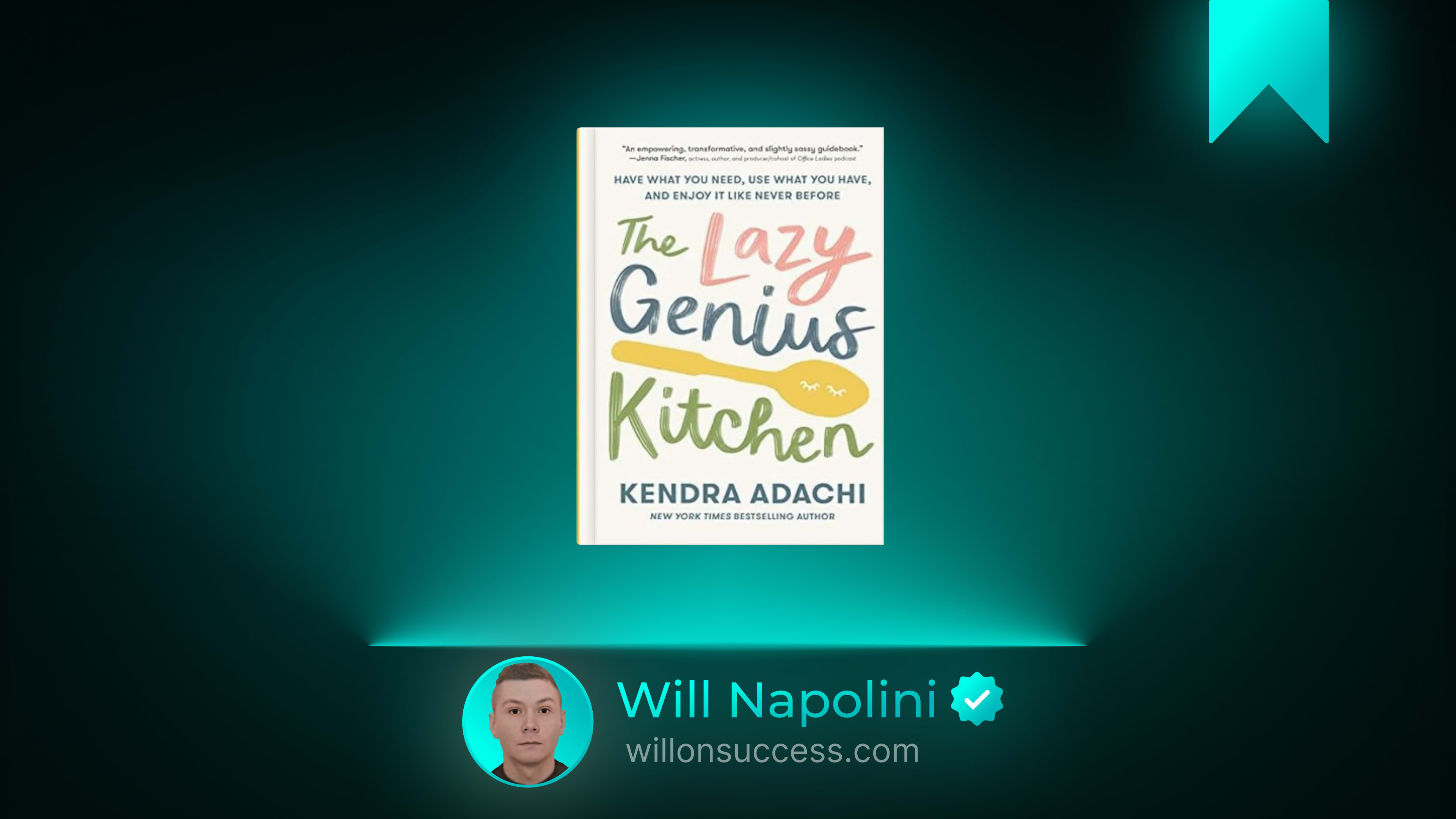
Kendra Adachi’s The Lazy Genius Kitchen is not a cookbook. Oh, it has recipes tucked in at the back—simple, honest ones. But the heart of the book is something else entirely. It is a permission slip and a blueprint at the same time. Permission to stop performing. A blueprint for building a kitchen life that actually fits yours.
What I want to show you today is how Adachi’s central idea can quietly change the way you move through one of the most repetitive, draining, and essential parts of your daily existence: feeding yourself and the people around you.
The One Sentence That Changes Everything
Adachi’s philosophy rests on a deceptively simple line that runs through all her work: Be a genius about the things that matter to you and be lazy about the things that don’t.
Read that again. Let it settle.
Most of us approach the kitchen with a strange, undifferentiated guilt. We feel we should care equally about sourcing organic vegetables, having a spotless counter, cooking from scratch five nights a week, presenting food beautifully, and never letting leftovers go to waste. We treat every kitchen task as if it carries the same moral weight. And because we cannot excel at all of them simultaneously, we feel like we are failing at all of them constantly.
Adachi’s insight is that you do not have to optimize everything. You get to choose. You get to say, “This one thing—eating dinner together as a family, or having a hot meal ready when I walk in from work, or simply not spending my entire Saturday chopping vegetables—that is what matters to me. And the rest can be good enough. The rest can be lazy.”
This is not lowering your standards out of defeat. It is directing your energy with intention. A craftsman does not sand every surface of a house with the same care. They know where the finish will be seen and where it will not. That is not laziness. That is wisdom.
Decision Fatigue Is the Real Enemy
Here is what I have come to believe after years of watching people struggle with their kitchen lives: the problem is rarely cooking. The problem is deciding.
What are we eating tonight? Do I have the ingredients? If not, do I have time to shop? Should I make the thing the kids will eat or the thing I actually want? Can I use what is in the freezer, or will that require thawing time I do not have? Is this healthy enough? Is this too repetitive? Will I feel guilty if I make pasta for the third time this week?
By the time you have answered those questions, you are exhausted. And you have not turned on a single burner.
Adachi names this clearly. The mental load of food decisions is enormous, and it falls disproportionately on the person in the household who “handles dinner.” The book’s systems are designed to collapse dozens of nightly decisions into a handful of choices made once, calmly, in advance.
Her approach is not rigid meal planning. She is not asking you to color-code a spreadsheet on Sunday evening. What she offers instead is something gentler: the practice of deciding once. You choose a pattern. Maybe Tuesday is always tacos. Maybe Thursday is always breakfast for dinner. Maybe you rotate through five meals you genuinely like and stop agonizing over novelty. You make the decision when your mind is clear, and then you simply execute it when your mind is tired.
A small decision becomes a direction, and a direction repeated long enough becomes a rhythm. And rhythm is what carries you through the evenings when you have nothing left.
Lower the Bar Before You Build the System
One of the most freeing ideas in the book is Adachi’s insistence that your kitchen systems must be built for the version of you who is tired, distracted, and not particularly inspired. Not the version of you who watched a cooking show on Saturday morning and felt a surge of ambition.
She talks about building meals and routines around the “lazy” version of yourself—the one who will not, realistically, make a three-component sauce after a ten-hour day. And instead of shaming that version, she designs for her.
What this looks like in practice: keep a short list of meals that require fewer than five ingredients. Know which nights of the week you genuinely cannot cook, and plan for those nights without apology. Keep a drawer or shelf of “emergency dinner” items—a jar of good sauce, a bag of frozen dumplings, eggs that can become a meal in eight minutes. The goal is not culinary achievement. The goal is feeding yourself with dignity and without a crisis at six p.m.
I think of it like weatherproofing a house. You do not build for the one perfect sunny day. You build for the storm. You build for the Tuesday in February when everything has gone sideways and you still need dinner on the table.
Your Kitchen Should Serve Your Life, Not the Other Way Around
There is a section of the book that addresses something I think many of us feel but rarely name: the kitchen as a source of low-grade, persistent shame. The cluttered counter. The expired items in the back of the pantry. The appliance you bought for a phase that lasted two weeks. The mismatched containers.
Adachi does not tell you to overhaul everything in a weekend. She does not tell you to throw out every spice older than six months and start over with a matching set of glass jars. What she says, in essence, is: look at how you actually use your kitchen, and arrange it for that life.
If you make coffee every morning, the coffee supplies should be where your hand naturally reaches. If you never bake, the stand mixer does not need counter space. If your family eats cereal three mornings a week, the cereal does not need to be hidden in a cabinet like a guilty secret. It can live where it is used.
This principle extends beyond physical arrangement. It reaches into how you think about feeding people. Adachi pushes back gently against the idea that hospitality requires performance. You can feed a friend a simple meal—soup from a pot, bread from the store, a salad thrown together in four minutes—and that is enough. That is, in fact, generous. The gift is not the complexity of the food. The gift is the act of saying, Sit down. You do not have to take care of yourself tonight. I will do this small thing for you.
Batch, Repeat, Release
If I had to name the most practical operational principle in the book, it would be this: batch your efforts where it genuinely helps, and release the rest.
Adachi is not prescribing a Sunday ritual where you roast six sheet pans of vegetables and portion everything into identical containers. That works for some people. For others, it creates a different kind of pressure—the pressure to use everything before it spoils, the monotony of eating the same prepped meal four days running.
Instead, she suggests smaller, more flexible batching. Cook a double portion of rice because it takes the same effort as a single portion and future-you will be grateful on Thursday. Wash and dry the lettuce when you get home from the store so it is ready for three days of salads and sandwiches. Make one sauce that can go on pasta tonight, on a grain bowl tomorrow, on eggs the morning after.
The key word is flexible. You are building small reservoirs of readiness, not locking yourself into a rigid plan. You are giving your future self a few gifts without turning Sunday into a second job.
Consistency before intensity. A few small preparations that make the week easier will serve you far longer than one heroic afternoon of cooking followed by three weeks of exhaustion and takeout.
Feed the People in Front of You
One of the quieter, more tender threads running through the book is Adachi’s reminder to cook for the actual humans in your life. Not the imaginary family who will happily eat grilled salmon with a Meyer lemon beurre blanc. The real ones. The teenager who will eat plain buttered noodles and be genuinely content. The partner who lights up over a specific soup you make in twenty minutes. The friend who just wants to sit at your table and talk and does not care whether the plates match.
What you repeat in your kitchen—the simple meals, the familiar flavors, the Tuesday tacos—becomes a language of care. It becomes the way your people know they are known. You do not need to impress them. You need to feed them, and sometimes the plainest food, offered warmly, feeds more than the most elaborate dish offered with stress.
Who Will Benefit Most From This Book
If you are someone who feels a low hum of anxiety every afternoon as dinnertime approaches, this book is for you. If you have tried rigid meal-planning apps and abandoned them by week two, this book is for you. If you feel like you should care more about cooking than you actually do, or if you care deeply but cannot make it fit your schedule, this book is for you.
It is especially useful for parents managing multiple food preferences, for people who cook for themselves alone and struggle with motivation, and for anyone recovering from the belief that a good kitchen means a perfect kitchen.
Where it may be less useful: if you are a confident, experienced cook looking for new recipes or advanced technique, this is not that book. If you already have a kitchen rhythm that brings you joy, you will not find much here to change. The book is for the person still searching for permission and structure.
What I Want You to Do With This
Understanding the philosophy is good. Living it is better. So let me make this concrete.
This week, choose one dinner decision and make it permanent. Maybe it is “Friday is always pizza night.” Maybe it is “Wednesday is always whatever is in the freezer.” Maybe it is “I will always have the ingredients for one simple pasta dish in the pantry.” You do not need to plan all seven dinners. You need to remove one nightly decision and give yourself back a small piece of mental quiet.
Write it down. Put it somewhere you will see it—a note on the fridge, a line in your calendar. Then, next week, when the question “What are we eating?” arises for that night, you simply execute the decision you already made. No deliberation. No guilt. Just the meal, and the evening that follows it.
One more small thing: tonight, before you go to bed, open your refrigerator. Do not organize it. Do not clean it. Just look. Find one item that needs to be used tomorrow and decide, right now, what you will do with it. Tomorrow, you will not have to think. You will simply act. And that tiny act of deciding-now-for-later is the whole philosophy in miniature.
The Door Is Open
What Adachi understands, and what I have come to believe through my own long relationship with kitchen counters and grocery lists and the particular fatigue of a Wednesday evening, is this: the way you feed yourself is not a small thing. It is one of the most repeated acts of your life. You will do it thousands upon thousands of times. And if every one of those times carries a small weight of guilt, performance, or dread, that weight compounds into something heavy indeed.
But if you can set the weight down—if you can say, This is enough. This simple meal, this ordinary evening, this kitchen that looks like a life is being lived in it—then something shifts. The kitchen stops being a stage and becomes a room. You stop being a performer and become a person. And the act of feeding yourself becomes what it was always supposed to be: a small, steady act of care.
You do not owe anyone a beautiful dinner. You owe yourself a kind one.
Choose the meal. Lower the bar. Decide once. Feed the people in front of you. And let the rest be lazy.
The rice in your refrigerator is waiting. Go make something simple with it. That is enough. That has always been enough.