The Mastery of Letting Go: What the Final Battle Teaches Us About True Power
There comes a season in every meaningful life when the map runs out.
The mentors who guided you are gone. The institutions that protected you have failed. The clear, step-by-step instructions you relied on in your youth no longer apply to the complex, messy reality you are facing. You find yourself in the wilderness, carrying a burden that feels too heavy, with no guarantee that you will succeed.
If I could sit across the table from you, I would tell you that this wilderness is not a punishment. It is the crucible. It is the exact place where the person you were is dismantled, so the person you are meant to become can finally step forward.
We spend our early years trying to accumulate power, status, and control, believing that if we just gather enough resources, we will be safe. But there is a dangerous assumption hiding inside that pursuit. We assume that mastery over our lives means conquering every obstacle and eliminating every vulnerability.
What if true power is not found in what you can conquer, but in what you are willing to surrender?
The Big Idea
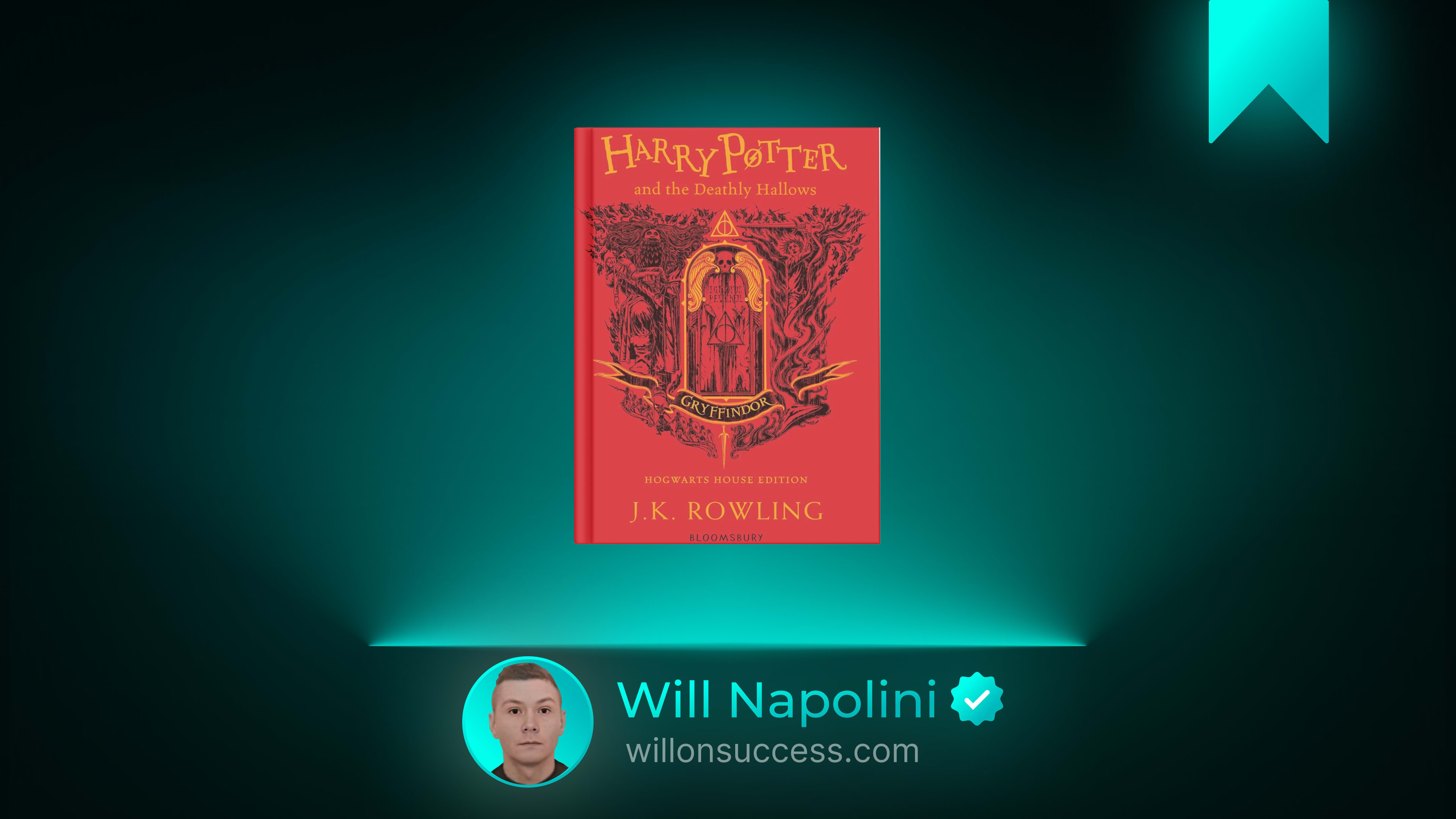
J.K. Rowling’s Harry Potter and the Deathly Hallows is the climax of a sprawling epic, but at its core, it is a profound psychological exploration of the ego, the fear of failure, and the ultimate necessity of surrender.
The central thesis of the book is that true mastery over your life does not come from fragmenting yourself to avoid pain, nor does it come from chasing magical shortcuts to gain control. True mastery comes from the willingness to face your deepest vulnerabilities, dismantle the toxic parts of your own ego, and walk into the unknown with your soul entirely intact. It teaches us that the greatest victories in life are not won by destroying our enemies, but by refusing to become them.
The Story and the Concept
The story begins in total isolation. Harry Potter, now seventeen, has left the safety of his school. His mentor, Albus Dumbledore, is dead. The magical government has fallen to the dark wizard Lord Voldemort. Harry, along with his best friends Ron and Hermione, is on the run, living in a cramped tent in the woods, starving, and hunted.
Their mission is seemingly impossible: they must find and destroy Horcruxes—hidden objects containing fragments of Voldemort’s soul. To make matters worse, one of these objects is a heavy golden locket that they must take turns wearing. The locket is deeply dark; it feeds on their insecurities, amplifies their despair, and turns them against one another.
Midway through their grueling journey, Harry learns of the Deathly Hallows: three legendary magical objects that, when united, make the possessor the “Master of Death.” Harry is torn. Should he pursue the Hallows to gain the ultimate power to defeat Voldemort? Or should he continue the miserable, unglamorous work of destroying the Horcruxes, as Dumbledore instructed?
Ultimately, Harry realizes that to destroy the final piece of Voldemort’s soul, he must sacrifice his own life. He walks alone into the dark forest to face the dark wizard, accepting his death. But because he surrenders willingly, he survives. In the final confrontation, Harry does not use a killing curse to defeat Voldemort. He uses a simple disarming charm, allowing the dark wizard’s own rebounding hatred to destroy him.
The Locket in the Tent: Surviving Your Own Mind in Isolation
When Harry, Ron, and Hermione are hiding in the woods, the physical danger of being hunted is almost secondary to the psychological torture of the golden locket.
Because the locket contains a piece of a dark soul, it actively works to break their spirits. When Ron wears it, it whispers that his mother loves his siblings more than him. When Hermione wears it, it whispers that she is entirely alone and unloved. When Harry wears it, it whispers that he is a failure and a burden to his friends. The locket takes their quiet, normal doubts and turns them into deafening, paralyzing despair.
I have seen this happen to so many brilliant people when they enter a “wilderness” season.
When you are stripped of your usual comforts, your external validation, and your daily routines, the inner critic gets incredibly loud. You start a new business, and suddenly the quiet moments are filled with whispers that you are an imposter. You go through a painful breakup, and the silence in your apartment convinces you that you are fundamentally unlovable.
The locket is the manifestation of our unmanaged shadow self. It is the anxiety, the jealousy, and the shame that we usually distract ourselves from, suddenly amplified by isolation.
The most crucial lesson the trio learns is that you cannot wear the locket all the time. They establish a rule: they must take turns carrying the burden, and when it becomes too heavy, they must take it off and hand it to someone else.
You cannot survive the wilderness if you refuse to share the weight of your own mind. When the inner critic becomes deafening, you must have the humility to take the locket off. You must call a friend, a therapist, or a mentor and say, “I am carrying something heavy today, and I need you to hold it for a while.” Isolation is the fertile soil where fear grows; connection is the sunlight that burns it away.
Hallows vs. Horcruxes: The Shiny Distraction vs. The Ugly Work
Midway through the book, Harry faces a critical strategic dilemma. He can pursue the Deathly Hallows—legendary artifacts that offer immense power, invisibility, and the ability to resurrect the dead. Or, he can continue hunting Horcruxes—ugly, hidden, toxic objects that require immense effort and danger to destroy.
The Hallows represent the ego’s desire for a shortcut. They represent the fantasy that if we just acquire enough power, enough money, or enough status, we will never have to feel vulnerable again. Voldemort is obsessed with the Hallows because he is terrified of his own mortality. He wants to conquer life by force.
The Horcruxes represent the necessary, unglamorous work of shadow work. They are the bad habits, the deep-seated resentments, the addictions, and the toxic traits we have hidden away in the dark corners of our lives.
Harry is deeply tempted by the Hallows. It is so much more exciting to chase a legendary wand than to sit in a muddy tent trying to destroy a cursed cup. But he eventually realizes a profound truth: You cannot build a new life until you have dismantled the toxic foundations of the old one.
We do this in our own lives constantly. We would rather chase the “Hallow” of a new business venture than destroy the “Horcrux” of our chronic procrastination. We would rather chase the “Hallow” of a new romantic relationship than destroy the “Horcrux” of our unresolved childhood trauma. We seek external power to avoid internal healing.
Growth before achievement demands that we prioritize the Horcruxes. The shiny new strategy will not save you if your foundational habits are corrupted. You must be willing to do the ugly, quiet, painful work of destroying the parts of yourself that are keeping you fragmented. Only when the toxic pieces are gone can you become whole.
The Walk into the Forest: The Courage to Surrender the Outcome
The climax of the book is not a massive, explosive battle. It is a quiet, terrifying walk into the dark.
Harry discovers that he himself is an accidental Horcrux. As long as he lives, the dark wizard cannot be defeated. To save the people he loves, Harry must walk into the forest and allow himself to be killed. He does not know he will survive. He does not have a backup plan. He simply accepts that this is what must be done, and he walks into the dark.
This is the ultimate threshold of human maturity: the willingness to surrender the outcome.
We spend our entire lives trying to control the variables. We want a guarantee that if we work hard, we will get the promotion. We want a guarantee that if we love deeply, we will not be betrayed. We want a contract with the universe that says our suffering will be rewarded.
But life does not sign contracts.
Action before intention means doing the right thing simply because it is the right thing, entirely detached from the guarantee of a reward. True courage is not the absence of fear; it is the decision that something else is more important than your fear.
When you are faced with a terrifying transition—leaving a secure but soul-crushing job, ending a comfortable but dead relationship, or speaking a truth that might cost you your reputation—you will want a guarantee. You will want to know how it ends before you take the first step.
You will not get one. You have to walk into the forest anyway. You have to trust your character more than you trust your need for control. When you finally let go of your desperate grip on the outcome, you stop being a hostage to your own anxiety. You become free.
The Disarming Charm: Winning Without Losing Your Soul
When Harry finally faces Voldemort in the courtyard of the school, the dark wizard casts the killing curse—the ultimate spell of destruction and domination.
Harry does not respond with an equally destructive curse. He casts Expelliarmus, the disarming charm. It is the simplest, most defensive spell in his arsenal. He does not try to kill Voldemort; he simply neutralizes the threat. Because of the complex magical laws of loyalty and wand ownership, Voldemort’s own killing curse rebounds and destroys him. Harry wins by remaining entirely himself.
This is a masterclass in conflict, leadership, and personal integrity.
When we are attacked, when we are betrayed, or when we are pushed into a corner, our instinct is to escalate. We want to destroy the person who hurt us. We want to use the killing curse in our arguments, our divorces, and our business disputes. We want to leave the other person in ruins so we can feel safe.
But when you use the weapons of your enemy, you slowly become your enemy. If you compromise your integrity to defeat a competitor, you have lost the very thing you were trying to protect. If you use cruelty to win an argument with your spouse, you have destroyed the marriage to win the point.
Principles before hacks means understanding that how you win matters just as much as whether you win. You do not have to destroy your opponent to neutralize the threat. You can set a firm boundary without being vicious. You can leave a toxic job without burning the bridge to ash. You can stand your ground without losing your soul.
True power is not the ability to inflict damage. True power is the ability to remain grounded, principled, and whole, even when the person across from you has lost their mind.
Why This Matters in Your Life
You might be reading this and thinking, I am not hunting soul fragments, and I am not walking into a magical forest to face a dark lord.
But you have your own wilderness. And you have your own forest.
You are navigating a world that constantly tempts you to fragment yourself. It tempts you to compromise your values for a paycheck, to numb your pain with distractions, and to chase the shiny “Hallows” of status while ignoring the “Horcruxes” of your own unhealed wounds.
If you try to navigate your life by accumulating more control, you will eventually be crushed by the weight of your own anxiety. You will become like Voldemort—so terrified of failure and vulnerability that you fracture your own soul just to survive.
But when you choose the path of wholeness, you change the entire architecture of your reality. You stop running from your fears and start dismantling them. You stop trying to control the uncontrollable and start mastering your own character.
In your career, this makes you a leader who can navigate massive uncertainty without panicking, because your identity is not tied to the quarterly results. In your relationships, it allows you to love deeply without the paralyzing fear of loss, because you know you can survive the wilderness. In your personal growth, it means you finally stop looking for a magical shortcut, and you embrace the quiet, profound power of doing the hard work.
Practical Application
Understanding the philosophy of surrender and wholeness is valuable, but understanding without action changes nothing. If you want to stop fragmenting yourself and start mastering your life, here is how you begin.
Take Off the Locket Identify the specific environments, apps, or relationships that act as a “Horcrux locket” in your life—the things that consistently amplify your anxiety, jealousy, or despair. You do not have to throw them in a volcano today, but you must take them off. Institute a hard boundary: no checking email after 7:00 PM. No scrolling social media in the morning. Give your mind a chance to breathe without the dark whispers of the algorithm.
Identify Your Horcrux What is the one toxic habit, resentment, or fear that you have hidden away and refused to deal with? Is it your tendency to avoid difficult conversations? Is it your secret belief that you are not smart enough? Write it down. Stop chasing new “Hallows” (new productivity apps, new business ideas) until you have made a concrete plan to dismantle this one foundational Horcrux.
Practice the Disarming Charm The next time you are in a heated conflict—whether with a colleague, a partner, or a stranger—consciously choose not to escalate. Do not use the “killing curse” of personal attacks, sarcasm, or bringing up past mistakes. Simply state your boundary clearly, calmly, and firmly. Neutralize the threat without inflicting unnecessary damage. Watch how the dynamic shifts when you refuse to match their chaos.
Walk Into the Forest Identify one area of your life where you are paralyzed by the need for a guarantee. You want to know the business will succeed before you launch. You want to know the relationship will work out before you commit. Accept that the guarantee will never come. Take one small, concrete step forward into the unknown today, entirely as an act of faith in your own resilience.
Who Should Read This Book
Harry Potter and the Deathly Hallows is essential reading for anyone in a season of profound transition, grief, or isolation. It is for the leader carrying a burden they cannot share, the entrepreneur in the messy “wilderness” phase of their startup, and anyone who is tired of chasing shortcuts and is finally ready to do the deep, unglamorous work of healing.
It is a heavy book. It deals intimately with death, grief, and the loss of innocence. If you are looking for a light, escapist adventure, this is not it. But if you need a story that will validate the darkness of your current season, challenge your reliance on control, and remind you that true victory comes from remaining whole, this book will be a lifelong anchor.
One Small Step
Today, I want you to identify one “Hallow” you are chasing to avoid doing the hard work of destroying a “Horcrux.”
Maybe you are obsessively researching a new diet to avoid facing your emotional eating. Maybe you are planning a massive career pivot to avoid having a difficult conversation with your current boss.
Drop the Hallow for the next 24 hours. Stop researching. Stop planning. Turn your attention entirely to the Horcrux. Have the conversation. Face the emotion. Do the ugly work.
You do not need more power to build a meaningful life. You do not need a magical shortcut to find your peace. You just need the courage to stop running, face the dark parts of yourself, and walk forward, whole and unbroken.
True power is not the ability to control the world. It is the courage to walk into the dark, and trust yourself to find the way back.