Kane and Abel: Why Your Greatest Rival Might Be Your Best Teacher
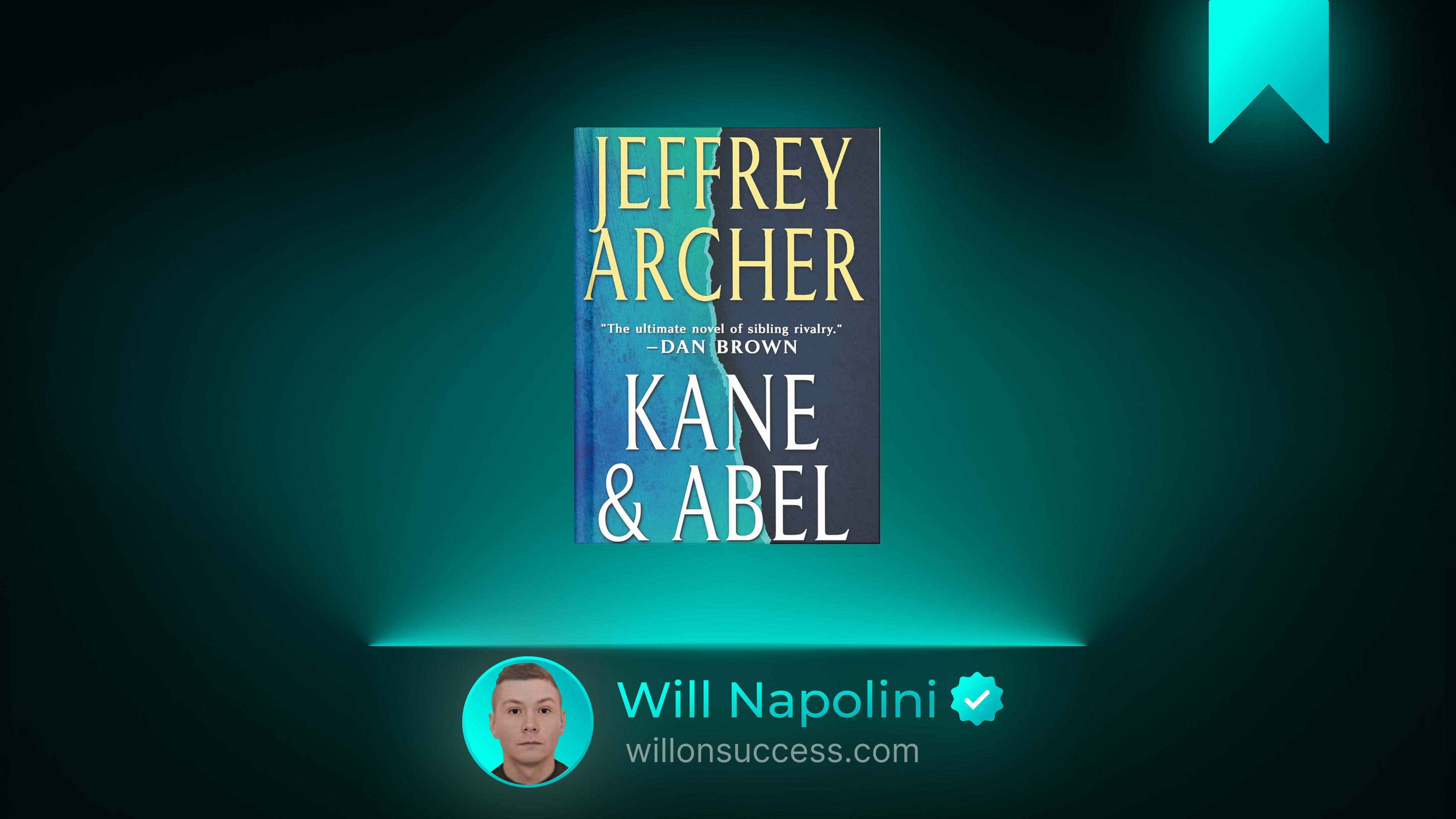
I want to show you an idea that changed the way I think about the people who frustrate me most.
For years, I believed that my obstacles were external. The colleague who got the promotion I wanted, the competitor who undercut my prices, the friend whose life seemed to move in perfect rhythm while mine felt chaotic—I saw them as interruptions to my story. I thought if they would just disappear, my path would clear.
Then I read Kane and Abel.
Jeffrey Archer’s novel is often shelved as historical fiction or a family saga, but beneath the sweeping narrative of two men born on the same day in 1906 lies a profound meditation on personal development. It is not merely a story about wealth, power, or revenge. It is a mirror held up to the architecture of our own ambitions.
What I discovered was this: Your greatest rival is rarely your enemy. They are often the unacknowledged architect of your character.
If you have ever felt consumed by comparison, stalled by resentment, or haunted by the success of someone else, this book has something urgent to tell you. Not because it offers a simple formula for beating your rivals, but because it exposes the dangerous illusion that winning against others is the same as winning at life.
The Big Idea: Ambition Without Character Is a Debt That Always Comes Due
At its heart, Kane and Abel asks a deceptively simple question: What is the true cost of success?
William Kane and Abel Rosnovski are born worlds apart—one into Boston banking aristocracy, the other into Polish poverty and war. Yet they share an identical date of birth, an iron will, and a relentless drive to build. Their lives become intertwined through decades of misunderstanding, missed connections, and a bitter feud that neither fully understands until it is too— title: “Kane and Abel: Why Your Greatest Rival Might Be Your Best Teacher” description: >- Jeffrey Archer’s epic saga reveals that success without character is a hollow victory, and that your deepest rival often holds the key to your own growth. Discover how to transform envy into fuel and ambition into legacy. date: 2026-08-17 00:00:00 +0800 categories: [book-summaries, personal-development] tags: [ jeffrey-archer, kane-and-abel, character-development, ambition, rivalry, resilience, legacy ] image: “IMAGE_URL” alt: “Two men standing on opposite sides of a chasm, looking toward a distant mountain peak, symbolizing rivalry and shared destiny” pin: false fallback: —
I want to show you an idea that changed the way I think about the people who frustrate me most.
For years, I believed that my obstacles were external. The colleague who got the promotion I wanted, the competitor who undercut my prices, the friend whose life seemed to move in perfect rhythm while mine felt chaotic—I saw them as interruptions to my story. I thought if they would just disappear, my path would clear.
Then I read Kane and Abel.
Jeffrey Archer’s novel is often shelved as historical fiction or a family saga, but beneath the sweeping narrative of two men born on the same day in 1906 lies a profound meditation on personal development. It is not merely a story about wealth, power, or revenge. It is a mirror held up to the architecture of our own ambitions.
What I discovered was this: Your greatest rival is rarely your enemy. They are often the unacknowledged architect of your character.
If you have ever felt consumed by comparison, stalled by resentment, or haunted by the success of someone else, this book has something urgent to tell you. Not because it offers a simple formula for beating your rivals, but because it exposes the dangerous illusion that winning against others is the same as winning at life.
The Big Idea: Ambition Without Character Is a Debt That Always Comes Due
At its heart, Kane and Abel asks a deceptively simple question: What is the true cost of success?
William Kane and Abel Rosnovski are born worlds apart—one into Boston banking aristocracy, the other into Polish poverty and war. Yet they share an identical date of birth, an iron will, and a relentless drive to build. Their lives become intertwined through decades of misunderstanding, missed connections, and a bitter feud that neither fully understands until it is too late.
The central thesis Archer explores is not that ambition is wrong, but that ambition untethered from integrity, empathy, and self-awareness becomes a destructive force. Both men achieve extraordinary external success. Both also pay devastating internal prices. Their rivalry drives them to greatness, but it also blinds them to what matters most.
This is the idea I want you to sit with: Achievement is not the destination. It is the test. And the test is not whether you can outbuild, outearn, or outlast your rival. The test is whether you can remain whole while doing it.
In my own mentoring work, I have watched talented people chase victories that left them empty. They won the argument but lost the relationship. They secured the deal but sacrificed their health. They built the empire but forgot why they started. Archer’s novel warns us that when we define ourselves solely in opposition to another person, we hand them the pen that writes our story.
You may be working hard and still wondering why nothing feels fulfilling. The answer might not be that you need more success. It might be that you need a different definition of it.
The Story That Reveals the Pattern
Let me walk you through the mechanism of this lesson without spoiling the emotional journey of the novel.
William Kane grows up with every advantage: name, education, capital. His discipline is forged in expectation. He believes in systems, rules, and the inherent order of institutions. Abel Rosnovski survives orphanages, imprisonment, and displacement before arriving in America with nothing but his mind and his hunger. His discipline is forged in survival. He trusts no system because every system has failed him.
Their paths cross repeatedly, yet they never truly see each other. Each interprets the other’s actions through the lens of his own wounds. Kane sees Abel as reckless and untrustworthy. Abel sees Kane as arrogant and cruel. Neither recognizes that they are, in many ways, the same man shaped by different circumstances.
The tragedy is not their conflict. The tragedy is their failure to recognize themselves in the other.
I have seen this pattern play out in countless lives. Two entrepreneurs in the same industry, convinced the other is unethical, when in reality they are both driven by the same fear of irrelevance. Two siblings competing for parental approval, unaware that they are both seeking validation they can only give themselves. Two colleagues vying for recognition, blind to the fact that their combined strengths could transform their organization.
Archer uses the device of parallel lives to show us that rivalry is often projection. We fight in others what we have not resolved in ourselves.
When you understand this, your rival stops being a villain and starts being a teacher. They reveal where you are rigid. They expose where you are insecure. They show you the parts of yourself you have disowned or denied.
This does not mean you must like them. It means you must learn from them.
Your Rival Reveals Your Hidden Curriculum
The first principle Kane and Abel teaches is that your strongest emotions toward a rival are data, not destiny.
Envy, resentment, and frustration are uncomfortable teachers, but they are precise ones. When you feel a sharp pang watching someone else’s success, that feeling is pointing to an unmet need or an undeveloped capacity within you. Perhaps you envy their confidence because you have not yet earned trust in your own voice. Perhaps you resent their freedom because you have not set boundaries that protect your own. Perhaps you are angry at their recognition because you have not clarified what recognition actually means to you.
Kane and Abel spend decades reacting to each other instead of reflecting on what those reactions reveal. You do not have to repeat their mistake.
Here is what I would tell you if we were sitting across a table right now: The next time you feel triggered by someone else’s achievement, pause before you judge. Ask yourself, “What is this feeling trying to teach me?” Write down the answer without filtering it. Do not shame yourself for the emotion. Emotions are messengers, not indictments.
Your rival is holding up a mirror. You can choose to smash it, or you can choose to look.
Success Built on Resentment Has a Ceiling
The second principle is that motivation rooted in opposition eventually exhausts itself.
Both Kane and Abel are extraordinarily capable. But their capabilities are constrained by the narrowness of their focus. Because they define their success in relation to the other, they cannot imagine possibilities beyond the binary of winning and losing. Opportunities for collaboration, reconciliation, and mutual elevation pass unnoticed because their vision is fixed on the scoreboard.
I have worked with professionals who spent years proving someone wrong, only to discover that the proof brought no peace. They had achieved the goal but lost the purpose. The energy required to sustain resentment is borrowed from the very reserves needed for creation.
Consistency before intensity applies here. A small, steady commitment to your own values outperforms dramatic bursts of competitive fury. Intensity fueled by anger burns hot and fast. Consistency fueled by conviction builds foundations that last.
Ask yourself honestly: Is your current motivation sustainable for the next decade? If your rival disappeared tomorrow, would you still want what you are chasing? If the answer is uncertain, it is time to reconnect with a deeper source of direction.
Character before circumstances means building your identity on principles that do not depend on anyone else’s behavior. When your worth is anchored internally, external comparisons lose their gravitational pull. You can admire others without diminishing yourself. You can compete fairly without losing your soul.
Legacy Is Measured in Relationships, Not Records
The third and perhaps most important principle is that what endures is not what you accumulated, but what you nurtured.
Without revealing the novel’s conclusion, I can say that Archer makes clear that the true measure of Kane and Abel’s lives is not found in bank ledgers or hotel empires. It is found in the quality of their loves, the depth of their regrets, and the impact they had on the people who knew them beyond their public personas.
Growth before achievement means recognizing that the person you become in the pursuit matters more than the prize itself. You can reach the summit and find it barren if you climbed alone. You can fall short of your original goal and discover that the climb itself transformed you into someone capable of a different, richer kind of success.
In my own life, the achievements I am most proud of are not the ones that garnered applause. They are the moments when I chose patience over pride, honesty over convenience, and connection over competition. Those choices did not make headlines. They made a life.
Your legacy is being written in real time, in the texture of your daily interactions. Every conversation is a brick. Every act of integrity is mortar. Every moment of genuine attention is a window through which light enters.
Do not wait until you have “arrived” to begin building what lasts. Begin now, in the ordinary Tuesday of your current reality.
Why This Matters on an Ordinary Tuesday
You might be thinking that this is grand philosophy for fictional tycoons, not practical wisdom for your actual life. But the dynamics Archer explores are playing out in your world right now, at human scale.
Consider the coworker whose communication style grates on you. Before you label them difficult, ask what their style reveals about your own assumptions regarding respect and efficiency. Consider the friend whose parenting choices trigger judgment in you. Before you distance yourself, ask what insecurity their choices are touching in your own sense of adequacy. Consider the competitor in your field whose visibility irritates you. Before you dismiss their work, ask what unexpressed desire for recognition their presence is awakening in you.
These are not distractions from your development. They are the curriculum.
When you shift from seeing rivals as obstacles to seeing them as mirrors, several things change. Your emotional reactivity decreases. Your strategic clarity increases. Your relationships deepen. Your sense of agency expands, because you are no longer waiting for someone else to change before you can move forward.
You stop outsourcing your peace to circumstances you cannot control.
Practical Application: Turn Insight Into Action
Understanding these principles is valuable. Living them requires practice. Here are three concrete steps you can take immediately.
Conduct a Rival Audit. Choose one person who currently triggers strong competitive or resentful feelings in you. Set a timer for twenty minutes and write freely in response to these prompts: What specific quality in this person provokes my reaction? Where does that quality exist in shadow form within myself? If I were to thank this person for what they have taught me, what would I say? Do not send the letter. The exercise is for you. Burn it afterward if you wish. The value is in the excavation, not the communication.
Define Success Independent of Comparison. Take thirty minutes this week to articulate your own metrics for a meaningful life. Write them down. Make them specific and observable. Instead of “be successful,” write “maintain weekly rituals of connection with three people I love.” Instead of “be respected,” write “speak truthfully even when it costs me.” Post these metrics somewhere visible. Refer to them before making decisions. Let them, not your rival’s trajectory, guide your next step.
Practice Generous Attention. For the next seven days, choose one interaction daily where you deliberately offer full, non-judgmental attention to someone you typically categorize as competition or opposition. Listen to understand, not to respond. Notice what arises in you during this practice. Discomfort is expected. Stay with it. Generosity toward those who challenge you is not weakness. It is strength training for your character.
These practices are small. They require no special resources. They demand only your willingness to turn toward difficulty rather than away from it.
Start small. Stay consistent. Let time do its work.
Who Should Read This Book
Kane and Abel will resonate deeply if you are ambitious but uneasy, successful but unfulfilled, or locked in a dynamic of comparison that drains more than it drives. It is essential reading for entrepreneurs, leaders, and anyone navigating complex family or professional rivalries. Readers who appreciate character-driven narratives with moral weight will find it richly rewarding.
It may be less useful if you are seeking tactical business advice or lightweight entertainment. The novel demands emotional engagement and patience with its sprawling scope. Some readers may find the mid-century social attitudes dated, though the core human dynamics remain strikingly relevant.
Despite its length and occasional melodrama, the book earns its place on any serious personal-development shelf because it treats ambition with the complexity it deserves. It refuses easy answers. It honors both the nobility and the peril of striving. In a culture obsessed with optimization and hacks, it reminds us that the deepest work is always interior.
One Small Step Today
Before you close this article, do one thing.
Identify the person who currently occupies the most mental real estate in your competitive imagination. Then, write one sentence completing this phrase: “What I am really longing for, beneath this rivalry, is __.”
Do not overthink it. Trust the first honest answer that surfaces.
That sentence is your compass. Everything else is noise.
Your rival is showing you where you still need to grow. Thank them silently, then turn your attention inward.
The person you are becoming is worth more than any victory you could win against them.