Stop Chasing, Start Attracting: What Dan Kennedy’s Magnetic Marketing Teaches About Building a Business That Chooses You Back
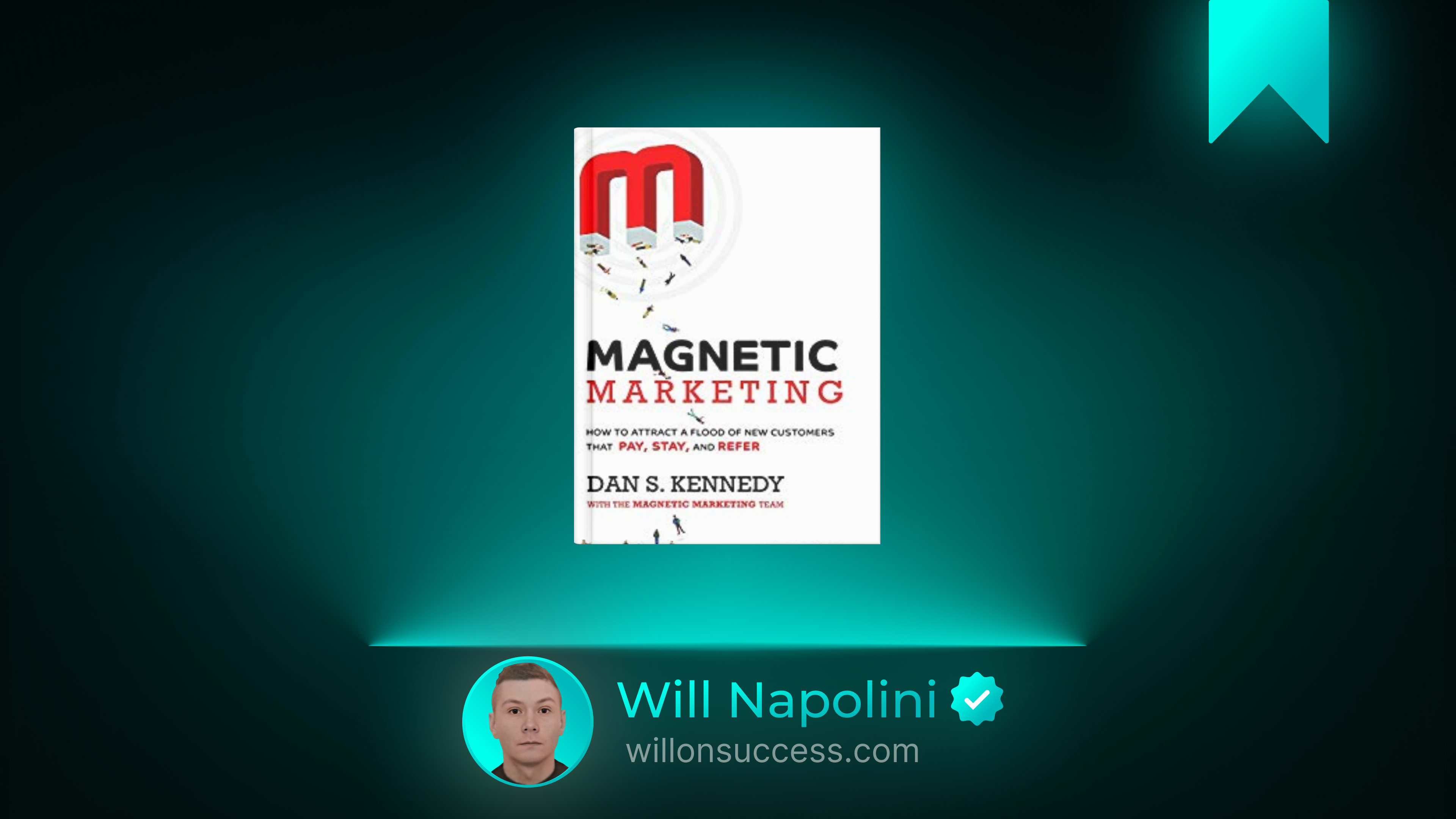
There is a specific kind of exhaustion that only entrepreneurs, freelancers, and creators know. It is the fatigue of the chase.
You have likely felt it. You spend money on an ad, post relentlessly on social media, or attend networking events, hoping that if you just put yourself out there enough times, the right people will finally notice you. You operate on a model of perpetual pursuit, convincing yourself that if you just hustle a little harder, the phone will ring. But when the phone stays quiet, or worse, when it rings with people who want to underpay you and micromanage you, the exhaustion turns into quiet despair. You begin to wonder if you are simply not cut out for this.
If you have ever felt like you are begging the market to pay attention to you, I want to offer you a different way to look at your work. The problem is not your work ethic. The problem is not your talent. The problem is that you are trying to catch the wind with a net, when you should be building a sail.
Dan Kennedy’s Magnetic Marketing is not a book about working harder. It is a foundational text on how to stop chasing and start attracting. Kennedy, a legendary direct-response copywriter and business strategist, wrote this book to dismantle the expensive, ego-driven myths of “Mad Men” style corporate advertising and replace them with a rigorous, measurable, and deeply respectful system for small business owners.
The central idea of the book is both liberating and demanding: True marketing is not about convincing the masses to like your brand. It is about creating a highly specific, measurable system that acts as a magnet—powerfully attracting the exact people who desperately need what you do, while actively and intentionally repelling those who do not.
This matters because how you market your work dictates the quality of your daily life. If your marketing is desperate, you attract desperate clients. If your marketing is clear, authoritative, and boundaried, you attract clients who respect your time, pay your fees, and value your expertise. You do not just build a better business; you build a better life.
The Architecture of Alignment: The Triangle
Before you can attract anyone, you must understand the mechanics of alignment. Kennedy structures his entire philosophy around a simple, unforgiving framework he calls the “Message-Market-Media” triangle.
Most business failures in marketing happen because the owner only focuses on one point of this triangle, ignoring the other two.
- The Market: Who exactly are you trying to reach? Not “everyone.” Not “small businesses.” But the specific, hyper-defined avatar of the person who has the exact problem you solve and the exact resources to pay for it.
- The Message: What are you saying to them? This is not your company slogan. This is the specific promise, the unique mechanism, and the empathetic articulation of their pain that proves you understand them better than they understand themselves.
- The Media: Where are you delivering this message? This is the channel—the direct mail piece, the specific podcast, the targeted email list, the local seminar.
The mechanism is simple: If your Message is brilliant, but you deliver it through the wrong Media to the wrong Market, you will fail. If you have the right Market and the right Media, but your Message is generic and boring, you will fail.
I have watched incredibly talented people burn through their savings because they had a great product (Message) and bought expensive billboard space (Media), but the people driving past that billboard (Market) had no use for their product.
You cannot compensate for a misaligned triangle with more effort. When the three points align, marketing stops feeling like a battle and starts feeling like a conversation that was already meant to happen.
The Courage to Repel: Why “Everyone” Is the Wrong Target
Here is a principle that requires genuine character to implement: A magnet does not attract everything. A magnet has two poles. It attracts what is aligned with its polarity, and it violently repels what is not.
Most people in business are terrified of repelling anyone. They water down their message. They lower their prices. They avoid stating their strong opinions because they want to be universally liked. They believe that casting the widest possible net will yield the most fish.
Kennedy argues the exact opposite. The most profitable, peaceful, and sustainable businesses are highly polarizing. They are designed to be absolutely irresistible to a very specific type of person, and completely unappealing to everyone else.
When you clearly state your high prices, your strict boundaries, and your specific philosophy, you will scare away the bargain-hunters, the time-wasters, and the complainers. This is not a failure of marketing. This is the system working perfectly.
Every time you repel a bad fit, you are clearing space for a good fit to find you.
I have mentored people who were drowning in difficult clients, only to realize that their marketing was accidentally designed to attract them. By using language that emphasized “cheap,” “fast,” and “we do anything,” they were signaling to the market that they were a commodity. When they changed their language to emphasize “premium,” “thorough,” and “our specific methodology,” the difficult clients stopped calling. The revenue didn’t drop; the peace of mind skyrocketed.
You must have the courage to be misunderstood by the many so you can be deeply valued by the few.
The End of “Hope” Marketing: The Dignity of Direct Response
One of the most profound shifts Kennedy demands is the move from “Institutional Advertising” to “Direct Response Marketing.”
Institutional advertising is what giant corporations do. Coca-Cola puts up a billboard that just says “Enjoy” with a picture of a bottle. They are not asking you to do anything right now; they are just trying to keep their brand in your mind. They have billions of dollars to burn on “brand awareness.”
Small business owners often copy this style because it looks professional. They run ads with their logo, a clever slogan, and their phone number, and then they sit by the phone and hope it rings. Kennedy calls this “hope marketing,” and he considers it a slow form of financial suicide.
Direct response marketing, on the other hand, demands a specific, measurable action right now. It asks the prospect to request a free report, call a specific tracking number, or download a guide. And here is the non-negotiable rule: Every single dollar spent must be tracked to a specific result.
If you spend $100 on an ad, you must know exactly how many leads it generated, how many of those leads became clients, and how much revenue those clients produced. If you cannot measure it, you are not marketing; you are donating money to a media company.
This is not just a business principle; it is a principle of personal accountability. It removes the ego from your work. You stop arguing with the market about how clever your ad was, and you start listening to the market about what actually works. It forces you to face reality, adjust your approach, and iterate until you build a machine that reliably produces results.
Educational Marketing: Giving Away the “What” to Sell the “How”
How do you convince a stranger to trust you with their money? Most people try to do it by talking about themselves. They list their degrees, their years in business, and their awards.
Kennedy suggests a radically different approach: Educational Marketing.
Instead of telling people how great you are, you demonstrate your expertise by teaching them. You give away your best advice for free. You write detailed guides on how to solve the exact problems your clients face. You explain the “what” and the “why” with total transparency.
When a prospect reads a twenty-page guide you wrote on “The 7 Mistakes Homeowners Make When Replacing a Roof,” and they realize you have just saved them from a catastrophic error, you are no longer a salesperson. You are an authority. You have provided value before asking for a dime.
By the time they call you, the sale is largely made. They are not calling to interrogate you; they are calling to hire the expert who just helped them.
People do not buy from people they trust; they trust people who have proven they understand the problem.
I have seen this principle transform careers. When you shift your posture from “Please buy from me” to “Let me show you how this works, and then you can decide if you want me to do it for you,” you reclaim all your power. You stop chasing and start inviting.
Why This Matters on an Ordinary Tuesday
It is easy to read about marketing funnels and tracking metrics and think this is only relevant to the “business” side of your life. But the architecture of Magnetic Marketing is actually an architecture for personal dignity.
Think about what an ordinary Tuesday looks like when your marketing is broken. You wake up anxious. You check your inbox, hoping for a lead. You take a call with a prospect who haggles over your rate, and because you are desperate for the cash flow, you accept the lower price. You spend the next three weeks doing work you resent, for a client who doesn’t respect you, while your own important projects gather dust.
Now think about what Tuesday looks like when your system is magnetic. You wake up and check your dashboard. Overnight, your educational lead magnet attracted five highly qualified prospects. You spend the morning having conversations with people who already understand your value and respect your process. You choose the one client who is the perfect fit. You spend the afternoon doing deep, meaningful work.
The difference between those two Tuesdays is not luck. It is not the economy. It is the system you built.
Marketing is simply the bridge between your gift and the people who need it. If the bridge is broken, your gift remains isolated, and the people who need it remain suffering. Building a magnetic marketing system is an act of service. It is how you ensure that your life’s work actually reaches the hands it was meant for.
Who Should Read This Book
Magnetic Marketing is dense, tactical, and unapologetically direct. Dan Kennedy’s writing style is blunt, opinionated, and entirely devoid of corporate fluff. He does not coddle the reader.
This book will fundamentally change your trajectory if you:
- Are a small business owner, freelancer, consultant, or entrepreneur who is tired of the feast-or-famine revenue cycle.
- Feel like you are working incredibly hard but are constantly underpaid and undervalued by your clients.
- Are willing to take radical responsibility for your lead generation and stop blaming the algorithm or the economy.
- Want to transition from competing on price to competing on authority and unique value.
You may find this book less useful if you:
- Are a brand manager for a massive Fortune 500 company with a billion-dollar ad budget (Kennedy’s principles are specifically designed for businesses that need a measurable return on every dollar spent).
- Are looking for “get-rich-quick” internet hacks or social media vanity metrics (Kennedy focuses on timeless, fundamental business psychology and direct mail/copywriting principles).
- Are easily offended by a blunt, no-nonsense tone that prioritizes results over politeness.
Practical Application: Building Your Magnet
Understanding the philosophy of attraction is valuable, but understanding without action changes nothing. Here is how you can begin integrating Kennedy’s principles into your work today.
1. Define Your “Anti-Avatar” Take out a piece of paper and write down the exact characteristics of the client you absolutely do not want to work with. What are their behaviors? What are their expectations? What language do they use? Once you have this list, review your current website, social media, and proposals. Are you accidentally using language that appeals to this person? Rewrite your materials to explicitly state your boundaries and filter these people out.
2. Create a “Lead Magnet” of High Utility Stop asking people to “Contact Us for a Quote.” Create a piece of highly valuable, educational information that solves a specific, narrow problem for your ideal client. It could be a checklist, a short video training, or a diagnostic tool. Give it away for free in exchange for their email address. This shifts you from a peddler to a teacher.
3. Implement the “Next Step” Rule Look at every piece of marketing you currently have in the world—your website, your business card, your email signature. Does it have a clear, specific, measurable next step? If it just says “Visit our website,” change it. Make it “Download our free guide to X,” or “Call this number to schedule a 15-minute diagnostic audit.” Give the market a specific track to run on.
One Small Step You Can Take Today
You do not need to rewrite your entire sales funnel by sunset. You only need to prove to yourself that you are willing to stand for something specific.
Today, write your “Positioning Statement” using this exact formula:
“I help [Specific Avatar] achieve [Specific Desired Result] through [Your Unique Mechanism/Method], without [The Thing They Hate Doing].”
Do not use jargon. Do not use buzzwords. Be painfully specific.
For example: “I help independent dental practices add $20,000 in monthly recurring revenue through our proprietary patient-reactivation email system, without requiring the dentist to make a single cold call.”
Once you have written it, read it aloud. Notice how it feels to claim a specific space in the world. Notice how it naturally repels the people who aren’t dentists, and powerfully attracts the ones who are.
You do not need the whole world to applaud you. You only need the right people to recognize you. And they cannot recognize you until you are willing to stand still, plant your flag, and clearly state exactly who you are and who you serve.
A magnet does not chase the iron. It simply holds its charge, and lets the physics of alignment do the rest.