The Courage to Burn: What Irving Stone’s Lust for Life Teaches About Devotion, Rejection, and the Cost of a Meaningful Life
I want to ask you a question that usually only surfaces when you are lying awake at two in the morning, wondering if you are wasting your life.
What if the measure of a successful life has absolutely nothing to do with recognition, comfort, or the applause of your peers? What if you are doing the exact right thing, but the world is entirely blind to it?
You may be working on a project that no one seems to understand. You may be building a business, raising a child, or mastering a craft in quiet obscurity, while watching people with half your talent and twice your luck get celebrated on public stages. It is easy, in those moments, to feel a creeping suspicion that you have chosen the wrong path. That if you were truly meant to do this, the doors would be open, the money would be flowing, and the validation would be loud.
If you have ever felt the quiet agony of being unrecognized, I want to introduce you to a man who lived that agony every single day of his adult life.
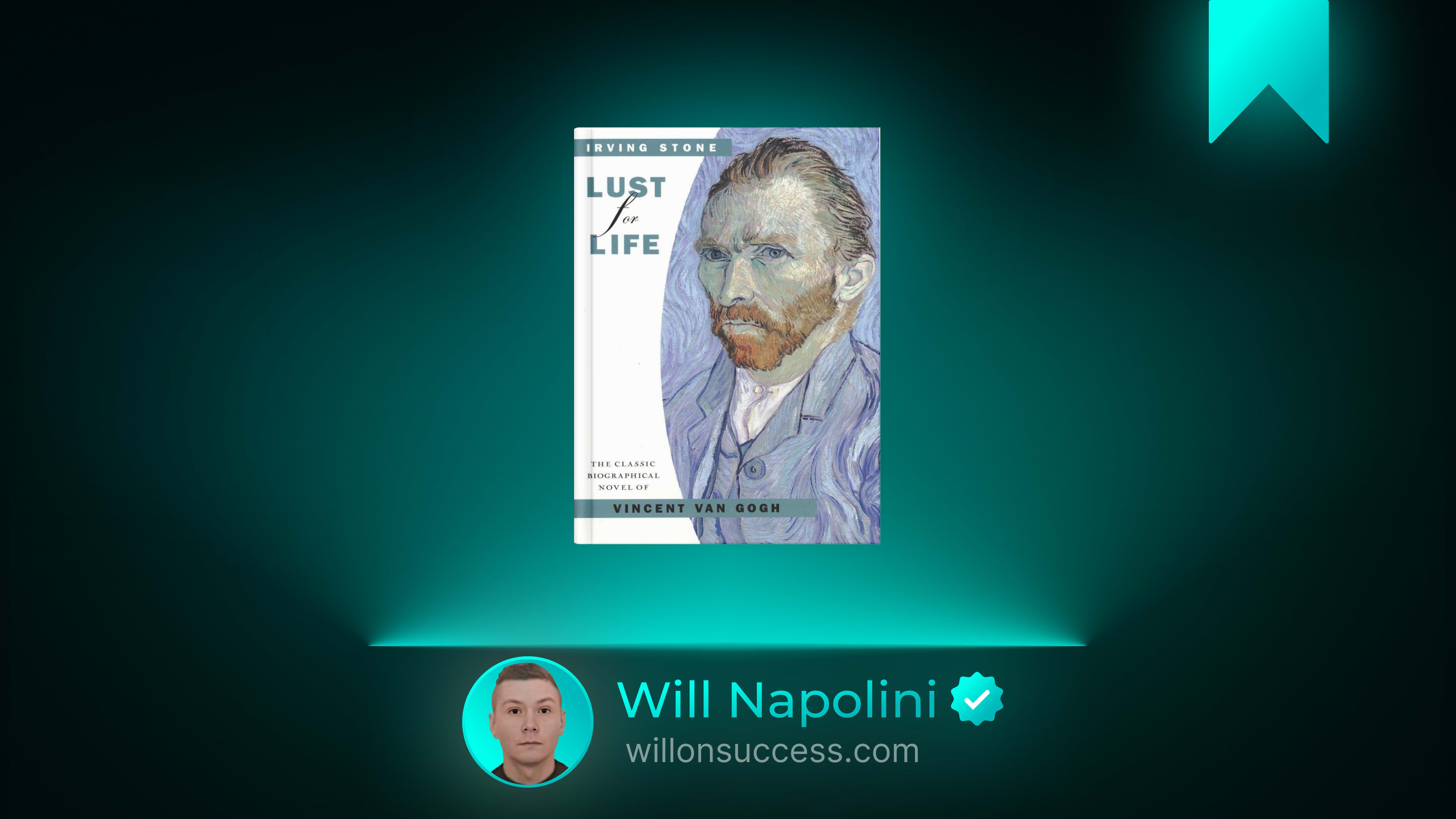
Irving Stone’s Lust for Life is a biographical novel about Vincent van Gogh. When we think of Van Gogh today, we think of genius, of swirling starry nights, of sunflowers that command hundreds of millions of dollars at auction. But the man Irving Stone spent years researching and writing about was not a celebrated master. He was a man who sold exactly one painting in his entire lifetime. He was considered a failure, a madman, a burden to his family, and an embarrassment to the art establishment.
Yet, he painted. He painted with a ferocity, a tenderness, and a desperate joy that defies human comprehension.
The central idea of Lust for Life is that a meaningful existence is not built on the foundation of external validation. It is built on an unbreakable, almost irrational fidelity to the fire inside you. A true “lust for life” is not the pursuit of pleasure, comfort, or ease. It is the willingness to be entirely consumed by your purpose, even when it costs you everything, and even when the world refuses to look.
This matters because we live in an era that confuses metrics with meaning. We have been taught that if a thing is good, it will be liked, shared, and rewarded. Stone’s masterpiece shatters that illusion and replaces it with a much harder, much more beautiful truth: The work itself is the reward. The act of becoming the person capable of doing the work is the entire point.
The Boy Who Failed at Everything Else
To understand the magnitude of Vincent’s devotion, you have to understand how thoroughly he failed before he found his medium.
Vincent did not begin as a painter. In his late teens and twenties, he was a serial failure. He tried to be an art dealer and was fired for arguing with customers about the artistic merit of the paintings they wanted to buy. He tried to be a teacher and was dismissed. He tried to work in a bookstore. He tried to be a preacher, going to the Borinage—a bleak, impoverished coal-mining region in Belgium—to minister to the poor.
It was in the Borinage that the turning point occurred. Vincent lived in a dirt-floored hut. He gave away his clothes and his money to the miners. He preached to them, but he began to realize that words were insufficient. He saw the profound, crushing dignity of these men who emerged from the earth covered in black dust, and he felt an agonizing need to capture their reality.
One day, he picked up a piece of charcoal and began to draw an old miner.
I have sat with so many people who are paralyzed by the fear that they haven’t “found their calling” yet. They look at their past failures—the dropped college major, the abandoned startup, the career pivot that didn’t work out—as evidence of their own defectiveness.
What I discovered in studying Vincent’s early life is that his failures were not detours; they were the necessary compost. His time as an art dealer gave him an encyclopedic knowledge of color and composition. His time as a preacher gave him a profound, aching empathy for the working class. His failures stripped away his ego and left him with nothing but a raw, unfiltered love for humanity.
You have not wasted your time. Every abandoned path was simply teaching you how to see the world, so that when you finally found your charcoal, you would know exactly what to draw.
The Architecture of Mastery: The Hundred Bad Hands
There is a myth that genius is a lightning strike. We imagine Vincent standing before a canvas in Arles, possessed by the muses, effortlessly slashing yellow and blue paint into a masterpiece.
Stone’s novel dismantles this myth with brutal, inspiring clarity. Vincent’s genius was not a gift; it was a conquest.
When Vincent decided to become an artist, he realized his technical skills were abysmal. So, he subjected himself to a grueling, monastic regimen of practice. He drew hands. Hundreds of hands. He drew hands holding shovels, hands holding babies, hands clutching bread. He drew the same weaver at his loom dozens of times, trying to capture the exact geometry of the machine and the posture of the man. He walked for miles in the freezing Dutch wind with a heavy wooden perspective frame on his back, just to understand how a plowed field receded into the horizon.
He did not wait for inspiration. He worked with the desperate consistency of a man trying to build a house before winter.
This is the principle of consistency before intensity. Vincent understood that you cannot paint the soul of a peasant if you do not know how to draw the callous on his thumb. He was willing to be terrible, to be slow, and to be exhausted, because he knew that mastery is simply the result of refusing to stop doing the boring, repetitive work of the beginner.
If you are frustrated by your current lack of progress, ask yourself: Are you waiting for the lightning strike, or are you drawing the hands? Are you willing to do the unglamorous, repetitive, frustrating work that no one will ever see, simply to build the foundation for the thing you want to create?
The Courage to Be Misunderstood
When Vincent finally moved to Paris and was exposed to the bright colors of the Impressionists, his palette exploded. He moved south to Arles, and his work became the swirling, vibrant, emotionally charged art we recognize today.
And the art world completely ignored him.
The Parisian dealers found his work too rough, too thick, too unrefined. His fellow artists, even those he considered friends like Paul Gauguin, often mocked his techniques or found his intensity exhausting. Vincent was painting the future, but he was forced to live in the present.
This is perhaps the most difficult lesson in the book. If you require the world’s permission to do your work, you will never do your work.
Vincent survived this crushing rejection because he fundamentally redefined his audience. He did not paint for the Parisian critics. He did not paint for the wealthy bourgeoisie. He painted for the people who would come after him. He painted to leave a record of what it felt like to be alive, to feel the heat of the southern sun, to see the tragic beauty of a pair of worn leather shoes.
Validation is a sugar rush; purpose is a slow-burning coal. When you tie your self-worth to the immediate reaction of your peers, you become a hostage to their limited imaginations. When you tie your self-worth to the integrity of the work itself, you become untouchable.
You must ask yourself: Am I creating this life, this business, this art, to be understood by the people around me right now? Or am I building it because it is true, even if it takes the world fifty years to catch up to my vision?
The Anchor of a Single True Connection
It is impossible to read Lust for Life without being profoundly moved by the relationship between Vincent and his younger brother, Theo.
Theo was an art dealer in Paris. He was grounded, practical, and deeply loving. For most of Vincent’s adult life, Theo sent him money, bought his paints, paid for his rent, and offered the only emotional anchor Vincent had in a world that constantly rejected him. Theo believed in Vincent’s genius when Vincent himself was drowning in doubt.
But this relationship was not a one-way street. Vincent’s letters to Theo (which Stone drew upon heavily for the novel) reveal a man of staggering intellect, deep philosophical insight, and profound gratitude. Vincent gave Theo a window into a world of beauty and passion that Theo, trapped in the commercial art trade, could only experience vicariously.
We often think we need a massive network, a crowd of supporters, or a viral following to succeed. Lust for Life teaches us that you do not need a crowd. You need one person. You need one person who sees your fire and is willing to help you tend it, who will hand you a piece of coal when you are freezing and tell you to keep going.
And just as importantly, you must be willing to be that person for someone else. Look around your life. Who is working in obscurity? Who has a vision that the rest of the world is too short-sighted to see? Be their Theo. Buy their coffee. Read their drafts. Tell them you believe in them. You cannot measure the power of being the single point of light in someone else’s darkness.
The Kiln of Suffering: A Crucial Distinction
I must pause here to address a dangerous myth that often surrounds Vincent van Gogh, and to clarify how Irving Stone handles it.
There is a romanticized idea of the “tortured artist”—the notion that mental illness, poverty, and suffering are the necessary ingredients for great art. Lust for Life explicitly rejects this.
Stone portrays Vincent’s mental breakdowns, his time in the asylum at Saint-Rémy, and his agonizing depressions not as the source of his genius, but as the thieves of his time. When Vincent was ill, he could not paint. The madness was a terrifying darkness that he fought against with every ounce of his will.
His genius did not come from his madness. It came from his profound, aching love for the world. It came from his ability to look at a gnarled olive tree or a starry night and feel such an overwhelming surge of connection that he had to put it on canvas before it broke his heart. His suffering stripped away his trivial concerns, but it was his lust for life—his desperate, clawing need to connect with the beauty of the earth—that produced the work.
Do not romanticize your own pain. Do not believe that you must be miserable to be meaningful. Your suffering may be the soil you are currently planted in, but it is not the water. The water is your curiosity, your empathy, and your relentless drive to create something good out of the raw material of your days.
Why This Matters on an Ordinary Tuesday
You are probably not a painter in 19th-century France. But the architecture of Vincent’s life applies directly to the architecture of yours.
Every time you choose to do the right thing when no one is watching, you are painting in the dark. Every time you choose to be kind to a difficult colleague, every time you sit down to write the code, the book, or the business plan when you are exhausted and unsure, you are participating in the same devotion.
The world will try to convince you that if you aren’t being rewarded, you should stop. It will tell you to pivot to something easier, something more lucrative, something more “liked.”
Lust for Life is a monument to the people who refuse to stop. It is a reminder that the most important things you will ever build will likely be misunderstood at first. The seeds you are planting today in the cold, hard dirt of your current circumstances are preparing to break ground in a season you cannot yet see.
Who Should Read This Book
Lust for Life is a sweeping, deeply emotional, and beautifully written biographical novel. It reads like a thriller, even though you likely know how the story ends.
This book will profoundly impact you if you:
- Are a creative, entrepreneur, or builder working in obscurity, needing proof that the work itself is the victory.
- Feel “behind” in life and need to see how a master spent his twenties failing at everything before finding his medium.
- Struggle with the need for external validation and want to build a more internal, resilient sense of purpose.
- Appreciate deep, character-driven historical narratives that explore the intersection of psychology, art, and human connection.
A gentle word of caution: The book deals heavily with Vincent’s severe mental health crises, his time in psychiatric asylums, and ultimately, his death by suicide. If you are currently in a fragile mental state, or if you are highly triggered by depictions of severe psychological anguish and self-harm, you should approach this book with care, or perhaps choose a different text for this season of your life. The book does not glorify his death; it mourns it as a tragic loss. But the weight of it is real.
Practical Application: Building Your Devotion
Understanding Vincent’s passion is inspiring, but inspiration without action is just entertainment. Here is how you can translate his “lust for life” into your daily reality.
1. The “Hundred Hands” Protocol Identify one skill in your life that you have abandoned because you weren’t immediately good at it. (Public speaking, coding, painting, writing, playing an instrument). Commit to doing it badly, on purpose, one hundred times. Remove the pressure of the “masterpiece.” Your only goal is to draw the hands. Track your repetitions, not your results.
2. The Audience Shift The next time you create something—a proposal, a piece of art, a meal, a garden—pause before you show it to anyone. Ask yourself: If no one else ever saw this, would I still be proud that I made it? If the answer is no, you are working for applause. Re-anchor your effort in your own standard of truth and beauty.
3. The Theo Audit Look at the three people closest to you. Are you acting as a Theo for any of them? Are you actively encouraging their obscure passions? Send a message today to someone who is working hard in the shadows. Tell them you see their effort, you believe in their vision, and you are in their corner.
One Small Step You Can Take Today
You do not need to move to the south of France or cut off your ear to prove your devotion. You only need to prove to yourself that your fire is still burning, independent of the world’s applause.
Today, carve out thirty minutes to do the thing you love, with the strict vow that you will never show it to anyone.
Write the poem and burn it. Paint the canvas and paint over it. Build the prototype and take it apart. Sing the song in your car with the windows rolled up.
Do it purely for the sensation of doing it. Reclaim the joy of the act from the anxiety of the outcome. Remind your nervous system that the work belongs to you first, and the world second.
We spend so much of our lives waiting for the gallery to open, for the critics to nod, for the crowd to finally understand what we have been trying to say. But the gallery is a distraction. The studio is where you live.
A life is not measured by the applause it eventually receives, but by the fire it refuses to let die while the room is still empty.