The Vow That Saves You: What Kamal Ravikant’s Love Yourself Like Your Life Depends On It Teaches About Radical Self-Compassion
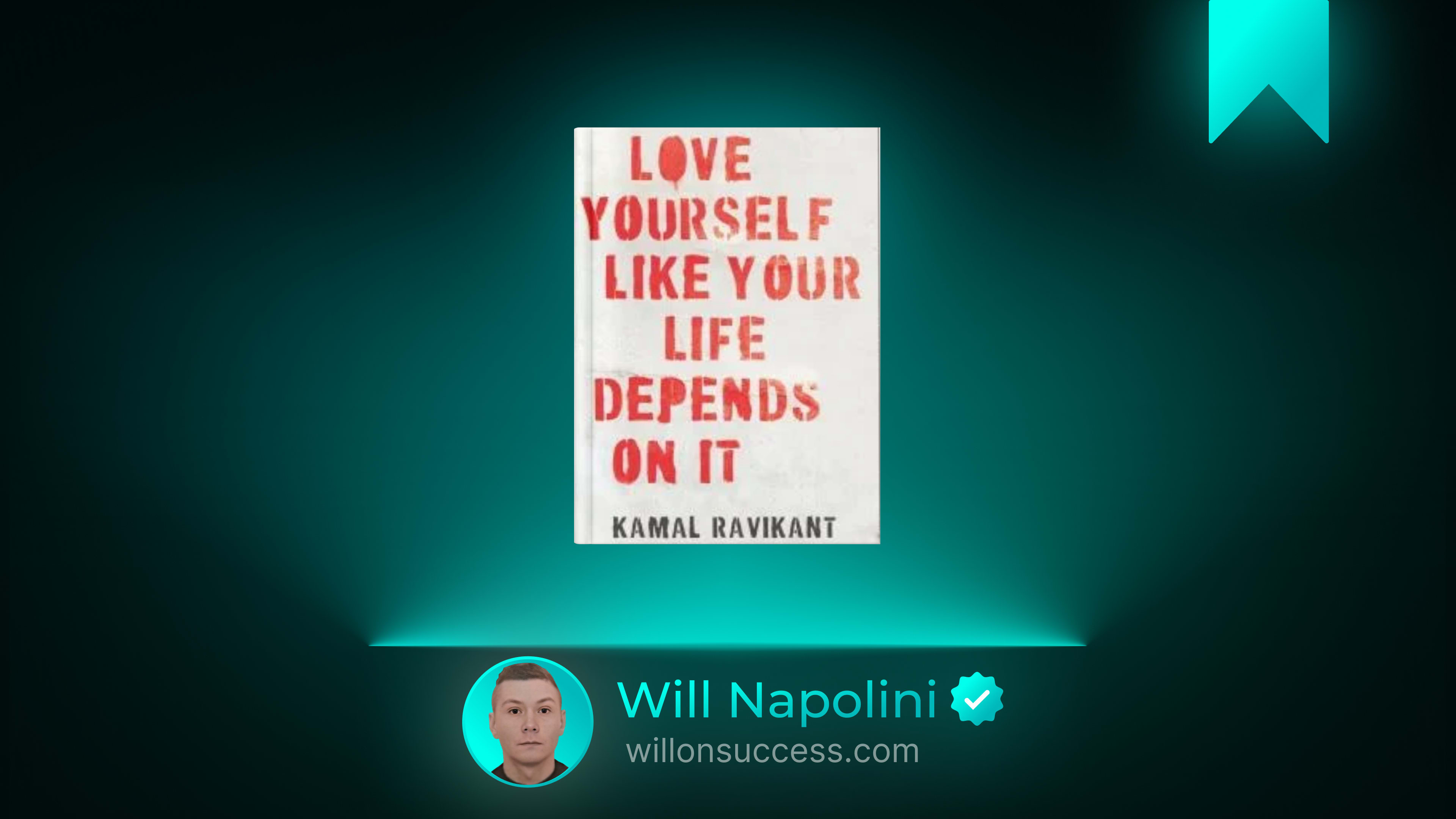
I want to take you to the exact moment when the bottom falls out of your life.
Not a minor setback. Not a bad Tuesday. I mean the moment when the life you built collapses, when the identity you relied on dissolves, and when the voice inside your head stops being a coach and becomes an executioner.
You may not have lost a company or faced bankruptcy, but you know this voice. It is the voice that whispers, You are not enough. You ruined this. You are fundamentally flawed. It is the voice that replays your mistakes on a loop while you are trying to fall asleep. It is the voice that tells you that if you just criticize yourself a little harder, you will finally become the person you are supposed to be.
When Kamal Ravikant found himself in that exact darkness, he did not find a way out by working harder. He did not find a way out by reading another productivity book or optimizing his morning routine. He found a way out by making a single, desperate, almost irrational vow.
Love Yourself Like Your Life Depends On It is not a book about bubble baths, affirmations, or treating yourself to a pastry. It is a survival manual written by a man who was actively dying inside.
The central thesis is as radical as it is simple: Self-love is not a feeling you wait to experience once you have achieved enough, earned enough, or fixed enough. Self-love is the foundational operating system of your life. If that operating system is corrupted by self-hatred, every application you try to run—your marriage, your career, your health, your creativity—will eventually crash.
Ravikant’s core argument is that you must commit to loving yourself with the same ruthless consistency and fierce dedication that you currently apply to your work or your ambitions. You must love yourself not because you are perfect, but because your life quite literally depends on it.
The Collapse and the Vow
To understand the power of this book, you have to understand the ruin that preceded it.
In 2011, Ravikant was a Silicon Valley entrepreneur whose startup had spectacularly failed. He had raised millions, hired a team, poured his soul into the vision, and then watched it all burn. He lost his money, his reputation, and his sense of self. He stopped eating. He stopped sleeping. He lay in bed staring at the ceiling, genuinely contemplating ending his life.
In the depths of this despair, he realized something profound. The external failure was merely a symptom of a deeper, internal collapse. He was fundamentally at war with himself. His inner dialogue was a wasteland of abuse.
So, he made a vow. He didn’t feel it. He didn’t believe it. But he said it aloud: I vow to love myself.
What followed was not a magical, cinematic transformation. It was a grueling, daily, mechanical practice. He decided to treat self-love not as a fleeting emotion, but as a muscle that had completely atrophied and needed to be rebuilt through relentless repetition. He applied the principles of building a startup—iteration, consistency, and ruthless focus—to the project of his own heart.
I have sat with people who are terrified of this concept. They worry that if they love themselves, they will become lazy. They fear that self-compassion is just an excuse for lowering their standards. But what I discovered, and what Ravikant proves through his own resurrection, is the exact opposite. Self-hatred is exhausting. It drains the energy you need to build, to create, and to connect. Self-love is not the abandonment of discipline; it is the fuel that makes discipline sustainable.
The Mental Loop: Rewiring the Default Narrative
The first pillar of Ravikant’s practice is what he calls the “Mental Loop.”
The human brain is wired for negativity. Evolution designed us to notice the rustling in the bushes, to remember the insult, to catalog our failures so we don’t repeat them. For most of us, this survival mechanism has mutated into a 24/7 internal radio station broadcasting our inadequacies.
Ravikant’s solution was not to argue with the radio station. It was to change the frequency. He began repeating the phrase “I love myself” continuously in his mind. While walking, while driving, while waiting in line, while lying in bed. Whenever he caught his mind drifting into worry, regret, or self-criticism, he gently but firmly returned to the loop. I love myself. I love myself. I love myself.
I know what you might be thinking. This sounds like mindless repetition. It feels fake.
It does feel fake at first. When you have spent thirty years telling yourself that you are a disappointment, saying “I love myself” feels like wearing a suit that is three sizes too big. But the brain does not distinguish between a “real” thought and a repeated thought. Neuroplasticity dictates that neurons that fire together, wire together.
By running the mental loop, you are not lying to yourself. You are interrupting a destructive neural pathway and laying down a new one. You are starving the inner critic of the attention it needs to survive.
You cannot think your way out of a mindset you thought your way into. You have to repeat your way out.
The Mirror Practice: Facing the Evasion
The second pillar is the most confrontational: Mirror Work.
Ravikant committed to looking deeply into his own eyes in the mirror every single day and saying, out loud, “I love myself.”
This is where the book moves from theory into visceral reality. Ravikant noticed something deeply unsettling during this practice. He could easily hold gaze with his right eye. But when he tried to look into his left eye, his gaze would dart away. He felt a physical resistance, a wave of shame and evasion. He realized that his left eye held the parts of himself he was trying to hide—the guilt, the fear, the self-betrayal.
So, he forced himself to look into the left eye. He forced himself to speak the words of love to the exact part of him that felt most unworthy.
I have watched people try this exercise and break down in tears within thirty seconds. We are so unaccustomed to truly looking at ourselves without judgment. We look in the mirror to check our hair, to critique our skin, to assess our weight. We rarely look in the mirror to witness our own humanity.
When you look into your own eyes and say “I love yourself,” you are making a contract with your own soul. You are telling the child inside you, the teenager inside you, the exhausted adult inside you: I see you. I am not abandoning you. We are in this together.
The Meditation of Self: Anchoring the Vow
The final pillar is meditation. But this is not a meditation focused on the breath, or on emptying the mind, or on achieving a state of zen detachment.
This is a meditation where the mantra is the vow. You sit in silence, and you anchor your attention to the phrase I love myself. When the mind wanders to the grocery list or the argument you had yesterday, you bring it back to the vow.
This practice moves the concept of self-love out of the intellectual mind and down into the nervous system. It teaches your body what safety feels like. For people who have spent their lives in a state of high-functioning anxiety, driven by the whip of their own inner critic, sitting in silence and bathing in self-acceptance can feel incredibly uncomfortable. The body expects the whip. When it doesn’t come, the nervous system has to relearn how to rest.
Why This Matters on an Ordinary Tuesday
It is easy to read about a Silicon Valley entrepreneur’s collapse and think, That’s an extreme situation. My life is fine.
But the absence of total ruin does not mean the absence of quiet, daily self-betrayal.
Consider how you treat yourself when you make a mistake at work. Do you offer yourself the same grace you would offer a colleague, or do you mentally flay yourself? Consider how you speak to your body when you look in the mirror. Consider the promises you make to yourself—I’m going to start writing, I’m going to go to sleep earlier, I’m going to set a boundary with my family—and how easily you break them, because deep down, you do not believe you are worth keeping a promise to.
Every time you break a promise to yourself, you are voting for your own unlovability.
Applying Ravikant’s framework changes the texture of your daily life. When you spill coffee on your shirt, instead of muttering, I’m such an idiot, you catch the thought and run the loop: I love myself. When you feel the urge to doom-scroll because you feel lonely, you put the phone down, look in the mirror, and offer yourself the presence you are seeking from a screen.
You stop treating yourself like a beast of burden that needs to be whipped into productivity, and start treating yourself like a garden that needs to be tended.
Who Should Read This Book
Love Yourself Like Your Life Depends On It is a short, punchy, deeply personal book. It is not a clinical psychological text, nor is it a sprawling philosophical treatise. It is one man’s raw, unvarnished account of how he saved his own life.
You will benefit profoundly from this book if you:
- Have a harsh, relentless inner critic that undermines your confidence and peace.
- Are recovering from a major failure, burnout, or loss of identity.
- Find yourself repeatedly self-sabotaging in relationships or careers because you don’t feel you deserve success.
- Are willing to commit to a simple, repetitive daily practice without needing a complex intellectual framework to justify it.
You may find this book less useful if you:
- Are looking for deep, scientific explanations of neurobiology (Ravikant focuses on the what and the how, not the deep clinical why).
- Are currently in the midst of severe, unmanaged clinical trauma or psychosis (while self-love is vital, it is not a substitute for professional psychiatric care).
- Find the concept of mantras or repetitive affirmations deeply grating and are unwilling to push through the initial discomfort to see the results.
Practical Application: Building Your Daily Protocol
Understanding the philosophy of self-love is valuable, but understanding without action changes nothing. Here is how you can begin integrating Ravikant’s protocol into your life today.
1. Set the Mental Loop Trigger Choose one mundane, daily activity to be the trigger for your mental loop. It could be your commute, washing the dishes, or walking the dog. During that specific activity, commit to repeating I love yourself in your mind. Do not worry if your mind wanders. Just bring it back. Build the habit of the loop in a low-stakes environment before trying to use it during a high-stress crisis.
2. The Two-Minute Mirror Vow Tomorrow morning, before you brush your teeth or check your phone, stand in front of the mirror. Look directly into your own eyes. If you feel resistance, notice which eye is harder to look into, and gently force your gaze there. Say out loud, with as much conviction as you can muster: “I love myself. I am on my own side.” Do this for just two minutes. It will feel awkward. Do it anyway.
3. The Evening Audit of Grace Before you go to sleep, review your day. Identify one moment where you were harsh with yourself, where you made a mistake, or where you felt inadequate. Mentally revisit that moment, but this time, imagine stepping into the scene and wrapping your arm around your own shoulder. Say to yourself, “It’s okay. We are learning. I love you anyway.”
One Small Step You Can Take Today
You do not need to overhaul your entire psychological framework by sunset. You only need to prove to yourself that you are willing to show up for your own life.
Tonight, make a micro-vow.
Find a quiet moment. Sit down. Take a breath. And say out loud, just once: “I vow to love myself.”
You do not have to feel it yet. You do not have to believe it entirely. You only have to speak it into the room. You are planting a seed in the dark. Your only job tomorrow is to water it.
We spend so much of our lives waiting for someone else to arrive and tell us that we are worthy, that we are enough, that we are safe. We wait for the partner, the boss, the parent, the audience to finally give us permission to exhale. But the door is locked from the inside. The permission you are waiting for can only be granted by the person looking back at you in the glass.
You cannot hate yourself into a life you love. The foundation of every good thing you will ever build is the quiet, relentless decision to be on your own side.