The Architecture of Your Life: How Decisions, Not Conditions, Shape Your Destiny
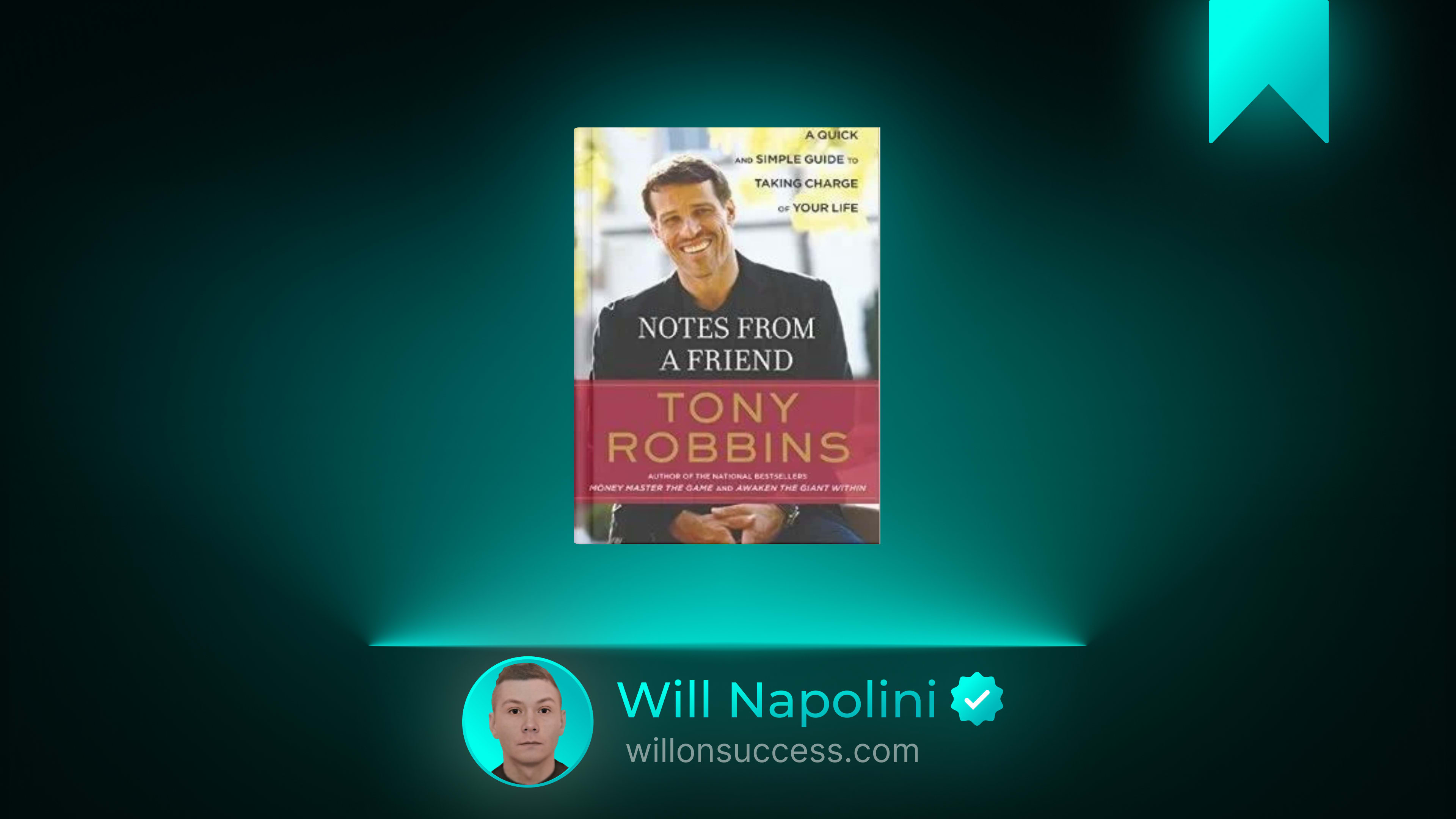
Imagine receiving a letter from a mentor who has walked the difficult road ahead of you. A letter that doesn’t offer empty platitudes or vague inspiration, but instead hands you the exact blueprints to build a life of meaning. That is the spirit behind Anthony Robbins’ Notes from a Friend. Written as a concise, intimate guide—like a letter to someone you deeply care about who is finally ready to take charge—it strips away the complexity of personal development and hands you the raw tools of transformation.
If I could sit across the table from you right now, I would ask you a question that might feel uncomfortable: Are you living your life, or are you just reacting to it?
Many of us move through our days like leaves caught in a storm. We are blown about by the economy, by the moods of our bosses, by the traffic, and by the unpredictable nature of other people. We believe we are stuck because of the circumstances we face. But the central thesis of this book offers a radically liberating truth: It is not the conditions of your life that shape your destiny, but the decisions you make within those conditions.
Circumstances are merely the raw material. Your decisions are the architect.

The Invisible Hand Guiding Your Choices
To understand how to take back the steering wheel of your life, you first have to understand the engine driving your current behavior. Robbins introduces a concept that governs every single human action: the Pain-Pleasure Principle.
Think of it as the invisible hand guiding every choice you make. From the moment you wake up to the moment you close your eyes, everything you do is driven by one of two forces: the desire to avoid pain or the desire to gain pleasure.
Why do you hit the snooze button when you know it will make you late? Because in that split second, your brain calculates that the immediate pain of leaving a warm bed is greater than the future pain of rushing to work. Why do you swallow your true feelings to avoid an argument with your partner? Because the known discomfort of resentment feels safer than the terrifying, immediate pain of conflict.
Most of us let pain and pleasure use us. We react blindly to whatever feels good in the moment or whatever hurts the least. But the secret to taking control of your life is learning how to use pain and pleasure, instead of having them use you. When you can consciously link massive pain to the habits that are holding you back, and massive pleasure to the habits that will move you forward, you rewire your own motivation. You no longer need to rely on fleeting willpower.
A Decision Is a Line in the Sand, Not a Wish
There is a profound difference between a preference and a decision. You might say, “I’ve decided to get out of debt,” or “I’ve decided to start that business.” But if months pass and nothing changes, you haven’t made a decision; you’ve merely expressed a wish.
The word decision shares its roots with the concept of cutting off. To make a true decision means to cut off any other possibility. It means drawing a line in the sand. When you make a real decision, the internal debate ends. You no longer wake up and ask, “Should I work on my goals today, or should I watch television?” The negotiation is over. You only ask, “How will I execute this today?”
I have seen people spend years agonizing over a career change, weighing the pros and cons until they are paralyzed by analysis. The moment they finally make a true decision, the anxiety evaporates. The fear doesn’t necessarily disappear, but the exhaustion of indecision vanishes. A true decision creates its own momentum.
The Search Engine of Your Mind
Your mind is the most powerful supercomputer on earth, and questions are the commands you type into it. The brain is designed to answer whatever you ask it.
If you walk into your house after a long day and ask, “Why am I so exhausted? Why does everything always go wrong?”, your brain will instantly search its database for evidence. It will pull up every past failure, every slight, every injustice to prove you right. It will hand you a perfectly constructed argument for why you are a victim.
But if you change the command—if you ask, “What was the best part of my day?” or “How can I use this challenge to grow stronger?”—your brain goes to work finding solutions and silver linings.
The quality of your life is in direct proportion to the quality of the questions you habitually ask. Successful people do not have fewer problems than anyone else; they simply ask better questions when the problems arise. Instead of asking, “Why is this happening to me?”, they ask, “What is great about this problem? What can I learn from this?”
The Physiology of Breakthroughs
We often think of emotion as something that happens to us. We wait until we “feel confident” before we ask for the promotion, or we wait until we “feel motivated” before we go to the gym. But Robbins teaches a fundamental truth: emotion is created by motion.
Your state of mind is inextricably linked to your physiology. Think about what your body looks like when you feel deeply depressed. Your shoulders slump, your head drops, your breathing becomes shallow, and your muscles lose their tension. Now, try to feel deeply inspired and fiercely confident while maintaining that exact physical posture. It is biologically nearly impossible.
You cannot think your way into a new state of being in a fraction of a second, but you can move your way into it. If you want to change how you feel right now, change how you move. Stand up straight, pull your shoulders back, breathe deeply into your chest, and move with purpose. You can literally step into a new emotional state by adopting the physiology of the person you want to be.
Why This Matters on an Ordinary Tuesday
It is easy to read about these concepts and feel a temporary surge of inspiration. But how do they apply to the messy reality of your actual life?
Let’s bring this into the workplace. You are handed a project that feels impossible, and your manager is demanding results by Friday. The “condition” is intense stress. The safe, reactive response is to complain to your colleagues, feel victimized by management, and do the bare minimum to avoid getting fired. That is letting circumstances dictate your state.
Taking charge means making a decision about who you are going to be in that situation. You consciously change your question from “Why do they always dump this on me?” to “What hidden skill can I master by navigating this pressure?” You change your physiology by walking into the strategy meeting with your head held high, signaling to your nervous system that you are capable. You are no longer a victim of the deadline; you are the architect of your response.
In your relationships, the pain-pleasure principle often causes us to withdraw when we feel misunderstood (avoiding the pain of an argument) or to attack (seeking the temporary pleasure of being “right”). Recognizing this invisible hand allows you to step back. You can choose to endure the temporary discomfort of a vulnerable conversation because you have linked massive pleasure to the long-term intimacy it will create.
How to Reclaim Your Agency Today
Understanding these tools is valuable, but understanding without action changes nothing. If you want to begin dismantling the trap of reactivity, you must start applying these principles immediately.
1. Leverage the Pain-Pleasure Principle Think of one habit you have been trying to break for years—perhaps procrastinating on a vital project or staying in a comfort zone that is slowly shrinking your life. Grab a piece of paper. Write down all the immense pain this habit has caused you, and the devastating pain it will cause you in 1, 5, and 10 years if you do not stop. Feel that discomfort deeply. Then, write down the immense pleasure and pride you will experience if you break the habit today. Condition your mind until the pain of staying the same becomes far greater than the pain of changing.
2. Design Your Morning Commands Tonight, write down three empowering questions to ask yourself the moment your feet hit the floor tomorrow morning.
- What am I most proud of in my life right now?
- What am I most excited about today?
- Who do I love, and who loves me? When you wake up, do not just read them. Ask them with genuine emotion. Watch how it shifts the entire trajectory of your morning before the world even has a chance to demand your attention.
3. The State-Change Interrupt The next time you feel a wave of anxiety, frustration, or lethargy wash over you, do not try to argue with it in your head. Interrupt the pattern physically. Stand up, shake out your limbs, take three massive breaths, and change your environment. Break the physical loop, and you will break the emotional loop.
Who Needs to Read This Book
Notes from a Friend is a masterclass for the overwhelmed. If you are someone who feels paralyzed by the sheer volume of self-help advice out there, or if you have read massive, dense books but struggled to implement the ideas, this concise guide is for you. It is perfect for the person standing at a crossroads who needs a quick, powerful reset of their mental framework.
However, if you are looking for deeply nuanced psychological therapy or a slow, meandering philosophical exploration, this book may feel too direct. Robbins writes with the urgency of someone trying to pull you out of a burning building. He is not interested in coddling your excuses; he is interested in handing you a ladder.
Your First Step Toward Mastery
You do not need to overhaul your entire life by sunset. You just need to prove to yourself that you are in the driver’s seat.
Today, I want you to make one true decision about something you have been putting off. It could be making a difficult phone call, throwing away the junk food in your pantry, or finally opening that intimidating spreadsheet.
Do not negotiate with yourself. Do not wait until you “feel like it.” Draw the line in the sand, change your physiology by standing up tall, and take the first action.
A wish keeps you waiting. A decision sets you in motion.