The Art of Starting Over: How to Choose Yourself and Reinvent Your Life
Have you ever looked at the life you have built—the career, the routines, the relationships—and felt a quiet, terrifying thought whisper in your ear: What if I am climbing the wrong mountain?
We are taught a dangerous myth. We are told that by the time we reach adulthood, we must pick a lane, build a ladder, and climb it until we retire. We treat our identity like a block of concrete poured in our twenties, assuming it must harden and stay fixed for the rest of our lives. If you deviate from the path, society labels you a failure or a flake.
If I could sit across the table from you right now, I would tell you the most liberating truth I have ever learned: You are not a block of concrete. You are a garden. And gardens are meant to be replanted, season after season.
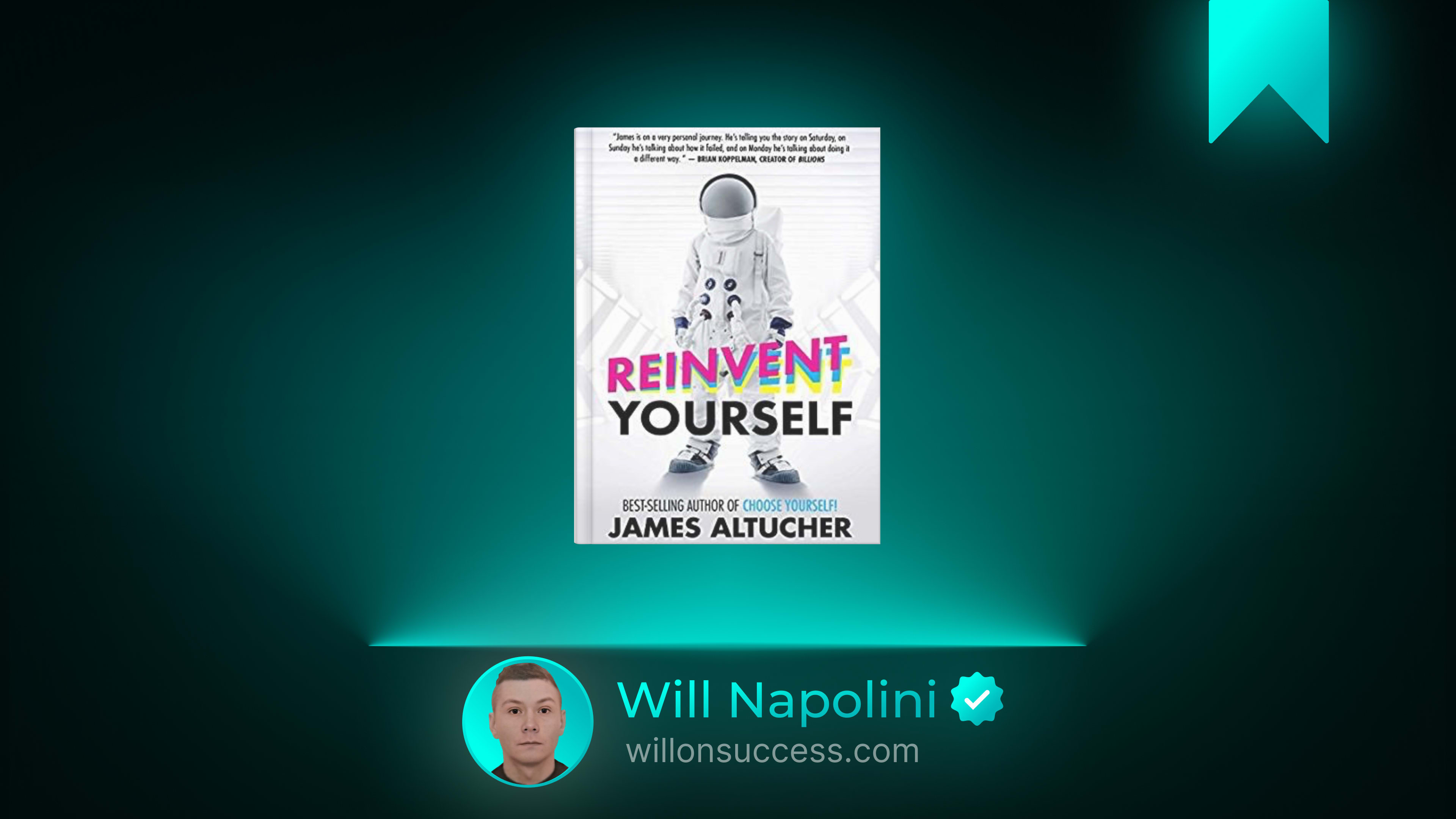
In Reinvent Yourself, entrepreneur and author James Altucher dismantles the myth of the single life path. This book is a collection of hard-won lessons, stories, and unconventional strategies for anyone who realizes that the life they are living no longer fits the person they are becoming.
The central thesis is both simple and radical: The era of the gatekeeper is over. You no longer need permission from a boss, a publisher, an investor, or society to change your life. You must “choose yourself.” When the world tells you to wait in line, choosing yourself means walking out of the line and building your own door.

The Ashes of the Old Identity
Altucher does not write about reinvention from an ivory tower. He writes from the ashes of his own life. During the financial crisis of 2008, he lost almost everything. The businesses he built failed, his investments vanished, and he found himself facing a level of despair and physical ruin that most people only read about in tragedies. He was a man who had tied his entire identity to being a “success,” and when the success evaporated, he felt he had ceased to exist.
I have seen this exact look in the eyes of brilliant people who get laid off in their fifties. They hand over a box of personal belongings and suddenly realize they do not know who they are without their title.
But in that rock bottom, Altucher discovered a profound secret. The identities we cling to—hedge fund manager, corporate executive, devoted spouse, reliable employee—are just clothes we wear. When the clothes are ruined, you are still there underneath. You can survive the death of an identity. And once you realize that your past does not own your future, you become free to put on new clothes.
The Gatekeepers Are Dead
For most of human history, if you wanted to change your life, you needed a patron. If you wanted to be a writer, a publisher had to choose you. If you wanted to be an investor, a firm had to hire you. We were raised in a world of gatekeepers, and we internalized their authority. We still walk through life waiting for someone in a position of power to tap us on the shoulder and say, “You are ready.”
Altucher’s core philosophy is that the gatekeepers are dead. The internet, the gig economy, and modern technology have democratized access to the world. If you want to write, you can publish today. If you want to build a business, you can launch it this weekend.
But here is the difficult truth: freedom is terrifying. When there is no one to tell you “no,” there is also no one to tell you “yes.” You have to validate yourself. Choosing yourself means looking in the mirror and saying, “I am the patron I have been waiting for.” You take full responsibility for your trajectory. There are no more excuses, only execution.
Building the Idea Muscle
Most people believe that good ideas are lightning strikes—rare, magical gifts bestowed upon a lucky few. Altucher argues that having ideas is a muscle, and like any muscle, it atrophies if you do not use it.
His most famous prescription is deceptively simple: Write down ten ideas every single day. It does not matter if they are ten ideas for a new business, ten ways to improve your morning routine, or ten titles for a book you want to write. The goal is not to execute all ten. The goal is to force your brain to sweat.
Why ten? Because your brain is a lazy, energy-conserving machine. It wants to keep you safe, which means it wants to keep you doing exactly what you did yesterday. When you force it to produce ten ideas, the first three are usually recycled thoughts. The next four are variations of things you have already seen. But by the time you reach idea number eight, nine, and ten, your brain starts to sweat. It has to make new neural connections.
Over time, this daily practice changes how you walk through the world. You stop seeing a crowded coffee shop and thinking, I wish I had thought to open this. You start seeing the inefficiencies, the gaps, the unmet needs. You become an opportunity-recognition machine. And when life inevitably knocks you down, you don’t panic. You just pull out your notebook and say, “Okay, what are ten ways I can solve this problem?”
The Daily Practice: The Four Pillars of Survival
You cannot build a new life on a crumbling foundation. Before you change your career or start a business, you must secure your baseline. Altucher outlines a daily practice that covers four areas: physical, emotional, mental, and spiritual health.
If you are eating garbage, sleeping four hours a night, and surrounding yourself with toxic people, your brain will not have the biological energy required to invent a new future. Reinvention is an endurance sport. It requires the stamina to face rejection, the emotional regulation to handle failure, and the mental clarity to spot opportunities. You do not negotiate with your daily practice. It is the rent you pay for the privilege of changing your life.
The Timeline of Mastery: Trusting the Five-Year Arc
We are deeply conditioned by the harvest cycle of agriculture, yet we expect the fruits of our labor in the timeline of a microwave. We want to reinvent ourselves by Friday.
Altucher provides a reality check through his “Cheat Sheet for Reinventing Yourself.” He maps out a realistic, unglamorous timeline for starting over in a new field:
Year 1: Study. You read obsessively. You find out who the masters are. You consume everything you can about your new domain. You are a student. Year 2: Practice. You do the work, often for free, just to build your skills and your network. You are an apprentice. Year 3: Build. You start creating your own projects and putting them into the world. You are a creator. Year 4: Earn. You begin to make a living from it. Your skills translate into market value. You are a professional. Year 5: Mastery. You achieve wealth and authority in your space. You are a master.
This timeline is a profound relief. It removes the panic of the present moment. If you are in Year 1, your only job is to read and learn. You do not need to be wealthy yet. You just need to be patient. You give yourself the grace to be a beginner.
The Loneliness of the Messy Middle
Reinvention is lonely. When you decide to change your life, the people around you will often resist. Not because they are malicious, but because your change forces them to look at their own stagnation. Your friends will say, “Why are you doing this? You had a good job.” Your family will worry about your stability.
You must prepare for this emotional friction. You cannot argue them into understanding. You can only outwork their doubts. As you build your daily practice and your idea muscle, your results will eventually speak for themselves. But in the messy middle, you must be your own fiercest protector. You have to trust the seeds you are planting even when the ground looks entirely barren.
Why This Matters on an Ordinary Tuesday
Why does this philosophy matter when you are just trying to get through a normal work week?
Because the world is changing faster than ever before. Entire industries are being automated. Companies are restructuring. The “safe” path is an illusion. If you do not know how to reinvent yourself, you will be at the mercy of every economic shift and corporate layoff.
But when you possess the skill of reinvention, fear loses its grip. If you lose your job on a Tuesday, you do not spiral into despair. You recognize it as the forced beginning of your Year 1. You look at your blank notebook, you write down ten ideas, and you begin the quiet, methodical work of building your next chapter. You become anti-fragile. The disruptions of the world no longer break you; they simply give you the raw materials for your next iteration.
How to Reclaim Your Agency Today
Understanding these concepts is valuable, but understanding without action changes nothing. If you want to begin the process of choosing yourself, you must start small.
1. Start the Idea Muscle Today Buy a small pocket notebook. Tomorrow morning, before you check your email or look at social media, sit down and write ten ideas. They can be ten ideas for a podcast, ten ways to make your current job more efficient, or ten places you want to travel. Do this every day for a month. Watch how your perception of the world shifts from seeing problems to seeing solutions.
2. Audit Your Information Diet In Year 1 of reinvention, your primary job is to study. Look at what you consumed over the last seven days. Was it mostly mindless scrolling, news that makes you angry, or entertainment that numbs you? Replace one hour of that consumption with deep study. Read a biography of someone who has the life you want. Listen to a podcast that dissects the mechanics of your desired field. Feed your brain the raw materials it needs to build a new reality.
3. Define Your Daily Practice Write down one small, non-negotiable action for your physical, emotional, mental, and spiritual health.
- Physical: Drink a glass of water and walk for twenty minutes.
- Emotional: Text one person you appreciate.
- Mental: Read ten pages of a challenging book.
- Spiritual: Spend five minutes in silence or meditation. Do not skip a day. This is the scaffolding that will hold you up when the heavy work of reinvention gets difficult.
Who Should Read This Book
Reinvent Yourself is a lifeline for the burned-out professional, the recently divorced, the laid-off worker, and anyone who feels a quiet, gnawing sense that they are meant for something else but has no idea where to start. It is for the person who feels they have “missed their window” because they are forty, fifty, or sixty years old. Altucher’s work proves that the window never closes; you just have to be willing to climb through it.
However, if you are looking for a rigid, corporate career ladder or a get-rich-quick scheme, this book will frustrate you. Altucher does not offer guarantees. He offers a grueling, highly personal methodology that requires immense self-responsibility. He will not hold your hand; he will hand you a shovel and tell you to start digging.
Your First Step Toward a New Life
You do not need to quit your job or move to a new city today. You just need to prove to yourself that your mind is still capable of generating new life.
Here is what I want you to do today.
Take out a piece of paper. At the top, write: Ten things I would do if I knew I could not fail and had to start over tomorrow.
Force yourself to write all ten. The first three will be easy. The next four will be cliché. The final three will require you to dig deep, to bypass your inner critic, and to access the creative, untamed part of your brain that has been silenced by years of playing it safe.
Read the list. One of those seeds is your next season.
The gatekeepers are gone. The waiting room is empty. The only permission you will ever need is your own. Pick up the pen, choose yourself, and begin.