The Quiet Power of the Micro-Step: Why Small Changes Outlast Radical Reinventions
We have been sold an exhausting lie about how change happens.
If you look at the self-help industry, the fitness world, or the corporate seminar circuit, the message is almost always the same: to change your life, you must shock your system. You need a radical overhaul. You need to wake up at 4:00 AM, completely rewrite your diet, launch a new business in a weekend, and transform your personality by Monday. We are taught to rely on massive bursts of motivation and sheer, white-knuckled willpower.
And for a few days, it works. You buy the expensive gear, you write the ambitious schedule, you feel the surge of adrenaline. But then, inevitably, the motivation fades. The alarm goes off in the dark, the weather turns cold, the stress of daily life returns, and you crash. You revert to your old habits, carrying a heavy new layer of shame and the quiet belief that you simply lack the discipline to succeed.
If I could sit across the table from you right now, I would ask you to set down that heavy burden of shame. The reason your radical reinventions keep failing is not because you are weak. It is because you are fighting against millions of years of human biology.
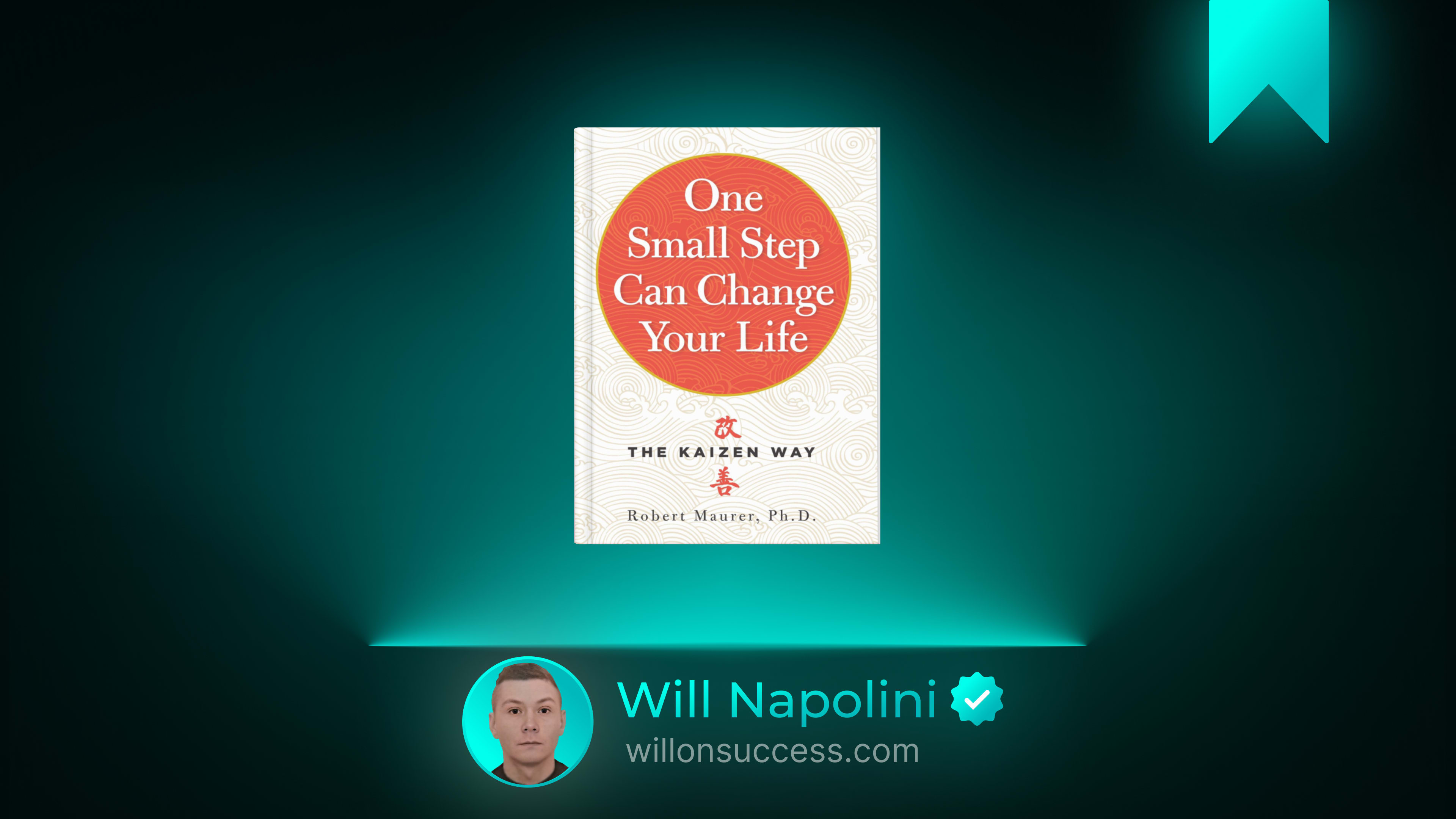
In his brilliant and deeply comforting book, One Small Step Can Change Your Life: The Art of Kaizen, psychologist Robert Maurer reveals a profound truth: the human brain is biologically hardwired to resist sudden, large changes. When you try to force a massive transformation, your brain perceives it as a threat, and it will sabotage you to keep you safe.
The central thesis of the book is that the secret to lasting change is not intensity, but insignificance. By taking steps so small that they barely register on your brain’s radar, you can slip past your mind’s internal alarm system and build a completely new life without triggering the fear that usually stops you dead in your tracks.
The Brain’s Smoke Detector
To understand why small steps work, you first have to understand the architecture of your own mind.
Deep inside your brain sits a small, almond-shaped structure called the amygdala. This is your brain’s smoke detector. Its primary job is to keep you alive by scanning the environment for threats. When it senses danger, it triggers the fight, flight, or freeze response, flooding your body with adrenaline and cortisol, and shutting down the rational, creative parts of your brain so you can react purely on instinct.
For our ancient ancestors, the amygdala was a lifesaver. It made them run from predators. But here is the catch: the amygdala does not distinguish between a physical threat, like a lion in the bushes, and a psychological threat, like a sudden disruption to your routine.
Your brain loves homeostasis. It likes things exactly the way they are because the way they are has kept you alive this long. So, when you announce, “Starting tomorrow, I am going to the gym for two hours every single day,” your amygdala wakes up. It senses a massive drain on your energy and a radical departure from your baseline. It hits the panic button. You suddenly feel an overwhelming urge to procrastinate, to eat comfort food, or to simply freeze on the couch. You think you are being lazy. In reality, your brain is successfully executing a survival protocol.
This is the biological wall that stops most people. But Maurer introduces a concept borrowed from Japanese manufacturing that acts as a master key to bypass this wall. It is called Kaizen—the practice of continuous improvement through small, manageable steps.
When you shrink the step down to something almost comically small, the amygdala stays asleep. The smoke detector does not go off. You are able to engage the cerebral cortex—the rational, creative, problem-solving part of your brain—and quietly wire in a new habit.
Ask Questions That the Brain Cannot Refuse
The first step in the Kaizen process is learning how to talk to yourself. When we face a challenge, our default instinct is to ask large, intimidating questions. How am I going to lose fifty pounds? How am I going to pay off this mountain of debt? How do I fix my failing marriage?
Large questions trigger the amygdala. They create fear, and fear paralyzes the creative brain.
Maurer suggests a radically different approach: ask small questions. A small question is one that is so gentle, so non-threatening, that your brain cannot possibly feel intimidated by it. It invites playfulness and curiosity rather than dread.
Instead of asking, “How do I write a novel?”, ask, “What is one sentence I could write today?” Instead of asking, “How do I become a healthier person?”, ask, “What is one tiny choice I can make at lunch today that is slightly better than yesterday?”
The human brain is an answering machine. When you feed it a small, safe question, it will happily go to work finding an answer. Over time, these small questions rewire your neural pathways, training your brain to look for micro-opportunities rather than shrinking away from macro-problems.
Think in Micro-Movements, Not Mega-Leaps
We are often told to visualize our success. We are instructed to close our eyes and picture ourselves crossing the marathon finish line, holding the published book, or standing on the stage. But if you are deeply afraid of the process, visualizing the massive end goal can actually trigger performance anxiety.
Maurer advocates for a technique he calls “mind sculpture,” which involves visualizing the process in micro-movements.
If you are terrified of public speaking, do not visualize a standing ovation from a crowd of thousands. That is too big. Close your eyes and visualize yourself walking up the steps to the podium. Visualize your hand touching the wood of the lectern. Visualize yourself taking one slow, deep breath and smiling at the person in the front row.
By mentally rehearsing the tiny, physical actions required to take the step, you desensitize your nervous system to the fear. You are laying down the neurological tracks before the train even arrives. When the moment comes to act, your brain feels a sense of déjà vu. I have been here before, it thinks. I am safe.
Solve Small Problems Before They Become Crises
One of the most powerful applications of Kaizen is in how we handle friction in our daily lives. In the manufacturing world, if a worker on a Toyota assembly line spots a tiny defect or a minor inefficiency, they are empowered to stop the line and fix it immediately. They do not wait for the machine to break down entirely.
In our personal lives, we tend to ignore the small problems. We ignore the slightly leaky faucet, the minor misunderstanding with our spouse, the awkward tension in a team meeting. We tell ourselves it is not a big deal. But small problems, left unattended, compound. They erode our energy and eventually manifest as massive crises.
Taking a Kaizen approach means training your eye to spot the pebbles in your shoe. It means giving yourself permission to pause and fix the tiny frictions while they are still small and manageable. It takes two minutes to apologize for a minor tone of voice. It takes two months to repair the resentment that builds when that tone of voice is ignored a hundred times.
Reward the Step, Not Just the Summit
We have a cultural habit of delaying gratification. We tell ourselves we will celebrate when the project is launched, when the weight is lost, when the house is clean. But the brain needs positive reinforcement during the process to build a lasting habit.
If your goal is to run a mile, and you only manage to put on your running shoes and walk to the end of the driveway, the perfectionist in you will say, “That was a failure. I didn’t even break a sweat.”
The Kaizen mindset says, “Success. I put on the shoes. I stepped outside.” And then, you reward yourself. You acknowledge the victory.
When you celebrate the micro-step, you release a small hit of dopamine. This neurochemical not only makes you feel good; it physically binds the new neural pathway together. You are teaching your brain that taking the small step is safe, rewarding, and worth repeating.
Why This Matters on an Ordinary Tuesday
It is easy to read about neuroscience and Japanese manufacturing and feel inspired. But how does this change the reality of a random Tuesday when you are tired, stressed, and facing a mountain of obligations?
It changes everything because it removes the requirement for motivation.
Motivation is an emotion, and like all emotions, it is fickle. It comes and goes with the weather, your blood sugar, and the amount of sleep you got. If your strategy for improving your life relies on feeling motivated, you will fail on the days you feel tired.
Kaizen does not require motivation. It only requires a willingness to do something so small it feels almost silly.
Think about your relationships. If your marriage or partnership feels distant, the “innovation” approach is to plan a massive, expensive weekend getaway to “reconnect.” But if the underlying dynamic is broken, a weekend away is just a band-aid. The Kaizen approach is to commit to one small action: making eye contact and offering a genuine, specific compliment for ten seconds every morning before you look at your phone. It takes no money, and almost no energy. But done consistently, it slowly rebuilds the foundation of trust and warmth.
Think about your finances. If you are overwhelmed by debt, trying to radically slash your budget all at once usually leads to a binge-spending rebound. The Kaizen approach is to find one single recurring charge you don’t use and cancel it. Or to commit to saving just one dollar a day. It feels insignificant, but it shifts your identity from someone who is “bad with money” to someone who is “taking control.”
How to Reclaim Your Momentum Today
Understanding the mechanics of the amygdala is valuable, but understanding without action changes nothing. If you want to stop fighting your own biology and start working with it, you must begin applying the art of Kaizen immediately.
1. The One-Minute Rule Choose one task you have been procrastinating on because it feels overwhelming. It could be cleaning the garage, writing a difficult email, or organizing your desk. Set a timer for exactly sixty seconds. Work on the task with total focus until the timer goes off. When it rings, stop. You have permission to walk away. Most of the time, the friction is entirely in the starting. Once the timer goes off, you will often find the amygdala is quiet, and you will choose to keep going. If you don’t, you still succeeded in taking the step.
2. The “Small Question” Journal Keep a notepad by your bed. Every night, write down one small, gentle question for your brain to solve while you sleep. What is one thing I could do tomorrow to make my morning routine 5% smoother? What is one kind word I could say to my colleague tomorrow? Do not force an answer. Just ask the question. Let your brain do the quiet work in the background.
3. Shrink the Standard Look at your current goals and ruthlessly shrink them until they are immune to failure. If your goal is to read a book a week, change it to reading one paragraph a night. If your goal is to meditate for twenty minutes, change it to taking three conscious breaths. Master the art of showing up. You can always increase the volume later, but you cannot increase the volume of a habit you abandoned because the bar was set too high.
Who Needs to Read This Book
One Small Step Can Change Your Life is essential reading for the chronic procrastinator, the perfectionist, and the person who is exhausted by the cycle of radical reinvention and inevitable collapse. If you are someone who constantly sets massive goals and then feels paralyzed by the sheer weight of them, this book will hand you a gentle, scientifically proven way out of the trap. It is a lifeline for anyone who feels stuck and believes they are simply broken.
However, if you are in an immediate, burning crisis—if your business is going bankrupt next week, or you are in a dangerous living situation—this book is not for you right now. Kaizen is a strategy for building a life, for healing, and for steady growth. It is not a strategy for emergency survival. When the house is on fire, you do not take small steps; you jump out the window. But once the fire is out, and it is time to rebuild the house, Kaizen is the only way to ensure it stands strong.
Your First Step Toward Freedom
You do not need to map out the next ten years of your life today. You do not need to overhaul your diet, your schedule, or your personality.
You only need to identify the very next micro-step.
Here is what I want you to do right now. Think of one thing you know you should do, but have been avoiding because it feels too big, too hard, or too uncomfortable. Now, shrink it. Shrink it until it is so small that the thought of doing it makes you smile at how easy it is.
Do that one tiny thing today.
A mountain is not climbed by leaping from the base to the summit. It is climbed by placing one boot in front of the other, a thousand times, without staring at the peak. You do not need to change your life today. You only need to change the next sixty seconds. Do that enough times, and your life will change itself.