The Help by Kathryn Stockett: What Silence Costs and What One Honest Voice Can Change
There is a question I have carried with me for years, and it arrived not through a philosophy lecture or a self-improvement seminar, but through a novel set in Jackson, Mississippi, in 1962. The question is this:
What are you willing to risk in order to stop being silent about something you know is wrong?
Not what you are willing to think. Not what you are willing to feel sorry about. What you are willing to actually do, when doing it might cost you comfort, friendships, safety, or the easy life you have built by looking the other way.
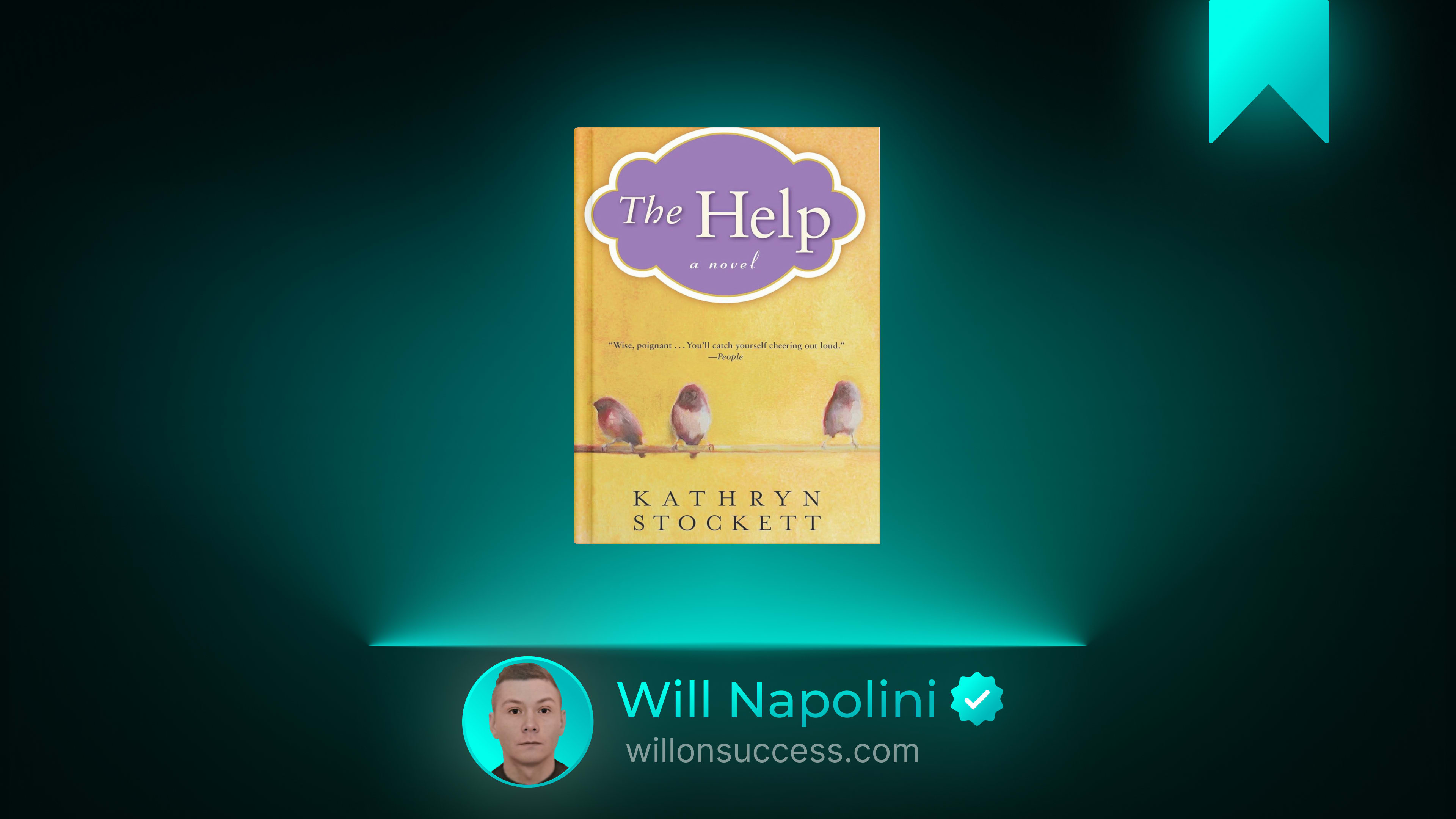
Kathryn Stockett’s The Help is a novel about Black domestic workers in the segregated South and the young white woman who decides to write down their stories. On the surface, it is a historical novel. But underneath the plot, underneath the characters and the setting, it is a book about the architecture of silence—how it is built, who maintains it, what it crushes, and what happens when one person decides to dismantle it, brick by brick, even while their hands are shaking.
I want to walk you through what this book taught me about courage, complicity, and the terrifying freedom of using your voice. And I want to show you how those lessons reach far beyond 1962 Mississippi. They reach into your office, your family dinners, your friendships, the quiet decisions you make every single day about what you will tolerate and what you will name aloud.
The Central Idea: Silence Is Not Neutrality
The deepest argument of The Help is not about racism as an abstraction. It is about the machinery of everyday cruelty—and the fact that the machinery runs on the silence of people who know better.
Stockett shows us a world where segregation is not maintained only by law. It is maintained by ordinary women who host bridge club on Tuesday afternoons, who bake casseroles, who smile at their neighbors, and who also enforce a system that dehumanizes the women raising their children. Hilly Holbrook, the novel’s antagonist, is not a cartoon villain. She is terrifying precisely because she is normal. She is the woman next door who believes, sincerely, that a separate bathroom for her maid is a matter of hygiene rather than dignity.
And around her, other women say nothing. They see. They know. And they say nothing, because saying something would mean losing their place at the table.
Here is what I have learned from sitting with this book: silence in the presence of injustice is never neutral. It is a choice. It is a vote cast for the existing order. And the longer you remain silent, the more the silence reshapes you until you can no longer remember what you once knew to be true.
You do not have to live in 1962 Mississippi for this to apply. You have seen it. Maybe you sat in a meeting and heard someone dismissed or mocked. Maybe you watched a family member be treated with casual cruelty at a holiday dinner. Maybe you noticed a colleague taking credit for someone else’s work, week after week, and you said nothing because you did not want to make things awkward.
The discomfort of speaking up is real. But Stockett’s novel asks you to weigh it against the other cost—the slow erosion of your own integrity, the quiet knowledge that you chose comfort over truth.
Three Voices, Three Kinds of Courage
The novel is told through three narrators, and each one represents a different relationship to courage.
Aibileen Clark has raised seventeen white children. She is gentle, steady, and deeply wise. She has survived decades of being rendered invisible, of being thanked with a nod and paid a pittance, of watching the children she loves grow up to repeat their mothers’ cruelties. When Skeeter asks her to tell her story, Aibileen’s first instinct is refusal. The danger is not abstract. A Black woman in Mississippi in 1962 who speaks openly about her white employers could lose her job, her home, her safety. Aibileen says yes anyway. Her courage is the courage of someone who has been afraid for a very long time and has decided that the fear no longer gets the final word.
Minny Jackson is Aibileen’s friend—fierce, sharp-tongued, unwilling to swallow the indignities that Aibileen has learned to absorb quietly. Minny’s courage looks different. It is louder, angrier, more confrontational. She has already lost jobs for speaking back. She carries the scars of a marriage where her voice is punished. And yet she tells her story too, because keeping it locked inside her is its own kind of dying.
Eugenia “Skeeter” Phelan is the young white woman who conceives the book. She is not a hero in the traditional sense. She is uncertain. She is naive in ways that matter. She benefits from the very system she is trying to expose, and Stockett does not let us forget that. But Skeeter’s courage is the courage of the person who has not been directly threatened, who has everything to lose socially and very little to lose physically, and who must decide whether the comfort of belonging is worth the price of complicity.
Three women. Three different costs. Three different reasons to be afraid. And the same essential decision: Will I let fear make my choices for me, or will I act in spite of it?
If I could sit across the table from you right now, I would tell you this: courage is not the absence of fear. It is not a personality trait that some people are born with and others lack. Courage is a decision you make while your stomach is in knots. It is sending the email, making the phone call, saying the sentence in the meeting, while your hands are trembling. Aibileen’s hands were trembling. Skeeter’s hands were trembling. They did it anyway.
The Story That Changes Everything
There is a thread running through the novel that I find more powerful than any plot twist: the act of being heard.
When Aibileen sits down and begins to speak her truth into Skeeter’s tape recorder, something shifts in her. Not because the world changes overnight. Not because the system collapses. But because for the first time, her experience is treated as real. As worthy of record. As something that matters beyond the kitchen where she has spent her life.
I have seen this in my own life, and I suspect you have too. There is a particular loneliness in carrying a truth that no one has asked you about. A story you have never been invited to tell. A perspective that the room keeps talking over. When someone finally says, “Tell me what happened. I want to hear it,” something unlocks. Not because the telling fixes the problem. But because being witnessed restores a piece of your humanity that isolation had quietly taken.
This is why storytelling matters. Not as entertainment. As recognition. As a way of saying to another person: Your life happened. It counted. You are not invisible.
Stockett understands this. The entire novel is structured around the radical act of writing down what powerful people would prefer to keep unspoken. And the danger the characters face is proportional to how threatening that act is to the existing order.
What You Repeat in Private Becomes the Life You Accept
One of the quieter lessons in the book concerns the women who say nothing. The ones who attend Hilly’s bridge parties and laugh at her jokes and go home and feel a faint, sick feeling they cannot name. They are not evil. They are acquiescing. And Stockett shows, with patience and precision, how acquiescence calcifies into identity.
You attend one dinner where someone is mocked, and you laugh along because you do not want to be the difficult one. You attend ten dinners. You attend a hundred. And somewhere along the way, you stop noticing. The thing that once made you uncomfortable becomes background noise. Then it becomes normal. Then you defend it. Then you cannot imagine it being any other way.
This is not a condemnation. It is a warning. And it applies to every area of your life where you have quietly decided that the cost of objecting is higher than the cost of accepting.
The marriage where you stopped asking for what you need. The job where you stopped raising your hand. The friendship where you stopped saying, “That hurt me.” Each small silence is manageable on its own. But stacked over years, they build a life you did not choose. A life that happened to you because you never interrupted it.
Aibileen could have stayed silent. Minny could have stayed silent. Skeeter could have written a different kind of book, a safe kind, the kind that would not cost her anything. They chose otherwise. And the novel suggests—without sentimentalizing, without promising that everything works out—that the choice to speak is what separates a life you endure from a life you inhabit.
The Danger of the Single Story
I want to be honest with you about the book itself, because honesty is part of what it teaches.
The Help has been criticized, and rightly so, for the fact that a white author wrote in the voices of Black women, and for the ways the novel centers white guilt and white redemption alongside Black suffering. Those criticisms matter. They remind us that who gets to tell a story is inseparable from the story itself.
But I think the novel still offers something important, if you read it with your eyes open. It asks you to notice whose stories are missing from every room you enter. Whose perspective is assumed, and whose is absent. Whose voice carries authority, and whose is treated as an anecdote.
In your own life, this question is practical. When you make decisions at work, whose input are you not soliciting? In your family, whose experience are you talking over? In your own mind, what part of your history have you decided is not worth examining?
The stories you refuse to hear do not disappear. They simply go underground, where they do their damage in silence.
What This Looks Like on an Ordinary Tuesday
Let me bring this down to the ground, because ideas that stay in the clouds help no one.
You do not need to write a book. You do not need to march or make a speech or burn your life down. But you do need to identify the one place in your life where you have been choosing silence because silence is easier, and you need to ask yourself whether that silence is still serving you.
Maybe it is a conversation with a parent that you have postponed for three years. Maybe it is telling your manager that the workload is unsustainable. Maybe it is admitting to yourself that the path you are on was chosen for you, not by you. Maybe it is apologizing for something you did six months ago that you have been pretending did not happen.
The action does not need to be dramatic. It needs to be honest. And it needs to be yours. No one can take that step for you. No book can take it for you. No mentor, no friend, no amount of reading and reflecting can substitute for the moment you open your mouth and say the thing you have been swallowing.
Aibileen started with one sentence. Then another. Then a whole life, poured into a tape recorder in a cramped kitchen, while the woman she worked for was out playing bridge.
You can start with one sentence too.
Who Should Read This Book
If you are someone who has ever felt invisible in a room, unheard in a relationship, or complicit in something you quietly oppose, this book will find you. If you are navigating a season where you know you need to speak up but fear is holding your jaw shut, Aibileen’s steady courage may be the companion you need.
If you are interested in the Civil Rights era told through intimate, domestic stories rather than political history, this offers that entry point, though I would encourage you to read it alongside memoirs and histories written by Black authors who lived those realities firsthand. The novel is a starting point, not the whole picture.
It is less useful if you are looking for a tidy resolution, or if you prefer books where the moral lines are drawn in thicker ink. Stockett’s world is messy. Good people are complicated. The ending does not fix everything. If you need a story where justice arrives fully and promptly, this may frustrate you.
But if you can sit with ambiguity, if you can hold grief and hope in the same hand, this book will stay with you longer than you expect.
One Small Step
Here is what I would ask of you today. Not tomorrow. Today.
Think of one truth you have been keeping quiet. One small, honest thing you have not said because you were afraid of the reaction. It does not need to be a confrontation. It can be as simple as telling a friend, “I appreciated what you did for me, and I never said so.” Or telling yourself, out loud, in a quiet room: “I am not okay with how this is going, and I am going to do something about it.”
Write it down first if you need to. See the words in your own handwriting before you speak them. Give yourself permission to tremble.
Then say it. Send it. Make the call. Walk into the room and be the person who does not look away.
You do not need to be fearless. You need to be willing. And willingness is smaller than you think. It is not a grand gesture. It is one breath, one sentence, one moment where you choose the harder right over the easier wrong.
Aibileen Clark raised seventeen children who were not hers, in a house where she could not use the same bathroom, in a city where her life was worth less than a white woman’s convenience. And still, she sat down. And still, she spoke. And still, she said: This is what happened. This is what it was like. And I will not be silent anymore.
You do not carry what she carried. But you carry something. And whatever it is, it is asking you to set it down by naming it.
The door is not locked. You simply have to turn the handle.