The Quiet Power of Patience: What The Horse Whisperer Teaches Us About Healing and Trust
What if the reason you keep failing at this has less to do with effort and more to do with your timing?
I have learned something difficult over the years: force rarely fixes what is already broken. When something fractures, our instinct is usually to push harder, speak louder, plan faster, and demand immediate repair. We treat setbacks like mechanical failures. We expect life to respond to pressure the way a lever responds to weight. But living things do not work that way. People do not. Hearts, habits, relationships, and wounded spirits do not yield to force. They yield to presence.
There is a dangerous assumption hiding inside the way most of us think about progress. We believe that if we care enough, we should be able to control the outcome. We confuse urgency with effectiveness. We mistake anxiety for dedication. And when things do not change on our schedule, we assume we are not trying hard enough, rather than recognizing that we may be trying in the wrong direction.
If I could sit across the table from you while you are carrying a heavy burden, I would not hand you a louder megaphone. I would ask you to sit quietly for a moment. I would point you toward a story that does not pretend to be a manual, but quietly teaches exactly how healing actually moves.
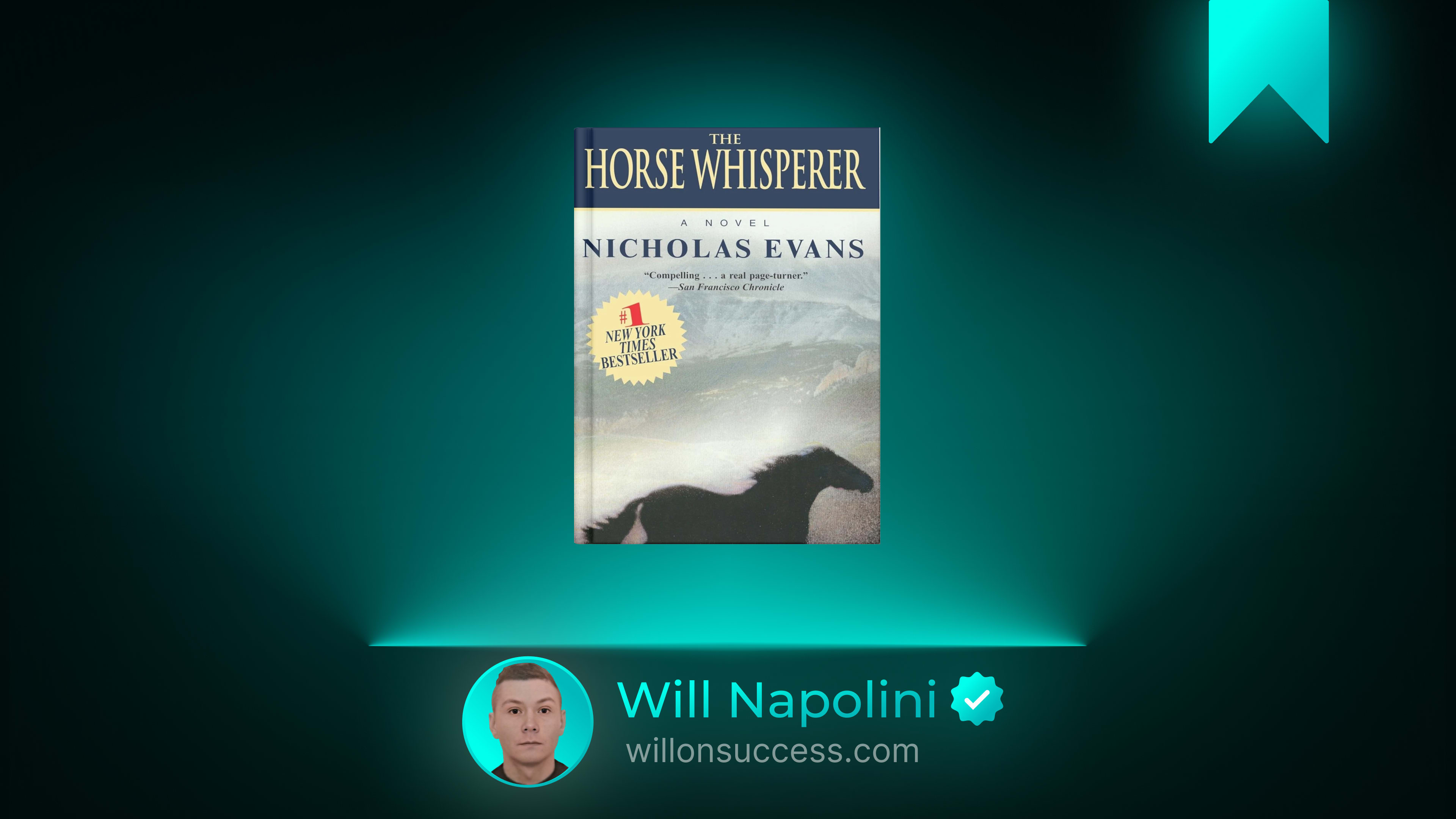
Nicholas Evans’ The Horse Whisperer is a work of fiction, but it carries a psychological truth so steady it has outlasted decades of reading lists and cultural shifts. It is the story of a teenager named Grace, her mother Annie, a severely traumatized horse named Pilgrim, and a quiet Montana horseman named Tom Booker. On the surface, it is a narrative about training horses. At its center, it is a mirror held up to our own impatience, our fear of losing control, and the quiet, unglamorous work of earning trust.
What I discovered when I sat with this book was not a new tactic for productivity or a clever framework for discipline. I found a reminder of a principle I had to relearn more times than I care to admit: you cannot rush what requires root.
The Big Idea
The central truth of The Horse Whisperer is simple, though rarely easy to practice: healing and trust cannot be manufactured; they can only be cultivated through patient, consistent presence.
Annie, Grace’s mother, approaches her daughter’s trauma the way many of us approach our own struggles. She researches. She plans. She drives across the country. She demands timelines. She wants a solution she can hold onto, a guarantee that the pain will end if she simply pushes through it with enough determination. It is a posture born of love, but it is also a posture born of panic.
Tom Booker operates differently. He does not argue with the horse. He does not force the girl. He watches. He waits. He learns the rhythm of their fear before he ever asks for their cooperation. He understands that trauma shrinks the world to a single point of survival, and that the only way to widen that world again is to prove, slowly and repeatedly, that you are not another source of pressure.
This is the book’s quiet thesis: when something is wounded, your first responsibility is not to fix it. Your first responsibility is to make it safe enough to begin healing.
That idea applies far beyond Montana pastures. It applies to the relationship you are trying to mend. It applies to the habit you keep breaking. It applies to the career transition that feels stalled. It applies to the part of yourself you keep criticizing into submission. You do not need more force. You need better conditions. You do not need louder commands. You need clearer signals.
The Story That Holds the Lesson
The novel opens with a riding accident that changes everything. Grace Maclean and her friend are thrown from their horses during a storm. Pilgrim, Grace’s horse, survives but becomes dangerously unpredictable, mirroring Grace’s own internal fracture. Her leg is severely injured. Her confidence shatters. Her mother Annie, terrified of losing her daughter to trauma or death, decides to take matters into her own hands. She flies to Montana to find Tom Booker, a man known for working with horses that others have given up on.
When Annie arrives, she brings her New York pace. She wants results. She wants reassurance. She wants Tom to explain his methods so she can manage them, optimize them, and guarantee them. Tom offers none of that. Instead, he introduces her to a different way of moving through the world.
He does not start by breaking the horse. He starts by understanding it. He reads the tension in its muscles. He notices where it braces. He gives it space to choose cooperation over flight. He moves slowly enough that the animal can register his intention before it feels threatened. He lets silence do the heavy lifting.
Grace, watching from a distance, begins to absorb the same rhythm. She stops trying to outrun her fear. She starts to sit with it. She learns that trust is not a switch you flip. It is a bridge you build, one plank at a time, often in fog, without knowing exactly when you will reach the other side.
The story is not sentimental. It does not promise that patience erases pain. Pilgrim does not become a gentle parade horse overnight. Grace does not magically forget the accident. Annie does not suddenly stop being anxious. But something shifts. The relationship to the problem changes. The posture softens. The grip loosens. And in that loosening, space opens for actual progress to take root.
You Cannot Force a Wounded Heart to Trust
We live in a culture that rewards intensity. We applaud the sprint, the pivot, the aggressive overhaul. We measure commitment by how loudly we announce it and how quickly we demand results. But intensity is a poor substitute for consistency, especially when dealing with fragile things.
Tom Booker’s approach reveals a hard truth: pressure creates resistance. When you push against a terrified animal, it braces. When you corner a frightened person, they shut down. When you try to bully your own nervous system into compliance, it rebels. The body remembers what the mind wants to forget. The only way forward is to stop treating fear like a flaw and start treating it like a signal.
If you are trying to change a habit, rebuild a relationship, or recover from a setback, ask yourself what kind of environment you are creating for that change to survive. Are you surrounding yourself with urgency, guilt, and unrealistic deadlines? Or are you building a space where small, repeated attempts can happen without punishment?
What you repeat in private eventually becomes visible in your life. If you repeat the pattern of demanding immediate perfection, you will train yourself to fear failure more than you desire growth. If you repeat the pattern of gentle correction and steady return, you will train yourself to trust the process.
The Illusion of Control and the Cost of Rushing
Annie’s journey is the journey of anyone who has tried to love, lead, or heal through sheer willpower. She arrives in Montana believing that if she can just figure out the right sequence, the right conversation, the right intervention, she can restore what was lost. She wants a map. Tom offers a compass.
A map assumes the terrain is fixed and the path is clear. A compass acknowledges that the ground shifts, the weather changes, and you must adjust your steps while keeping your direction steady.
We do this with our careers. We do this with our finances. We do this with our marriages and our friendships. We draft five-year plans as if life will cooperate with our spreadsheets. When it does not, we interpret the deviation as personal failure rather than natural friction.
The book shows us that control is often a costume we wear to hide our anxiety. We grip tightly not because we are strong, but because we are afraid of what happens when we let go. Yet letting go is not surrender. It is calibration. It is the recognition that you cannot manufacture trust, you can only offer it and wait to see if it is met halfway.
A small decision becomes a direction, and a direction repeated long enough becomes a life. If your direction is always toward speed, you will exhaust yourself. If your direction is toward awareness, you will eventually outpace your own resistance.
Healing Happens in the Space Between Actions
One of the most quietly radical ideas in the novel is that nothing is sometimes the most effective thing. Tom does not fill every moment with instruction. He does not crowd the horse. He does not talk to fill the silence. He allows the animal time to process, to weigh risk, to make a choice.
We rarely give ourselves that courtesy. We stack our days with tasks, our minds with noise, our relationships with unsolicited advice. We mistake motion for progress. We fill the silence because silence forces us to sit with the discomfort of not having an answer yet.
But growth requires room. Muscles tear to rebuild. Seeds crack open in the dark. Ideas ferment before they surface. If you never create space between your efforts, you never allow the integration to happen. You are constantly applying fertilizer to soil that has not had time to absorb what you already planted.
When you are working through something difficult, resist the urge to constantly intervene. Step back. Observe. Let the new behavior have time to settle. Let the conversation breathe. Let your nervous system register safety before you ask it to perform.
What you do not do can be just as important as what you do. The pause is not empty. It is where the work settles into the foundation.
Presence Outweighs Performance
Tom’s reputation is built not on tricks, but on attention. He watches how the horse shifts its weight. He notices the flick of an ear. He reads the tension in a jaw. He meets the animal where it actually is, not where he wishes it were.
This is the difference between managing a situation and actually understanding it. We often skip straight to solutions because sitting with reality feels like wasting time. But you cannot solve a problem you have refused to fully see.
In your own life, presence means noticing what is actually happening before you decide what you want to happen to change. It means asking your partner what they need instead of assuming. It means tracking your energy instead of ignoring it until you crash. It means admitting you are exhausted instead of powering through on fumes. It means looking at your finances without flinching, then making a plan that accounts for reality rather than optimism.
Presence is not passive. It is precision. It is the difference between swinging a hammer at a wall and finding the load-bearing stud. One leaves you bruised and frustrated. The other gives you something solid to build on.
Why This Matters On an Ordinary Tuesday
You may be working hard and still wondering why nothing is changing. You may be reading books, tracking metrics, attending meetings, having hard conversations, and still feeling like you are walking through mud. The problem may not be your effort. The problem may be your posture toward the process.
When you treat yourself or others like machines, you get breakdowns. When you treat yourself or others like living systems, you get adaptation.
This book helps you avoid the mistake of confusing urgency with importance. It helps you recognize that trust is earned in microseconds and destroyed in milliseconds. It shows you that the fastest way to break something is to demand it bend too quickly.
What changes when you apply this? You stop fighting your own humanity. You stop punishing yourself for needing time. You start building systems that account for friction rather than ignoring it. You learn to ask better questions. You learn to wait longer. You learn that consistency is not boring; it is protective. It is the difference between a spark that burns out and a fire that stays lit.
Practical Application
Understanding this idea is one thing. Living it is another. Here is how you can begin translating this wisdom into your daily rhythm.
1. The Three-Breath Rule Before Intervention Before you correct a habit, address a conflict, or tackle a stalled project, pause. Take three slow breaths. Ask yourself: Am I acting from clarity or from anxiety? If it is anxiety, wait. Give the situation twenty minutes or a full day. If it is clarity, proceed with measured steps. Anxiety produces reaction. Clarity produces response.
2. Map the Friction, Don’t Just Push Through It When something feels consistently difficult, stop labeling yourself as undisciplined or broken. Instead, document the exact moment the resistance shows up. Is it a time of day? A specific trigger? An unclear next step? Write it down. Naming the friction removes its power to masquerade as personal failure. Once you see it clearly, you can design around it instead of fighting it.
3. Replace “Fix It” With “Create Conditions” For the next week, when you notice yourself trying to force a result, shift your question. Instead of How do I make this work right now? ask What conditions would make this easier to sustain? That might mean removing a distraction, setting a smaller target, adjusting your schedule, or asking for help. You are still taking action, but you are acting on the environment, not just the outcome.
4. Journal Prompt: Where Am I Rushing What Requires Roots? Spend ten minutes writing honestly about one area of your life where you are demanding immediate results. What would patience look like here? Not passive waiting. Not avoidance. What would steady, consistent, low-pressure effort look like? Write out three small actions you could take daily that honor the timeline of actual growth rather than your anxiety.
5. Practice Strategic Silence In your next difficult conversation, whether with a colleague, a family member, or a friend, make it your goal to listen longer than you speak. Do not prepare your response while they are talking. Let the silence sit after they finish. You will be surprised by how often people resolve their own tension when given the space to hear themselves think. Silence is not empty. It is an invitation.
Who Should Read This Book
The Horse Whisperer will resonate most deeply with readers who are navigating recovery, rebuilding trust, or learning to lead with patience rather than pressure. If you have experienced a setback that left you questioning your own resilience, if you find yourself constantly trying to manage other people’s emotions or outcomes, or if you are tired of burnout-driven productivity, this novel will feel like a quiet conversation with someone who understands the weight you carry.
It is less useful for readers seeking step-by-step tactical guides, financial frameworks, or rapid skill-acquisition strategies. It does not hand you a checklist. It hands you a mirror.
What makes it worth reading is its refusal to romanticize healing. It shows the cost of impatience. It honors the dignity of slow progress. It reminds us that love without boundaries becomes control, and effort without direction becomes exhaustion. It is a story that stays with you long after the last page, not because of what it tells you to do, but because of how it changes the way you see what you are already doing.
One Small Step
Before you close this article, choose one thing you have been trying to force. It could be a habit you want to build, a conversation you need to have, a project you are avoiding, or a part of yourself you keep criticizing.
Set a timer for fifteen minutes. Sit quietly. Do not plan. Do not strategize. Just observe what you actually feel when you stop pushing. Notice where the tension lives. Notice what your mind reaches for to fill the quiet. When the timer ends, write down one small adjustment you will make tomorrow that honors patience over pressure. Maybe it is breaking a task in half. Maybe it is scheduling a walk instead of scrolling. Maybe it is simply going to bed thirty minutes earlier so you do not start the next day already depleted.
Then do it. Not because it will solve everything. But because it will teach you how to move differently.
The Door Opens Forward
You do not need to become someone else to move forward. You need to become more honest about who you already are, and more patient with how long it takes to change. Force might break open a door, but it rarely builds a home. Trust, presence, and steady repetition will.
If you have been carrying the weight of expectations that were never yours to hold alone, set them down for a moment. Breathe. Look at what is actually in front of you. Adjust your posture. Take one step that honors the timeline of real growth.
The path does not appear when you are ready. It appears when you begin to walk differently.
A quiet rhythm, kept long enough, will outlast every sudden storm.