The Human Design Workbook by Karen Curry Parker: A Practical Guide to Living by Your Own Blueprint
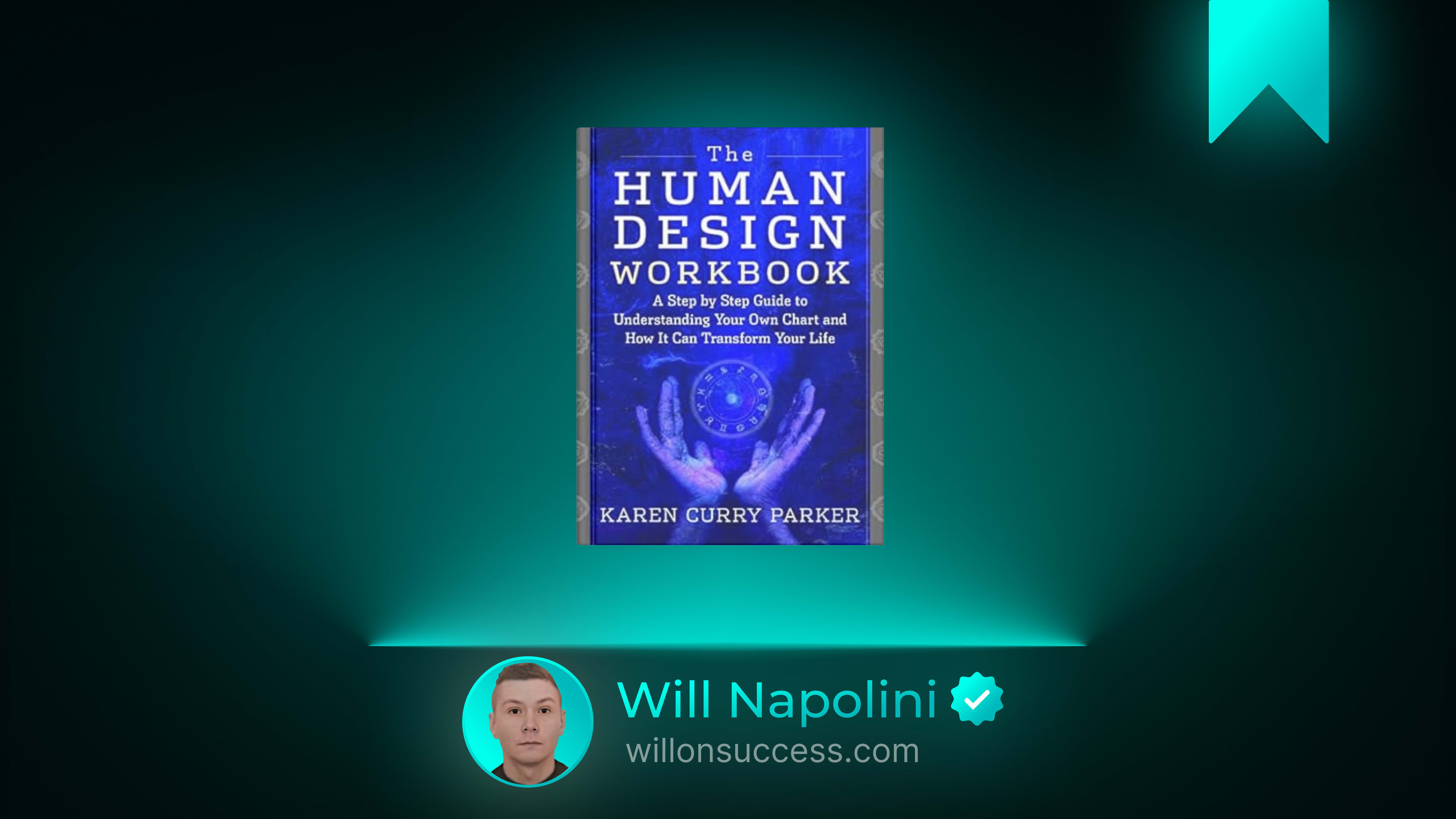
I want to show you an idea that changed the way I think about why some days feel effortless while others feel like pushing a boulder uphill. What if the friction you keep experiencing isn’t a character flaw, but a mismatch between how you’re trying to live and how you’re actually built?
The Big Idea
Karen Curry Parker’s The Human Design Workbook does not ask you to fix yourself. It asks you to stop guessing. The central premise is straightforward: every person operates with a distinct energetic architecture, complete with natural rhythms, decision-making mechanisms, and interaction patterns. When you try to force yourself into a one-size-fits-all model of productivity, leadership, or relationship dynamics, you create resistance. When you learn your blueprint and design your life around it, the resistance fades.
The book is less about mystical chart-reading and more about practical self-management. It translates an ancient, complex system into a series of grounded exercises, worksheets, and daily practices that help you recognize your natural strengths, make decisions with clarity, and conserve the energy you’ve been wasting on fighting your own nature. You do not need more willpower. You need a strategy that matches your actual design.
The Framework That Replaces Guesswork
At the heart of the book is a simple but powerful shift in perspective: you are not broken; you are just reading the wrong manual. Human Design maps your personality and energy through a system called the BodyGraph—a visual chart that shows how you process information, make decisions, and interact with others. Curry Parker strips away the esoteric jargon and focuses on what actually moves the needle in real life: your Type, your Strategy, and your Authority.
Your Type describes how your energy is naturally meant to initiate and respond. Your Strategy is the specific way you should interact with life to minimize friction. Your Authority is your inner decision-making center—the reliable guide that tells you what is truly right for you, often long before your logical mind catches up. The workbook format exists for a reason. Understanding your chart on paper means little until you test it against your actual habits, choices, and relationships. The book walks you through that translation process step by step, turning abstract theory into observable behavior.
Your Energy Type Is Not a Personality Trait, It’s an Operating System
We tend to think of personality as something we can consciously edit. Human Design suggests something different. Your Type is closer to an operating system. It dictates how you are meant to engage with opportunities, manage your energy, and interact with the world. Whether you are a Generator, Manifestor, Projector, Manifesting Generator, or Reflector, each Type comes with a specific way of initiating and responding. Generators and Manifesting Generators thrive on response and sustained momentum. Manifestors are built to initiate but must learn to inform before acting. Projectors are designed to guide and manage, waiting for recognition before stepping into their roles. Reflectors sample the environment and need time to gain clarity.
Here is what I have learned from watching people ignore this: you can push against your Type for years, but the cost is exhaustion. When you try to force initiation when your design calls for response, or when you try to manage others before you have been invited in, you create friction. The book does not ask you to change your Type. It asks you to stop fighting it. Once you recognize your natural operating system, you stop taking fatigue as a personal failure and start treating it as feedback.
Decision-Making Has an Inner Compass You’ve Been Ignoring
Most of us make decisions from the head. We list pros and cons, weigh external expectations, and hope our intuition will somehow catch up. Human Design introduces a different approach: decision-making through your Authority. Your Authority is not a vague feeling. It is a specific, measurable inner signal tied to your energy centers. Some people decide through gut responses, others through emotional clarity that only arrives after time passes, some through instinctive flashes, and others through a slower sampling process. The workbook spends considerable time helping you identify your Authority and then giving you exercises to test it.
I have seen this happen repeatedly: someone discovers their Authority is emotional, meaning their true yes or no only reveals itself after a period of stillness. Yet they have spent their entire career saying yes immediately to please others, then resenting the commitment three weeks later. When they finally honor their actual decision-making rhythm, the resentment evaporates. The mechanism is simple. You stop outsourcing your choices to logic alone. You learn to wait for your specific inner signal. You stop asking, “What should I do?” and start asking, “How does my system respond to this?”
Conditioning Creates Friction; Alignment Creates Flow
From the moment we are born, we are shaped by family, culture, education, and media. We absorb messages about how success should look, how relationships should work, and how decisions should be made. Human Design calls this conditioning. It is not evil. It is simply inaccurate for your specific design. The workbook treats conditioning like noise in a radio signal. You do not need to destroy it. You just need to learn how to tune your dial back to your own frequency.
When you operate from conditioning, you mimic other people’s strategies. You chase external validation. You confuse intensity with progress. When you operate from alignment, you stop performing and start participating. The shift does not happen overnight. It happens through repeated attention. You notice when you are forcing a path. You notice when you are saying yes out of guilt rather than genuine response. You begin to design your days around your actual energy peaks and troughs instead of someone else’s productivity template. Alignment is not passive. It is strategic. It means placing yourself in environments, relationships, and roles that match your blueprint rather than trying to force your blueprint to match your current circumstances.
Practical Mapping Turns Theory Into Daily Behavior
Ideas without application are just intellectual decoration. The strength of this workbook lies in its insistence on translation. Curry Parker does not leave you with a beautiful chart and a shrug. She provides structured exercises, reflection prompts, and behavioral experiments that bridge the gap between understanding and living. You learn how to track your energy, identify your decision-making patterns, and recognize when you are slipping into conditioned behavior. You map out your workday, your relationships, your communication style, and your boundaries through the lens of your design.
I have always believed that growth before achievement is the only sustainable path. This book embodies that principle. You do not read it to become more impressive. You read it to become more accurate. When your daily choices match your internal architecture, you stop leaking energy into the wrong projects, the wrong conversations, and the wrong commitments. The workbook format ensures that you do not just consume the material. You practice it. You make mistakes. You adjust. You let consistency outperform intensity.
Why It Matters
You may be working hard and still wondering why nothing is changing. You may be making decisions quickly, only to regret them later. You may be pouring energy into relationships or careers that constantly drain you, assuming that burnout is just the price of ambition. This framework changes the conversation. It shifts the question from “How do I push harder?” to “How do I work with my actual design?”
On an ordinary Tuesday, this looks like pausing before you send that email, asking whether you are responding to a genuine opening or forcing an initiation. It looks like recognizing that your need for space is not a flaw but a requirement for clarity. It looks like waiting for your emotional wave to settle before making a life-altering choice. It looks like designing your work schedule around your natural energy cycles instead of fighting a template that was never meant for you.
The mistake this helps you avoid is the assumption that everyone succeeds through the same mechanism. They do not. When you stop copying other people’s playbooks and start reading your own, you reclaim time, energy, and peace. You stop confusing exhaustion with virtue. You start building a life that fits, rather than forcing yourself into a life that does not. Character development begins when you stop pretending to be someone else and start honoring how you actually operate. External results often follow internal alignment.
Practical Application
Understanding your blueprint is only the beginning. The real work happens in the quiet moments when you choose to act differently. Here is how you can begin applying these principles immediately.
First, identify your Type and Strategy. Calculate your chart using a reputable Human Design generator. Note your Type and the corresponding Strategy. For the next seven days, track every decision, invitation, and opportunity. Before you act, ask: Am I following my Strategy, or am I forcing it? Write down what happens when you wait for the right opening versus when you push against it. Notice the difference in your energy levels by the end of each day.
Second, locate your Authority. The workbook provides clear guidance on how each Authority signals. Once you know yours, build a personal decision protocol. If your Authority is emotional, commit to a twenty-four- to forty-eight-hour waiting period before saying yes to anything that alters your routine. If your Authority is sacral, practice listening to your immediate bodily response to simple choices throughout the day. If your Authority is splenic, notice your first, quiet instinct before your mind starts negotiating. Treat your Authority as a muscle. You train it through repetition, not theory.
Third, run a conditioning audit. Pick one area of your life where you consistently feel resistance. It could be your communication style, your work rhythm, or how you handle conflict. Ask yourself: Whose voice am I following here? Is this my actual preference, or is this an expectation I absorbed years ago? Write down three ways you could adjust this area to better match your natural design. Test one adjustment this week. Keep what works. Discard what does not.
Fourth, design a weekly energy map. Instead of scheduling tasks randomly, block time according to your natural peaks and troughs. Place high-focus work during your strongest hours. Leave open margins for response and rest. Track your fatigue levels for two weeks. You will quickly see where you have been swimming upstream. Adjust your calendar accordingly. Let your schedule serve your design, not your calendar dictate your design.
Who Should Read This Book
This book is most useful for readers who feel stuck in cycles of burnout, decision fatigue, or chronic misalignment. It is particularly valuable for entrepreneurs, coaches, creative professionals, and leaders who want to build sustainable systems rather than rely on willpower. It is also helpful for anyone who has tried countless productivity frameworks and found that nothing sticks long-term. The workbook format rewards readers who prefer hands-on practice over abstract theory.
It may be less useful for readers looking for quick fixes, rigid step-by-step success formulas, or purely clinical psychological models. Human Design is a synthesis of ancient systems and modern coaching, and it operates on an energetic rather than strictly empirical framework. If you prefer heavily statistical research, you may find the system unfamiliar. If you are open to self-experimentation and practical reflection, you will find the workbook deeply applicable. The book is worth reading not because it promises perfection, but because it offers a reliable method for self-trust and energetic honesty.
One Small Step
You do not need to overhaul your life today. You only need to interrupt one conditioned pattern. Choose one decision you would normally make immediately. Pause. Wait for your inner signal, whether that means sleeping on it, checking your gut, or allowing time for emotional clarity. Write down what happens when you honor that signal. Let that single pause become the beginning of a new rhythm.
The deepest idea here is not about charts or types or strategies. It is about permission to stop performing and start participating in your own life. You have spent years trying to fit yourself into a mold that was never designed for you, mistaking friction for failure. Alignment does not mean you will never face difficulty. It means you will face difficulty with the right tools, at the right pace, and with your energy intact. I have walked alongside people who finally stopped forcing their way forward and discovered that the path was already there, waiting for them to walk it naturally. The shift begins with one honest question before you act: Does this match my design, or am I repeating someone else’s pattern? Write your answer down. Let it guide your next choice. A life that fits you does not arrive through force. It arrives through attention. Start listening to your own blueprint, and watch how much lighter the work becomes.