The Practicing Mind: Why Loving the Process Is the Skill You Never Knew You Needed
You have probably felt this before. You finish one goal, and instead of satisfaction, you feel the quiet pressure of the next one. You check something off the list, and the list simply grows longer. You tell yourself, Once I get there, I’ll finally feel like I’ve made it. But “there” keeps moving.
What if the problem is not that you lack discipline, or that your goals are wrong, or that you simply haven’t worked hard enough? What if the problem is that you have been taught to live at the finish line of every task, when life only ever happens in the middle of one?
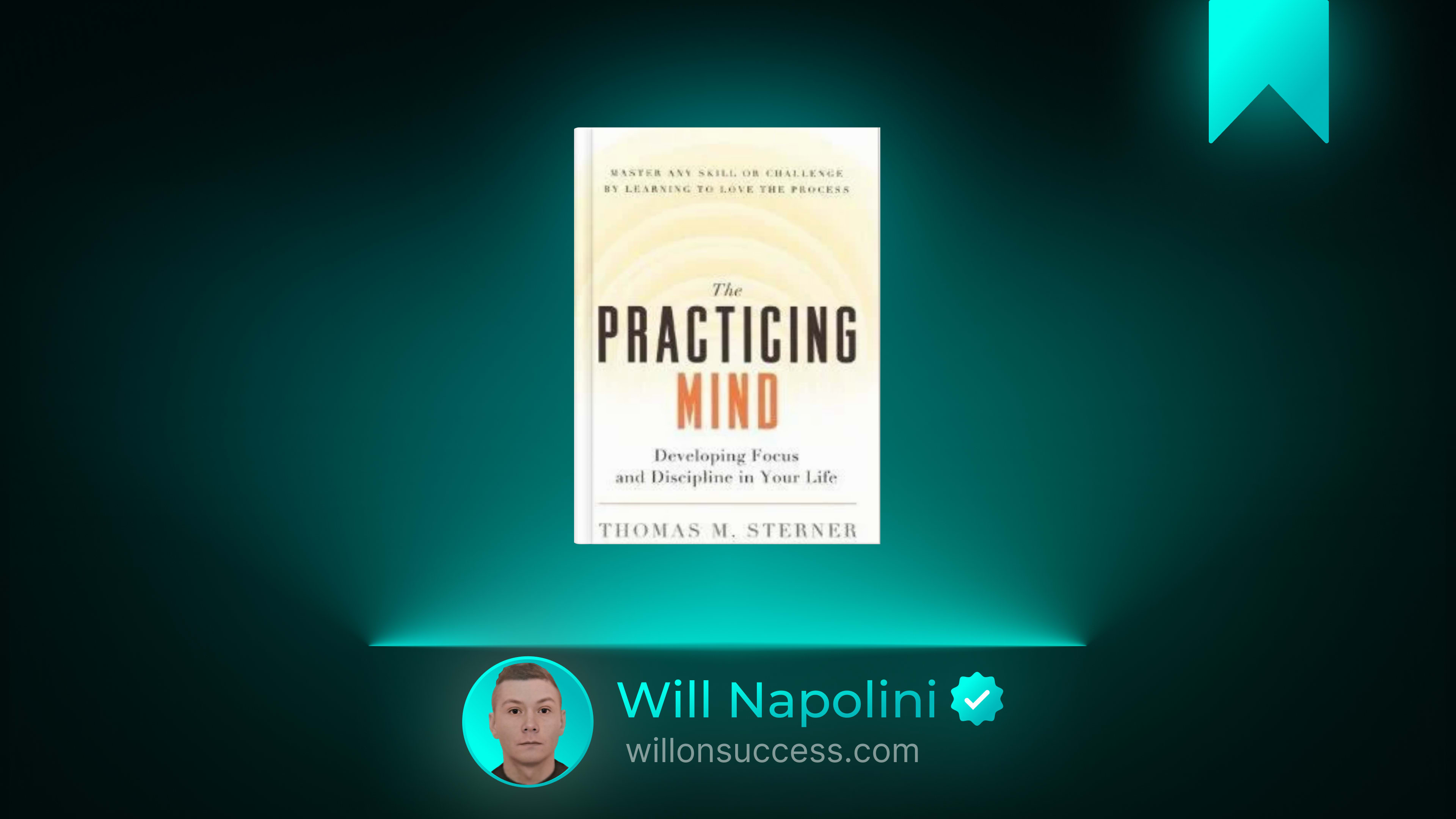
Thomas M. Sterner spent decades as a concert pianist and piano technician, watching himself and others struggle against the grinding repetition that mastery demands. Out of that long apprenticeship with patience came a small, quietly radical book called The Practicing Mind. Its central claim is deceptively simple: the way you practice anything—scales, spreadsheets, conversations, cooking dinner—shapes not just the result you get, but the person you become while getting it.
I have returned to this idea again and again over the years, and each time it lands a little deeper. Let me walk you through what Sterner teaches, and more importantly, how it changes the way you move through an ordinary week.
The Big Idea: You Are Already Practicing Something
Sterner’s foundational observation is this: you do not need to be a musician or an athlete to be in practice. You are always practicing. Every repeated thought, every habitual response, every way you handle frustration is a rehearsal. The question is never whether you are practicing. The question is what.
If you rehearse impatience every time traffic slows down, you are practicing impatience. If you rehearse self-criticism every time a project falls short, you are practicing self-criticism. These rehearsals are not neutral. They build grooves, the way water carves a canyon over years. What you repeat in private eventually becomes visible in your life.
This reframing matters because it removes the separation between “real practice”—the deliberate hour at the piano or the gym—and everything else. Your Tuesday morning commute, your response to a difficult email, the way you fold laundry while thinking about tomorrow’s meeting: all of it is practice. The shift Sterner invites is not to add more structured practice to your schedule. It is to bring the quality of attention, patience, and non-judgment that a good practice session requires into the hours you are already living.
The Child at the Piano Bench
One of the most useful images in the book comes from watching young children learn. Sterner observed that small children do not practice the way adults do. A four-year-old learning to tie her shoes does not think, I have been at this for three minutes and I still cannot do it. I must be defective. She tries. She fumbles. She tries again. The attempt itself is interesting to her. The result is secondary.
Somewhere along the way, most of us lost that. We replaced curiosity about the process with anxiety about the product. We began measuring every effort against an imagined endpoint and calling ourselves failures for not being there yet. Sterner’s point is not that goals are bad. Goals give direction. But when the goal becomes the only thing you can see, the present moment becomes nothing more than an obstacle between you and the future you actually want.
Think of it like walking through a forest toward a mountain you can see in the distance. If your eyes are locked on the peak, you trip over roots, miss the stream beside the trail, and arrive exhausted and resentful. If you walk with awareness of each step while keeping the mountain in your peripheral vision, you arrive stronger, more alert, and honestly more changed by the journey.
The mountain gives you direction. The walking gives you life.
Patience Is a Practice, Not a Personality Trait
One of the ideas I found most freeing in this book is Sterner’s treatment of patience. Most of us treat patience as something we either have or lack, like eye color. I’m just not a patient person, we say, as though it were a fixed feature of our wiring.
Sterner disagrees. Patience, in his view, is a skill built through repetition, the same way a pianist builds finger independence. You do not start with it. You develop it by noticing impatience, choosing not to act on it, and returning your attention to the task in front of you. Again and again. The impatience does not vanish. You simply stop letting it drive.
This matters because it means you are not broken for feeling frustrated. You are in training. The frustration is not evidence of failure; it is the resistance you work against to build the muscle. A weightlifter does not call the heaviness of the bar a sign that something is wrong. The heaviness is the point. In the same way, the discomfort of slowing down, of staying with a task you would rather rush through, is where the actual growth lives.
The Four Adjustments: Simplify, Small, Short, Slow
When Sterner discusses how to structure practice—whether at the piano or in daily life—he returns to a set of adjustments that I think of as turning down the volume so you can actually hear the music.
Simplify. Reduce the task to its essential components. Do not try to overhaul your entire life by Thursday. Pick one element.
Small. Make the unit of work small enough that you can complete it without feeling overwhelmed. One page. One conversation. One honest sentence in a journal.
Short. Keep practice sessions brief enough that you can sustain attention. You can always do another short session. You cannot recover a long one spent in fog.
Slow. Move slower than feels natural. Speed often disguises avoidance. When you slow down, you notice what you are actually doing instead of performing the gesture of doing it.
These are not rules. They are dials. Some days you turn them all the way down. Other days you loosen one. The principle underneath all four is the same: make the next step so clear and so manageable that you can take it without arguing with yourself first.
Self-Judgment Is the One Thing You Cannot Practice Your Way Out of—By Practicing It
Here is where the book gets genuinely challenging, and where I think most readers either lean in or set it down.
Sterner argues that self-judgment is itself a form of practice. Every time you think, I should be further along by now, you are rehearsing a narrative of inadequacy. That rehearsal does not motivate you. It drains the energy you would otherwise spend on the actual work. It turns practice into punishment, and punishment is something you naturally want to avoid. So you procrastinate. Not because you are lazy. Because your inner environment has made the work feel like a courtroom instead of a workshop.
The alternative is not positive affirmations pasted over the same judgment. The alternative is observation without verdict. You notice the mistake. You correct it. You move on. A piano student who hits a wrong note does not need to deliver a speech about what kind of person hits wrong notes. They play the passage again.
This does not mean you lower your standards. It means you separate the evaluation of the work from the evaluation of your worth. Those two things have been tangled together for most of us since childhood, and untangling them is slow, quiet work. But it is possible. And it changes everything about whether you can sustain effort over years instead of weeks.
What This Looks Like on an Ordinary Tuesday
Let me bring this down to ground level, because principles that only work in theory are not principles. They are decorations.
You wake up. You have a project due at work that you have been putting off. The old pattern says: feel a spike of dread, scroll your phone for twenty minutes to numb the dread, then rush through the task feeling behind and resentful.
The practicing-mind version looks different. You sit down. You open the document. You notice the dread. You do not argue with it. You set a small intention: I will work on this for twenty minutes and focus only on the next paragraph. You do not think about the finished product. You do not grade yourself for how slow you are. You write the paragraph. Then the next. If your mind wanders, you bring it back, the way you would gently redirect a child’s hand back to the keys.
The work gets done. But more importantly, you have practiced something other than avoidance. You have rehearsed presence. And that rehearsal compounds.
The same logic applies to washing dishes, to listening to your partner after a long day, to the third rep at the gym when you would rather rack the weight. Each of those moments is a vote for the quality of attention you want your life to be built from.
The Paradox at the Center
There is a paradox Sterner returns to, and it took me several readings to feel it fully. The paradox is this: you will achieve better results by caring less about the result and more about the doing.
This sounds like a fortune cookie until you test it. Think about the last time you were so absorbed in a task—cooking, writing, building something, solving a problem—that you forgot to check the clock. The quality of what you produced was almost certainly higher than the last time you worked while mentally calculating how much was left. Absorption produces excellence. Anxiety about the finish line produces tension, and tension produces shortcuts.
You do not have to abandon ambition. You are allowed to want the promotion, the finished book, the stronger body, the deeper relationship. Sterner is not asking you to stop wanting. He is asking you to stop letting the wanting poison the doing. The wanting points you toward the mountain. The doing is the trail beneath your feet. You need both. But you can only walk one step at a time, and that step is where your life is actually happening.
Who Will Benefit Most From This Book
If you are someone who sets ambitious goals but feels quietly exhausted by the gap between where you are and where you think you should be, this book will feel like permission to breathe. If you struggle with perfectionism, procrastination born of anxiety, or a persistent sense that you are always behind, Sterner’s framework addresses the root rather than the symptom.
It is especially useful for people in long, slow skill-building seasons: musicians, writers, students, athletes, entrepreneurs in the early years, parents raising small children. Anyone whose “result” is years away but whose daily life is made of small, unglamorous repetitions.
I will be honest about where the book may not land as well. If you are looking for high-energy motivation, tactical productivity systems, or a step-by-step plan for a specific goal, this is not that book. It is quieter than that. It is more about the orientation you bring to your systems than about the systems themselves. Some readers may find the pacing slow. That slowness is, of course, the point. But it helps to know what you are walking into.
A Practice You Can Start Before You Finish Reading
I want to leave you with something concrete, because understanding without action is just a pleasant afternoon.
Here is a small experiment. Choose one routine task you do every day—making coffee, brushing your teeth, walking from your car to your office, washing a single dish after dinner. Tomorrow, do that one task with full attention. No phone. No mental rehearsal of your to-do list. Just the warmth of the water, the sound of the spoon, the feel of your feet on the floor.
You will drift. That is fine. Notice the drift and come back. You are not meditating on a mountaintop. You are washing a dish. But you are doing it the way a musician plays a scale: slowly, attentively, without judging whether the scale is “good enough” to perform yet.
Do this for one task, once a day, for a week. That is all. You are not trying to become enlightened. You are practicing the skill of being where you are while you are there. And that skill, built one small repetition at a time, changes how you show up everywhere else.
You start small. You stay present. You let the repetition build something you cannot yet see.
The Door That Stays Open
What Sterner helped me understand, and what I hope lands for you, is that you do not need to arrive somewhere before your life counts. You are not in a waiting room for a future version of yourself who will finally be disciplined enough, successful enough, patient enough to deserve the present moment.
You are in practice now. You have always been in practice. The only question that has ever mattered is whether you practice with awareness or on autopilot, with patience or with self-punishment, with attention to the step or only to the distant peak.
You do not need to fix everything tonight. You need to choose one small thing and do it with your whole attention, gently, without verdict.
Tomorrow, you do it again.
And the doing becomes the life you were always trying to get to.