The Prophet by Kahlil Gibran: Why These Poetic Truths Still Cut Through the Noise of Modern Life
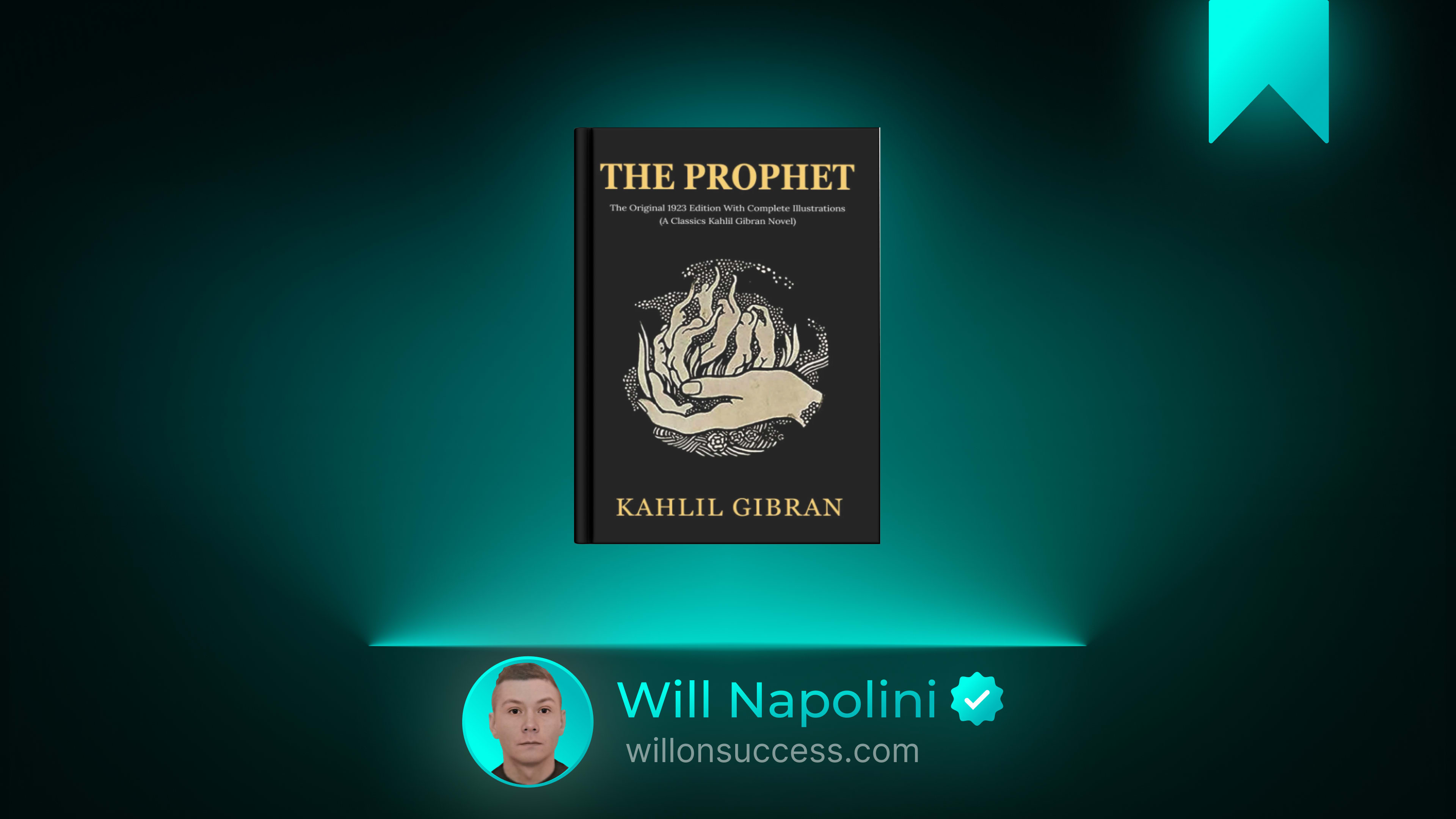
There is a small book, barely a hundred pages long, written over a century ago by a Lebanese immigrant who painted, drew, and wrote in a cramped Boston studio. It contains no system, no ten-step framework, no productivity hack. And yet people keep returning to it—during weddings, during funerals, during the quiet 2 a.m. hours when the noise of the world finally falls away and you are left alone with the question you have been avoiding.
The question is this: How am I supposed to live?
Not how to optimize your Tuesday. Not how to build a personal brand. How to actually live—through love, through work, through grief, through the strange and sometimes unbearable beauty of being a conscious person in a world that keeps asking you to be something smaller than you are.
Kahlil Gibran published The Prophet in 1923. If I could sit across the table from you and press this book into your hands, I would say: do not read it the way you read most books. Do not skim it for takeaways. Read it slowly. Read one section, then close it, then walk outside and let it settle into you the way rain settles into dry soil.
Because this book does not give you answers. It gives you better questions. And better questions, held honestly, slowly rebuild a life.
The Frame: A Man Leaving a City, Asked to Speak Before He Goes
The structure of The Prophet is deceptively simple. A man named Almustafa has lived in the city of Orphalese for twelve years. He is waiting for the ship that will carry him home. As he walks toward the harbor, the people of the city gather around him. They are not asking for advice in the way we usually mean it. They are asking him to speak truth into the parts of life they cannot quite name.
One by one, they ask: Speak to us of love. Speak to us of work. Speak to us of children. Speak to us of sorrow. Speak to us of freedom.
And Almustafa speaks. Twenty-six short essays. Each one a few pages long. Each one addressing a dimension of human experience that we all face but rarely examine with honesty.
What strikes me, every time I return to this book, is that Gibran never speaks down. Almustafa does not lecture. He describes. He holds up a mirror made of language and says, in effect: Look. This is what love actually is. This is what work actually means. This is what your pain is doing inside you.
And the reader recognizes something true. Something they have always felt but never had words for.
The Central Idea: You Already Know What You Need—You Have Simply Stopped Listening
If I had to distill the entire book into one principle, it would be this: the wisdom you are searching for is not outside you. It is buried beneath the noise, the hurry, the borrowed opinions, the fear of sitting still. The Prophet does not hand you new information. It clears away the clutter so you can hear what you already suspect to be true.
Gibran wrote this book during a period of intense personal searching. He had lost his mother, his brother, and his sister to illness within a few devastating years. He had emigrated from Lebanon to Boston as a child. He lived between cultures, between languages, between grief and beauty. And out of that tension came a voice that refused to separate joy from sorrow, work from love, freedom from responsibility.
That refusal to separate things is the book’s deepest teaching. We live in a culture that constantly asks you to choose: career or family, ambition or peace, strength or tenderness. Gibran says the division is the illusion. The full life holds both. The full life insists on both.
Love Is Not a Cage—It Is a Space You Protect Together
The section on love is perhaps the most widely read, and perhaps the most misunderstood. Gibran’s Almustafa describes love not as possession, not as merger, not as the erasure of two people into one blurred identity. He describes it as two pillars standing apart, supporting the same temple. The pillars do not collapse into each other. They hold the structure precisely because there is space between them.
I have seen this play out in relationships again and again. Two people fall in love and immediately begin negotiating who will give up what, who will shrink, who will manage the other’s emotions. And slowly, quietly, the love becomes a management project. A negotiation. A performance.
What Gibran points toward is harder and more beautiful than that. Love, in his telling, is the willingness to stand beside another person without owning them. To rejoice in their separate, strange, unfolding self. To protect the space in which they can still become who they are becoming.
If you are in a relationship right now, ask yourself one question tonight: Am I loving this person, or am I managing them? The answer may be uncomfortable. That discomfort is where growth begins.
Work Is Love Made Visible—Not a Punishment You Endure
Here is an idea that changed the way I think about Monday mornings. Gibran writes that work is love made visible. That when you build a house with care, you are weaving a thread of affection into the walls. That when you tend a garden, you are speaking to the earth the way you would speak to someone you cherish.
Now, I know what you are thinking. You are thinking about the spreadsheet you will open at 9 a.m. The email thread that could have been a single sentence. The meeting that exists only because someone is afraid of making a decision alone.
And you are right to think that. Not all work feels like love made visible. Some of it feels like endurance. And I will not pretend otherwise.
But here is what I have learned, and what Gibran’s words helped me see more clearly: the meaning of work is not determined solely by the task. It is shaped by the intention you bring to it. The craftsman who sands a piece of wood for the tenth time is not merely sanding. He is deciding that this object will carry his care into someone else’s life. You can bring that same quality of attention to an ordinary task. Not because the task demands it. Because you do.
Work becomes hollow when it is severed from purpose. Work becomes holy when you reconnect it to the person it serves—even if that person is simply the future version of yourself.
Your Children Are Not Yours to Sculpt
This may be the most necessary and most difficult passage in the entire book. Gibran writes that your children come through you but not from you. They are not yours to shape into a corrected version of your own unlived life. They belong to life itself, to a tomorrow you cannot visit.
He uses the image of a bow and arrows. You are the bow. Your children are the arrows. The archer—life, or God, or whatever word you trust—bends you so that the arrow can fly far. Your job is to be bent willingly. To be stable. To release.
If you are a parent, you know how terrifying that image is. To bend, to hold steady, and then to let go. To watch the arrow fly in a direction you did not choose.
And if you are not a parent, this principle still reaches you. Think of the people you mentor, the friends you advise, the younger colleagues you guide. The temptation is always to sculpt. To fix. To make them into a version of yourself that turned out well. Gibran asks you to resist that temptation. Your role is to steady the bow. Not to aim the arrow.
Joy and Sorrow Are Carved by the Same Hand
One of the most quietly radical ideas in The Prophet is that joy and sorrow are not opposites. They are carved from the same wood. The deeper your capacity for sorrow, the deeper your capacity for joy. The well that holds your laughter is the same well that held your tears.
I think about this when I see people trying to build a life that is only comfortable. Only pleasant. Only free of friction. They curate their days to avoid any difficulty, any loss, any grief. And then they wonder why their joy feels thin. Why happiness arrives and leaves without really touching them.
You cannot selectively numb. If you build walls against sorrow, you build the same walls against depth, against connection, against the kind of joy that makes you catch your breath in an ordinary moment.
Gibran does not romanticize suffering. He does not say pain is good. He says pain is the breaking open of the shell that encloses your understanding. And that breaking, while it hurts, is what allows you to grow into a larger life.
This is not a platitude. This is something you learn in your body, over years, after you have walked through something you thought would end you and discovered, slowly, that it did not. That you are still here. That you are, in some ways you cannot yet name, larger for it.
Freedom Is Not the Absence of Constraint
In a culture that sells freedom as the absence of obligation—no boss, no schedule, no commitments, no roots—Gibran offers a more demanding definition. He suggests that freedom is not found by removing all chains. It is found when you choose your commitments consciously, when your obligations are expressions of your values rather than accidents of circumstance.
Think about that for a moment. The person who has no commitments is not free. They are untethered. And untethered is not the same as free. A river without banks is not a river. It is a swamp. It spreads in every direction and moves toward nothing.
The banks are what give the river its force, its direction, its ability to carve through stone over time.
Your commitments—your work, your relationships, your daily disciplines—are not the walls of a prison. They are the banks of your river. Choose them carefully. Then let them give your life direction and force.
The Quiet Thread: Self-Knowledge Before Self-Improvement
Running through every section of The Prophet is a quieter, more persistent theme than any single topic. It is this: before you can change your circumstances, you must be willing to know yourself. Not the version of yourself you perform for others. Not the version you post online. The actual, complicated, sometimes contradictory person underneath.
Gibran writes that self-knowledge is the beginning of all knowledge. And I believe him. I have seen people read a hundred self-improvement books and change nothing, because they were using the books as armor. As a way to avoid sitting in a quiet room with their own unexamined life.
You do not need another strategy until you have spent honest time with the question: What do I actually want, and what am I doing to avoid it?
That question is uncomfortable. Good. Discomfort is the price of clarity.
Who Should Read This Book—and Who Might Not
The Prophet is for the person who is tired of advice that treats life as a problem to be solved. It is for the reader who wants language for feelings they have had but could never name. It is for anyone navigating love, loss, parenthood, purpose, or the slow work of becoming who they actually are.
It is not a book for someone looking for a structured system or a step-by-step plan. Gibran does not give you a checklist. He gives you a lens. If you need concrete frameworks, you will want to pair this book with more practical resources.
And I will be honest: some readers find the language too elevated, too poetic, too removed from the grit of daily life. That is fair. The book asks you to slow down and meet it in a contemplative register. If you are not in a place where you can do that, it may not land. Set it aside. Come back in a year. It will still be there.
But if you are in a season of transition—leaving a job, ending a relationship, losing someone, becoming a parent, rebuilding after failure—this book will meet you where you are. It has met millions of readers in exactly those places for over a century.
What This Looks Like on an Ordinary Tuesday
Let me bring this down from the poetic to the practical. How do you actually live with these ideas on a regular Wednesday when the laundry is piling up and the inbox is full?
Here is what I would suggest. Not a system. A practice.
One passage, one morning. Choose a single section of The Prophet—perhaps “On Work” or “On Giving” or “On Pain.” Read it slowly over your morning coffee. Not the whole book. One section. Then close the book and carry that one idea into your day like a stone in your pocket. Let it bump against your hours. Let it change the texture of your attention.
One honest question, one evening. Before you sleep, ask yourself one question the book raised. Did I work today as if the work mattered to someone? Did I love today without trying to own? Did I let myself feel what I felt, or did I numb it? Write the answer down. Even one sentence. Especially one sentence.
One small act of giving. Gibran writes that you give but little when you give of your possessions. It is when you give of yourself that you truly give. This week, give someone your full attention. Not a text. Not a half-listening nod while you check your phone. Sit with someone and listen the way you would want to be listened to. That is giving yourself. And it costs more than money.
One Small Step You Can Take Before You Close This Page
Here is what I would ask of you. Not tomorrow. Today.
Find a quiet corner. Five minutes. No phone. Open The Prophet to the section on whatever word is heaviest in your life right now. Love, if love is where the ache is. Work, if work is where the emptiness lives. Sorrow, if sorrow is what you have been carrying without setting down.
Read that section once. Slowly. Out loud, if you can. Let the words land in your chest, not just your mind.
Then write one sentence about what you noticed. One sentence. That is enough. That is the beginning.
Because here is what I have come to believe, after years of reading and rereading this small, strange, luminous book: the truths that change your life do not arrive with fanfare. They arrive quietly, in a few lines of poetry, on an ordinary evening, when you are finally still enough to hear them.
And once you hear them, you cannot unhear them.
You start listening. You start living from what you hear. You let the rest follow in its own time.
The ship is always waiting at the harbor. The question is whether you will walk toward it carrying the life you meant to live, or the one you settled for while you were busy.
You do not have to settle. You never did.
Now go read the first page. The rest will meet you there.