The Universe in You: How Carl Sagan’s Cosmos Rewires Our Sense of Purpose
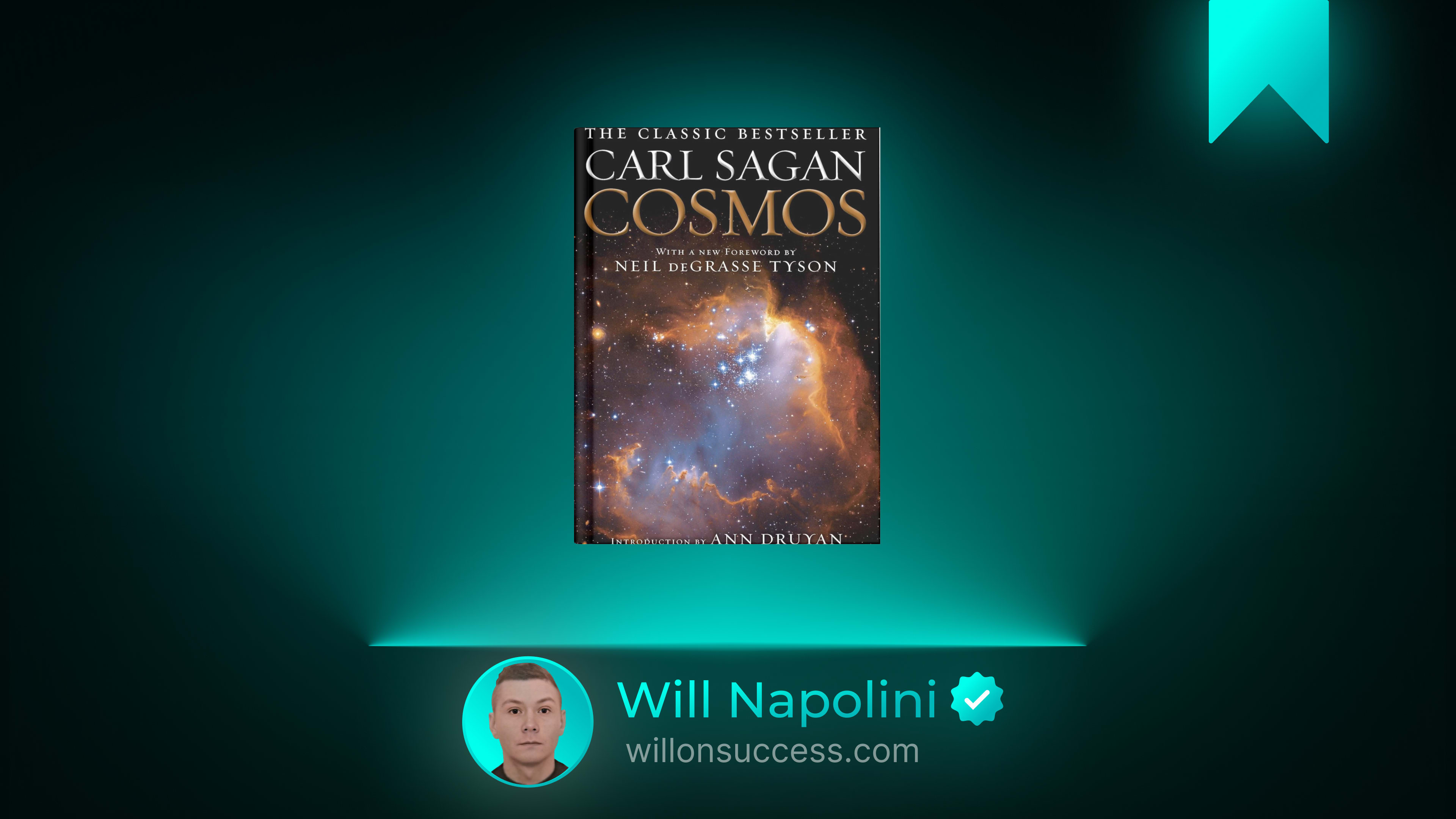
There is a specific kind of vertigo that hits when you truly think about the scale of your life. You are sitting in traffic, or staring at a spreadsheet, or lying awake at 2:00 AM worrying about a conversation you had three days ago, and suddenly the sheer weight of your daily problems feels crushing. We live with our heads down, focused on the immediate, the urgent, the microscopic details of our survival. And because our field of vision is so narrow, our obstacles appear massive.
If I could sit across the table from you right now, I would ask you to do something that feels counterintuitive. I would ask you to look away from the problem. I would ask you to look up.
Long before modern mindfulness apps and productivity frameworks, an astronomer named Carl Sagan offered a different kind of intervention. In his masterpiece Cosmos, Sagan did not just teach us about galaxies and nebulae. He taught us about ourselves. He understood that the most powerful tool for navigating the difficulties of a human life is not a better calendar or a sharper morning routine. It is perspective.
What I discovered in Sagan’s work was not merely a tour of the solar system. I found a profound, grounding philosophy for how to live. He offered a way to shrink our anxieties without shrinking our sense of meaning. He showed me that understanding our place in the vastness of the universe does not make us insignificant. It makes us entirely irreplaceable.
The Big Idea: We Are the Universe Experiencing Itself
Most of us carry a quiet, unexamined assumption that we are separate from the world around us. We think of ourselves as solitary figures walking across a stage, isolated inside our own minds, fighting against an indifferent environment.
Sagan dismantles this illusion with a single, breathtaking scientific fact: The atoms that make up your body were forged in the hearts of collapsing stars. The carbon in your cells, the iron in your blood, the calcium in your teeth—none of it was created on Earth. It was cooked in the nuclear furnaces of ancient stars that exploded billions of years ago, scattering their elements across the void, which eventually coalesced to form our planet, and eventually, you.
From this, Sagan draws his most famous and foundational conclusion: We are starstuff.
But he takes it one step further, into the realm of pure philosophy. He writes that we are not just physical matter. We are matter that has woken up. We are matter that has developed the capacity to think, to feel, to wonder, and to ask questions. Therefore, human beings are not a cosmic accident stranded on a lonely rock. We are a way for the cosmos to know itself.
This is the central thesis of the book, and it changes everything. If you are the universe experiencing itself, then your life is not a meaningless distraction from the void. Your consciousness is the universe’s greatest achievement. Your ability to love, to build, to learn, and to overcome is the mechanism by which the cosmos understands its own majesty.
You do not need to search for a grand, external purpose to validate your existence. Your purpose is built into your very biology. You are here to witness, to understand, and to care for the fragile spark of awareness you have been given.
The Story of the Shadow: Paying Attention to the Ordinary
To understand how Sagan viewed the pursuit of knowledge, we have to look at one of his favorite historical stories, which he recounts in the early chapters of Cosmos. It is the story of Eratosthenes, a librarian in ancient Alexandria, who lived in the third century BCE.
Eratosthenes was reading a papyrus scroll and came across a curious observation. In the southern city of Syene, on the longest day of the year, the sun shone directly down a deep well, casting no shadow. The sun was exactly overhead. But Eratosthenes knew that on that exact same day, in his own city of Alexandria, a vertical stick did cast a shadow.
Most people would have read that fact and moved on. It was a trivial detail. But Eratosthenes stopped. He asked a simple question: Why? If the Earth is flat, the sun should be directly overhead in both places at the same time. The only way a stick could cast a shadow in Alexandria while casting none in Syene is if the surface of the Earth is curved.
He measured the angle of the shadow in Alexandria. He hired a professional walker to pace out the distance between the two cities. Using basic geometry, he calculated the circumference of the entire planet. He was astonishingly close to the actual number, and he did it without leaving his city, using nothing but a shadow, a stick, and the willingness to pay attention.
I love this story because it illustrates a principle that applies far beyond astronomy. Profound truths are rarely hidden in complex, inaccessible places. They are hidden in plain sight, waiting for someone willing to notice the shadows.
You may be working hard and still wondering why you feel stuck. Often, the answer is not that you need to work harder. It is that you are ignoring the shadows in your own life. You are ignoring the small, daily data points—the slight tension in your chest when you open your email, the way you feel drained after spending time with a certain friend, the quiet voice telling you that your current path is misaligned. Eratosthenes changed human history because he refused to ignore a small discrepancy. What small discrepancy in your own life are you currently choosing to overlook?
The Architecture of Awe
One of the most vital emotional tools Sagan provides is the cultivation of awe. In our modern lives, we often view awe as a luxury—a feeling we might experience on a vacation to the Grand Canyon, but not something relevant to a Tuesday morning.
Sagan argues that awe is not a luxury. It is a psychological necessity.
When we lack awe, our ego expands to fill the available space. Our minor inconveniences become tragedies. A delayed flight feels like a personal insult. A critical comment from a colleague feels like an indictment of our worth. We become the center of a very small, very stressful universe.
But when we deliberately expose ourselves to the scale of the cosmos, something remarkable happens to our psychology. Sagan introduces the concept of the Cosmic Calendar, a framework that compresses the 15-billion-year history of the universe into a single calendar year.
In this calendar, the Big Bang happens on January 1st. The Milky Way galaxy forms in the spring. The Earth condenses in early September. The first simple life appears in late September. The dinosaurs arrive on Christmas Eve and are gone by December 30th.
And humans? All of human history—every war, every empire, every invention, every love story, every mistake you have ever made—occurs in the last ten seconds of December 31st.
When you truly internalize this scale, your ego does not shatter; it relaxes. The crushing weight of your daily anxieties is placed into its proper context. The mistake you made at work, the awkward conversation you had, the financial stress you are carrying—these things still matter, but they are no longer the center of gravity. Awe acts as a solvent for the ego. It washes away the illusion that the universe is micromanaging your embarrassments.
You look up. You breathe out. You remember where you are.
The Candle in the Dark: Balancing Wonder and Skepticism
It would be easy to read Cosmos and think Sagan was just a poet of the stars. But he was also a rigorous, uncompromising scientist. He understood that wonder without skepticism is just gullibility, and skepticism without wonder is just cynicism.
He famously described science as a “candle in the dark.” It is a way of thinking that requires us to hold two opposing ideas in our minds at the same time. We must be open to breathtaking, revolutionary new ideas (wonder), but we must also subject those ideas to the most ruthless, unforgiving scrutiny (skepticism).
How does this apply to your personal development?
We live in an era drowning in information, much of it designed to manipulate our fears and confirm our biases. We are constantly sold “hacks” for success, secret formulas for wealth, and absolute certainties about how the world works.
Sagan’s principle demands that you take responsibility for your own mind. It asks you to approach your life with a balance of open-hearted curiosity and rigorous testing. When someone offers you a new philosophy or a new business strategy, do not accept it blindly just because it sounds inspiring. Ask: What is the evidence? Does this actually work, or does it just feel good to believe?
Conversely, do not let your critical thinking harden into cynicism. Do not become so skeptical that you lose the ability to be moved by a beautiful idea, a generous act, or a moment of genuine human connection. The goal is not to be a skeptic who believes nothing. The goal is to be a seeker who demands proof, but remains entirely open to the magic of what is true.
The Fragility of the Library
Perhaps the most emotionally resonant and cautionary section of Cosmos is Sagan’s recounting of the rise and fall of the Library of Alexandria.
For centuries, Alexandria was the brain of the world. It was a research institution where the greatest minds of antiquity gathered to study mathematics, literature, astronomy, and medicine. It was a monument to the human desire to know. But it was also fragile. Over centuries, through neglect, political turmoil, and eventually intentional destruction, the library burned. Countless works of ancient knowledge, plays, histories, and scientific discoveries were lost forever.
Sagan uses this story to deliver a quiet but urgent warning: Knowledge is not a permanent fixture. Progress is not guaranteed. The accumulated wisdom of the human race is a fragile thread, and it can be severed in a single generation if we do not actively protect it, value it, and pass it on.
I want you to think about your own mind as a modern Library of Alexandria.
You have access to more information in your pocket than the ancient scholars could have imagined in their wildest dreams. But how are you tending your library? Are you filling it with deep, challenging, nourishing ideas? Or are you letting it burn through the slow, daily neglect of endless scrolling, outrage consumption, and shallow distractions?
You are the custodian of your own consciousness. If you spend your days feeding your mind on trivia and anxiety, you are letting the library burn. Protecting your attention is not just a productivity tip; it is a moral obligation to the generations of humans who suffered and died to build the knowledge you currently take for granted.
Why This Matters on an Ordinary Tuesday
You might be wondering how astrophysics and ancient history help you navigate a difficult week at work or a strained relationship at home.
Here is the translation: The cosmic perspective does not make your daily life meaningless. It makes it precious.
If, as far as we currently know, this pale blue planet is the only place in the vast, cold, silent universe where life has taken root, then every single interaction you have is a cosmic event. When you choose to be patient with your child instead of yelling, you are introducing warmth into a cold void. When you choose to do your work with integrity instead of cutting corners, you are bringing order to entropy. When you forgive someone who wronged you, you are performing an act of profound, universe-defying grace.
Your daily attention is the lens through which the universe observes itself.
If you truly believed that you are the universe waking up, how would you treat the people around you? You would realize that they, too, are starstuff. They, too, are the cosmos trying to figure itself out. The petty grievances, the need to be right, the desire to dominate a conversation—all of it falls away when you realize you are looking at another expression of the same miracle you are.
Practical Application: Building a Cosmic Routine
Understanding our place in the universe is valuable, but understanding without action changes nothing. Here are three concrete ways to bring Sagan’s wisdom into your daily life.
1. The Ten-Second Cosmic Zoom-Out When you feel your stress spiking—when you are stuck in traffic, when you receive a frustrating email, when you feel overwhelmed by a deadline—stop. Do not react immediately. Take ten seconds to consciously zoom out. Picture the room you are in. Then the building. Then the city. Then the curvature of the Earth. Then the silent orbit of the planet in the dark. Remind yourself: I am a brief, brilliant flash of consciousness on a small rock. This problem is temporary. I can handle it. Let the awe shrink the anxiety. Then step back into the moment and act.
2. Audit Your Library Take thirty minutes this weekend to look at the “shelves” of your digital life. Look at the accounts you follow, the newsletters you read, the podcasts you listen to. Ask yourself: Is this material building my library, or is it burning it down? Unsubscribe from three sources that make you feel cynical, anxious, or inadequate. Replace them with one source that challenges your intellect, expands your understanding of history, or deepens your appreciation for the natural world. Curate your inputs with the reverence of an ancient librarian.
3. Practice Rigorous Wonder Once a week, take a walk without your phone. Find something ordinary—a tree, a cloud, the way water moves down a drain, the behavior of a bird. Observe it closely. Then, ask yourself the Eratosthenes question: How does this actually work? What is the mechanism here? Look it up when you get home. Read about the biology of the tree, the fluid dynamics of the water, the migration patterns of the bird. Reconnect with the sheer, improbable miracle of the physical world. Let curiosity replace assumption.
Who Should Read This Book
Cosmos is for anyone who feels crushed by the weight of modern life and needs a larger context in which to breathe. It is for the curious, the seekers, the scientifically minded, and the philosophically hungry. It is for the person who wants to understand not just how the universe works, but what it means to be a human being living inside it.
It is especially valuable for those who feel a false dichotomy between science and spirituality. Sagan bridges that gap entirely, showing that a rigorous understanding of physics and biology can produce a sense of reverence and awe that rivals any traditional theology.
It may be less useful for the reader looking for a rapid, step-by-step framework to optimize their business or fix a specific behavioral habit. This book will not teach you how to negotiate a raise. But it will teach you how to put the anxiety of the negotiation into a perspective that allows you to walk into the room with quiet, unshakeable dignity.
What makes Cosmos worth your time, ultimately, is its profound emotional intelligence. Sagan writes not as a detached academic, but as a deeply compassionate mentor who loves humanity, sees our flaws, understands our fragility, and believes in our potential.
One Small Step
You do not need to master astrophysics today. You do not need to overhaul your entire worldview before the sun goes down. You just need to do one thing.
Tonight, step outside. Look up at the sky. Find one star, or the moon, or even just the dark space between the clouds. Look at it for sixty seconds.
Think about the light hitting your eyes. If it is a star, that light left its source years, perhaps centuries, before you were born. It traveled across the freezing, silent vacuum of space, surviving the vastness, just to end its journey on the retina of your eye.
Take a slow breath. And say to yourself, quietly: I am the universe, looking back at itself.
That is not a small thing. It is the foundation of everything else. Once you know who you are, and where you come from, the question is no longer whether your life matters. The question is what you will choose to do with the brief, beautiful time you have been given to shine.