Beyond the Horizon: What Kon-Tiki Teaches Us About Courage, Preparation, and Trusting the Current
There is a specific kind of silence that exists only when you have done everything in your power to prepare, and the outcome is no longer in your hands.
It is not the silence of passivity. It is not the silence of giving up. It is the active, vibrating silence of trust.
I have stood in that silence more than once in my life, usually right before a decision that could not be undone. You likely know it too. It is the moment after the research is finished, after the advice has been gathered, after the gear has been checked, and yet the path forward still looks impossible. The experts say it cannot be done. The data suggests failure is probable. Your own fear whispers that you are not enough.
In those moments, we often mistake hesitation for wisdom. We wait for a guarantee that will never come.
But what if the missing ingredient is not more certainty, but a different kind of courage? Not the loud, chest-thumping bravery of movies, but the quiet, stubborn resolve to build something true and then let the current take it where it must?
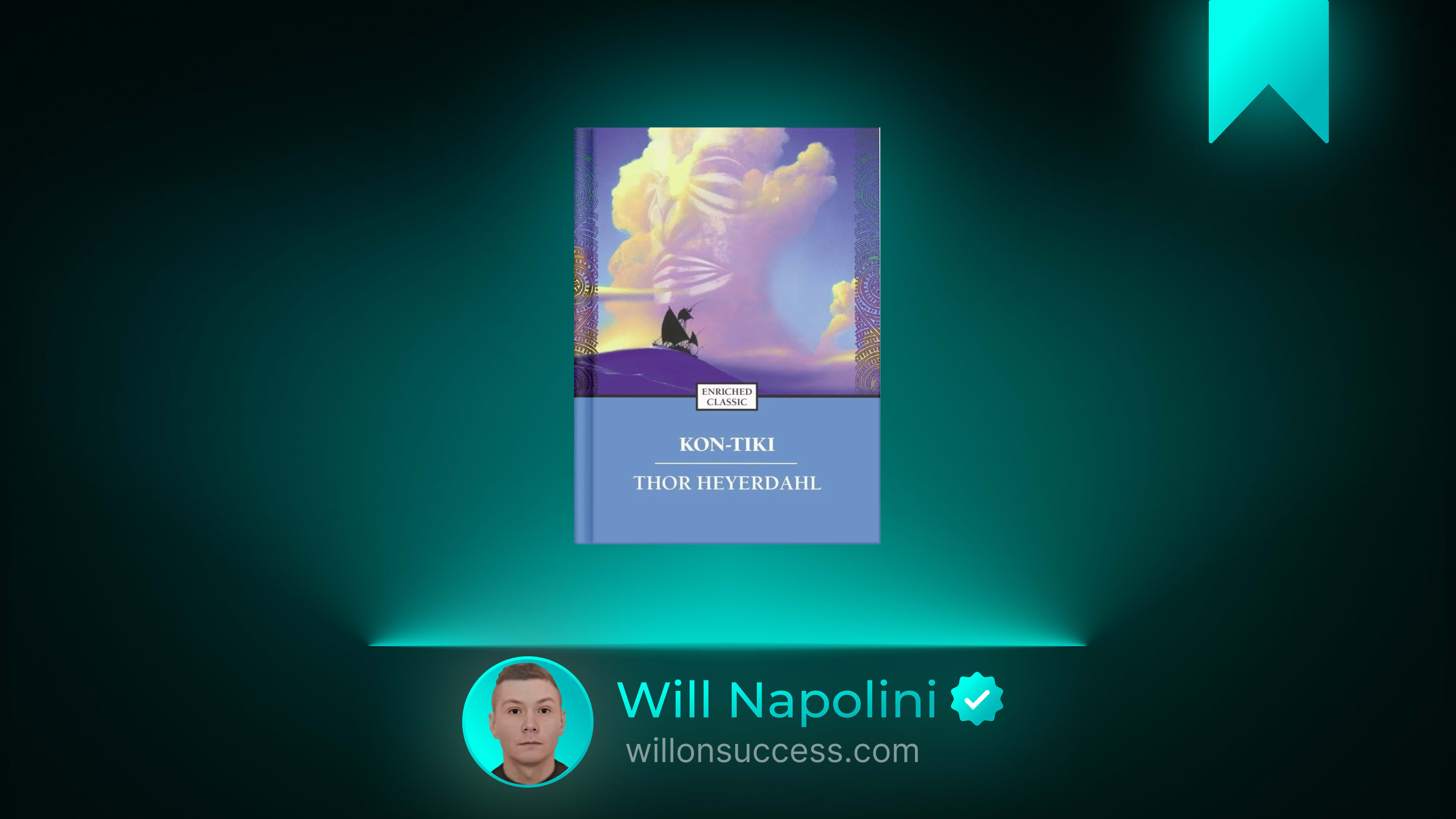
This is the heartbeat of Thor Heyerdahl’s Kon-Tiki. While history remembers it as an anthropological experiment to prove Polynesian settlement theories, I have always read it as a profound manual for the human spirit. It is a story about what happens when you stop asking for permission from the world’s skeptics and start building according to your own conviction.
If you are standing at the edge of your own ocean today, wondering if your raft will hold, this story is for you.
The Big Idea: Conviction Is a Form of Engineering
The central thesis of Kon-Tiki is often misunderstood. On the surface, it appears to be a tale of survival against nature. But beneath the salt spray and shark attacks lies a deeper argument: True possibility is born where rigorous preparation meets unshakeable belief.
Heyerdahl did not succeed because he was reckless. He succeeded because he was meticulous. His “crazy” idea—to sail a primitive balsa raft from Peru to Polynesia—was dismissed by virtually every maritime expert of his time. They told him balsa wood would become waterlogged and sink within weeks. They said the ocean currents were wrong. They said ancient peoples could not have possessed the necessary technology.
He listened to all of them. Then he went back to the source material. He studied archaeological records, botany, oceanography, and indigenous construction techniques with obsessive care. He did not ignore the experts out of arrogance; he transcended their limitations through deeper immersion in the primary evidence.
Here is what I want you to understand: Heyerdahl’s faith was not blind. It was engineered.
When we face our own impossible projects—a career pivot, a creative endeavor, a difficult relationship repair, a health transformation—we often oscillate between two extremes. Either we plunge in without preparation, calling it “faith,” or we prepare endlessly without ever launching, calling it “prudence.”
Kon-Tiki teaches us the third way. Preparation is the vessel. Belief is the wind. You cannot cross any meaningful distance with only one.
The Raft Was Built Before the Voyage Began
One of the most powerful lessons from Heyerdahl’s journey occurs long before the raft touches water. It happens in the jungles of Ecuador, selecting the balsa trees.
Heyerdahl discovered that modern timber merchants had been wrong about balsa wood. The experts assumed all balsa behaved the same way. But Heyerdahl learned from local foresters that only freshly cut, green balsa logs possessed the natural sap that prevented water absorption. Seasoned, dried balsa—the kind commercially available—would indeed sink. The experts were correct about the wood they knew, but they were wrong about the wood Heyerdahl needed.
This distinction matters enormously for your life.
How often have you been told that your dream is impossible based on someone else’s experience with materials that do not match yours? How many times have you accepted a limitation that applies to the general population but not to your specific situation?
I have mentored people who were told they were “too old” to start a business, or “too introverted” to lead, or “too unconventional” to succeed. These assessments were often made by well-meaning people using standardized metrics. But you are not a standardized metric. Your context, your timing, your unique combination of strengths and circumstances—these are your green balsa logs.
Do not accept secondhand conclusions about first-hand realities.
The lesson is not to ignore expertise. It is to verify that the expertise applies to your specific raft. Sometimes, the only way to know if something floats is to build it according to the original specifications rather than the modern assumptions.
What This Looks Like on an Ordinary Tuesday
You do not need to be crossing the Pacific to apply this. You might be:
- Rebuilding confidence after failure: Others may tell you that recovery takes years, citing average statistics. But your healing timeline depends on your specific support system, your self-awareness, and your daily practices—not an aggregate average.
- Starting a creative project: Critics may say the market is saturated. But they are analyzing yesterday’s market with yesterday’s tools. Your unique voice combined with emerging platforms may create a category that didn’t exist when they formed their opinion.
- Navigating a relationship: Well-intentioned friends may declare certain dynamics “toxic” based on general patterns. But they haven’t lived inside your history, your growth arc, or your partner’s capacity for change.
The principle remains: Validate your materials yourself. Build with what is true for you, not merely what is commonly believed.
The Crew Was Chosen for Character, Not Credentials
Heyerdahl assembled a crew of six men. None were professional sailors. They were chosen for psychological compatibility, practical skills, and shared commitment to the mission. One was a refrigerator salesman. Another was a sociologist. They were engineers, artists, and adventurers—but none were mariners.
This seems counterintuitive. Shouldn’t an ocean voyage be staffed by expert sailors?
Heyerdahl understood something that corporate hiring managers and team builders often miss: Skills can be learned at sea. Character cannot.
On a tiny raft in the middle of the Pacific, technical sailing knowledge mattered less than the ability to remain calm during a storm, to share limited resources without resentment, to maintain morale during weeks of monotony, and to trust each other when exhaustion set in. A brilliant navigator with a fragile ego would have been more dangerous than a humble learner with steady nerves.
I have seen this truth play out in organizations and families repeatedly. We hire for resumes and marry for potential, then wonder why things fall apart under pressure. We optimize for competence in fair weather and neglect resilience in storms.
Your inner crew matters as much as your outer one. When you are undertaking something difficult, ask yourself:
- Am I surrounding myself with people who validate my vision or merely my comfort?
- Do the voices I listen to possess the character required for this journey, even if they lack the traditional credentials?
- Have I cultivated patience, humility, and humor within myself—the qualities that sustain effort when expertise runs dry?
Competence gets you to the dock. Character gets you across the ocean.
Trusting the Current When You Cannot See Land
Perhaps the most emotionally resonant aspect of Kon-Tiki is the long middle passage. Weeks stretched into months. The horizon remained empty. Doubt crept in not as a dramatic crisis, but as a slow erosion. Had they miscalculated? Were they drifting aimlessly? Was the entire premise flawed?
Heyerdahl describes moments of profound uncertainty. Yet he also describes a disciplined attention to small signs: the behavior of birds, the color of the water, the pattern of swells, the presence of marine life. He could not see land, but he could read the ocean’s language.
This is where most of us abandon ship.
We expect transformation to announce itself with visible landmarks. We want confirmation that we’re on track. When progress becomes invisible, we assume we’re lost.
But growth, like ocean navigation, often operates below the threshold of immediate perception. You may be doing everything right and still see nothing changing. That does not mean you are drifting. It means you are in transit.
I have learned to distinguish between being lost and being in passage. Being lost means you have no reference points and no direction. Being in passage means you have committed to a course and are reading subtle indicators that others cannot see.
Faith is not the absence of doubt. Faith is the discipline of reading smaller signs when larger ones are absent.
What are the small signs in your life right now? Not the grand outcomes, but the quiet confirmations:
- A conversation that felt slightly more honest than last month’s
- A task completed despite lacking motivation
- A boundary held without guilt
- A moment of peace amid ongoing chaos
- An instinct that feels truer than your anxiety
These are your seabirds. They do not prove you’ve arrived. But they suggest you are moving toward something real.
Why This Matters More Than Ever
We live in an age of manufactured certainty. Algorithms predict our preferences. Analytics forecast our outcomes. Optimization culture promises that if we just follow the right formula, risk can be eliminated.
But the most meaningful dimensions of human life refuse to be optimized. Love. Purpose. Creativity. Healing. Legacy. These require voyages into unmapped territory where guarantees dissolve and character emerges.
Kon-Tiki reminds us that uncertainty is not a bug in the system of a meaningful life. It is the feature.
When you embrace this, several shifts occur:
- You stop waiting for consensus. Validation becomes nice but unnecessary. Your internal compass, calibrated through preparation and principle, becomes sufficient.
- You redefine failure. Missing your intended destination does not mean the voyage was worthless. Heyerdahl proved his anthropological theory, but he also discovered things about human endurance, ocean ecology, and indigenous technology that no controlled study could reveal. The journey yielded truths beyond its original hypothesis.
- You develop patience for process. When you understand that meaningful crossings take time, you stop demanding instant results. You learn to find satisfaction in the rhythm of the work itself.
- You honor both preparation and surrender. You build carefully. Then you release control. This balance prevents both paralysis and recklessness.
Practical Application: Building Your Own Raft
Understanding these principles intellectually changes nothing. Embodied practice changes everything. Here is how to translate Kon-Tiki into action:
Conduct a Primary Source Audit
Identify one area where you’ve accepted a limitation based on secondhand information. Go back to the original sources. Read the actual studies, talk to people living the reality, examine the raw data. Ask: “Is this truly impossible, or merely unfamiliar?” Replace inherited assumptions with verified knowledge.
Define Your Non-Negotiable Materials
List three character qualities or foundational principles that must be present in your endeavor, regardless of external validation. For Heyerdahl, it was fresh balsa, traditional lashing techniques, and crew harmony. For you, it might be integrity, sustainability, compassion, or creative authenticity. Write them down. Let them guide decisions when shortcuts tempt you.
Practice Reading Small Signs
Each evening for two weeks, record one subtle indicator of progress in your most important undertaking. Not outcomes. Indicators. Over time, review these entries. You will likely discover momentum that was invisible in real-time. This builds the muscle of faithful attention.
Assemble Your Inner Crew Consciously
Audit the voices influencing your journey. Are they equipped for storms, or only for harbors? Seek out at least one person whose character you trust more than their credentials. Share your uncertainties with them. Notice how their presence affects your resolve.
Launch Before You Feel Ready
Set a date. Not when conditions are perfect. Not when fear disappears. A real date. Commit publicly or to an accountability partner. Preparation without launch is merely elaborate procrastination. Build as thoroughly as you can. Then push off.
Who Should Read This Book
Kon-Tiki will speak deeply to you if:
- You are pursuing a vision that others consider unrealistic
- You feel stuck between over-preparation and premature action
- You are navigating a long season of invisible progress
- You value stories that combine adventure with philosophical depth
- You need historical proof that ordinary people accomplish extraordinary things through alignment of belief and craft
It may be less useful if:
- You seek step-by-step tactical guides for specific modern problems
- You prefer contemporary case studies over historical narratives
- You are uncomfortable with mid-20th-century cultural perspectives (the book reflects its era in ways worth noting critically)
- You want quick motivation without sustained reflection
Despite its age, Kon-Tiki endures because it addresses perennial human challenges. The ocean changes. The raft evolves. But the need for courage rooted in conviction remains constant.
One Small Step Today
Before this day ends, identify one assumption limiting your most important pursuit. Just one.
Then spend thirty minutes investigating it directly. Not through summaries or opinions. Through primary sources, direct observation, or honest conversation with someone living the reality.
Write down what you discover. Note where inherited beliefs diverge from verified truth.
This single act of intellectual honesty is the first plank of your raft. It costs nothing but attention. Yet it begins the shift from borrowed certainty to earned conviction.
The ocean does not care about your doubts. But it responds faithfully to a vessel built with truth.
Your voyage does not require perfect conditions. It requires a true beginning. Start there. The current will meet you.