The Initiates of the Flame by Manly P. Hall: Why True Wisdom Is Forged, Not Found
You may have read a hundred books, taken dozens of courses, and filled notebooks with insights, yet still feel no different when you wake up in the morning. Information multiplies while character stagnates. I have seen this pattern repeat enough times to recognize its quiet danger: we mistake collecting ideas for undergoing transformation. What if the reason you keep circling back to the same frustrations has less to do with how much you know, and more to do with what you have actually allowed yourself to become?
The Big Idea
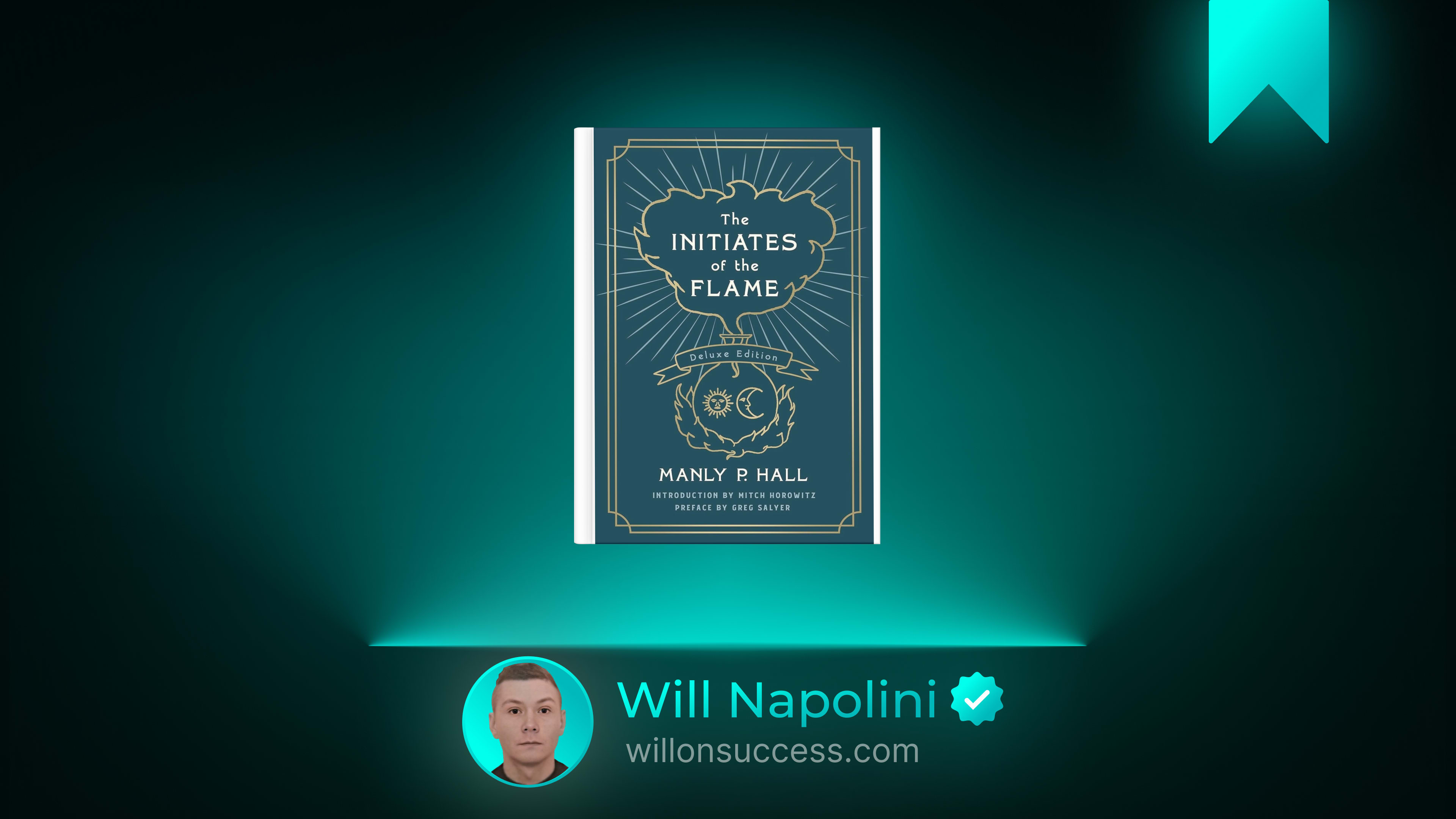
Manly P. Hall’s The Initiates of the Flame arrives at a conclusion that cuts through modern self-help fatigue: wisdom is not something you acquire. It is something you earn through sustained attention, moral readiness, and the willingness to let old parts of yourself burn away. Hall does not offer a step-by-step manual for quick success. Instead, he traces a thread that runs through ancient mystery schools, philosophical lineages, and sacred traditions—the symbol of the flame. Across cultures, fire represents awakened consciousness, discipline, and the quiet courage required to keep a deeper life alive. The book’s central thesis is simple but demanding: the flame of insight will not light itself, and it will not stay lit without deliberate tending. Real growth begins when you stop trying to grab wisdom from the outside and start preparing yourself from the inside to hold it.
The Story or Concept
Hall draws heavily on the historical and symbolic weight of sacred fires. In ancient temples, certain flames were kept burning for generations. They were not maintained by occasional dramatic efforts, but by daily, unglamorous attention. A caretaker would wake before dawn, trim the wick, add precisely measured fuel, and shield it from drafts. The ceremony around the flame was not superstition; it was a living metaphor for the human mind. A wandering, distracted consciousness is easily extinguished by every passing wind of doubt, distraction, or comfort. A focused, disciplined consciousness requires structure, protection, and regular nourishment.
Hall uses this imagery to explain what he calls initiation. In modern language, we often treat initiation as a ceremony you attend, a credential you earn, or a milestone you reach. In the tradition Hall explores, initiation is a process of purification. You do not enter the fire unchanged. You pass through it. The heat strips away what is false, what is borrowed, what is held together by ego rather than conviction. The book suggests that the individuals history remembers as truly wise were not simply born with clarity. They were forged by sustained pressure, by the repeated choice to align their actions with their understanding, and by the quiet willingness to let comfort give way to character.
The Flame Is Tended, Not Ignited Once
We live in a culture that rewards ignition and ignores tending. You start a new routine with fierce enthusiasm. You buy the tools, announce the goal, and push hard for two weeks. Then life happens. A missed day becomes three. Three becomes silence. You conclude that discipline is a personality trait you either have or lack. Hall’s framework quietly dismantles that assumption.
Fire does not survive on dramatic sparks. It survives on rhythm. The ancient caretakers understood that the flame required predictable attention, not occasional heroics. The same principle governs your development. A single breakthrough moment will not rebuild your habits. A well-designed daily practice will. You do not need more motivation. You need a system that makes the right action easier, protects your focus from unnecessary friction, and treats consistency as the real engine of change.
When you align your behavior with this reality, you stop waiting for inspiration and start building infrastructure. You create small, non-negotiable commitments that survive bad days. You stop measuring progress by intensity and start measuring it by presence. The flame stays lit not because you are extraordinary, but because you refuse to abandon the hearth.
Initiation Is Purification, Not Permission
Modern self-development often treats growth as an accumulation layer. Add another book, another habit, another certification. Yet Hall points out that every serious tradition frames initiation as a stripping away. You do not become ready by adding more to your schedule. You become ready by removing what distorts your vision.
Purification is not punishment. It is alignment. It asks a quiet but unavoidable question: What are you holding onto that is keeping your hands full, your mind scattered, and your energy divided? It might be the need to be seen as successful before you are actually competent. It might be the resentment you replay like a favorite song. It might be the subtle habit of blaming circumstances while quietly avoiding the one choice you could actually control.
When you treat growth as purification, your approach shifts. You stop asking, “What can I add to my life to make it better?” and begin asking, “What can I stop doing that is keeping me stuck?” You recognize that comfort is not inherently evil, but misplaced comfort is a slow leak. You learn to sit with the friction of doing the right thing when it would be easier to perform the right thing instead. The heat you feel when you finally face a hard truth is not a sign that something is wrong. It is the sign that something is finally burning away.
Wisdom Demands a Worthy Vessel
Hall repeatedly returns to an idea that many modern readers find uncomfortable: insight requires readiness. You can hand a beginner a master’s blueprint, but without the foundation, the structure will collapse under its own weight. Knowledge given to an unprepared mind often becomes arrogance, anxiety, or paralysis.
This is not elitism. It is physics. A cracked container cannot hold water, no matter how pure the source. Your character is the container. If your attention is fragmented, your ethics are flexible, and your commitment bends when it meets resistance, then any wisdom you absorb will simply leak out into noise. Growth before achievement is not a moral preference. It is a structural necessity.
Building the vessel takes time. It looks like keeping small promises to yourself when no one is watching. It looks like speaking honestly when a lie would be easier. It looks like doing the unglamorous work of organizing your environment, your finances, your relationships, and your routines so they support your highest intentions instead of sabotaging them. When the vessel is strong, insight does not overwhelm you. It settles into you. It becomes steady. It begins to shape your decisions without force.
The Fire Spreads Through Service, Not Hoarding
There is a subtle trap in personal development: you can become so focused on self-improvement that improvement becomes another form of isolation. Hall observes that in the traditions he studies, the initiates were never meant to keep the flame for themselves alone. The fire was tended so it could light other hearths. Hoarded wisdom stagnates. Shared wisdom compounds.
This does not mean you must abandon your own work to help others. It means your development should naturally produce usefulness. When you learn to manage your attention, you become a calmer presence in your home. When you build financial discipline, you reduce the stress that poisons your relationships. When you practice honest self-assessment, you stop projecting your frustration onto the people around you. The flame warms the room it sits in.
If your growth only serves you, it will eventually shrink. If it expands outward into responsibility, it will stabilize. You begin to measure your progress not by how much you know, but by how reliably you show up for the people and projects that depend on you. Wisdom becomes visible in your consistency, not your vocabulary.
Why It Matters
You do not need this book to recognize how easy it is to drown in information while starving for direction. You already feel the gap between what you understand and how you live. Hall’s work matters because it refuses to let you hide behind more reading, more planning, or more theory. It asks you to look at the quality of your attention, the honesty of your self-assessment, and the durability of your commitments.
What changes when you apply this framework? You stop chasing breakthroughs and start building routines that survive ordinary days. You stop waiting for perfect conditions and begin protecting your focus from unnecessary noise. You stop treating discomfort as a sign to retreat and start treating it as evidence that you are finally moving in the right direction. On an ordinary Tuesday, this looks like choosing the task you have been postponing, speaking the truth you have been avoiding, and protecting your time from demands that do not align with your stated priorities. It is not dramatic. It is deliberate. And deliberate choices, repeated long enough, become a life.
A small decision becomes a direction. A direction repeated becomes a character. A character, lived out consistently, becomes a legacy.
Practical Application
Ideas remain decorative until they touch behavior. If you want to move from understanding to embodiment, here is how you begin.
Start with a daily tending ritual. Choose one practice that strengthens your attention or character and commit to it for thirty days. It could be fifteen minutes of focused reading without your phone nearby, a brief period of honest reflection on your decisions, or a physical routine that demands steady effort. The content matters less than the consistency. You are not trying to achieve mastery in a month. You are training your nervous system to trust your commitments.
Conduct a quiet audit of what is draining your flame. Write down three habits, relationships, or commitments that consistently scatter your focus or pull you into reactivity. You do not need to eliminate them overnight. You only need to recognize them, reduce their grip, and replace them with boundaries that protect your energy.
Build a vessel through kept promises. Choose one small promise to yourself and keep it without exception for two weeks. It should be observable, measurable, and entirely within your control. Examples: go to bed at the same time every night, complete one important task before checking messages, or speak without complaint for a full day. Track it. When you keep it, your self-trust compounds. When you break it, adjust the commitment rather than abandoning the practice.
Shift from accumulation to application. After reading, listening, or learning, ask yourself one question before moving on: What is one action I can take within twenty-four hours that proves I understood this? Write it down. Do it. Record what happened. Wisdom that never touches behavior is just entertainment.
Who Should Read This Book
The Initiates of the Flame will serve you best if you are tired of superficial growth, if you recognize that your real obstacle is not lack of information but lack of integration, and if you are willing to treat personal development as a long-term craft rather than a quick fix. It rewards readers who value depth over speed and who are ready to look honestly at their own patterns.
It may feel less useful if you are searching for step-by-step productivity hacks, if you prefer highly structured, metric-driven frameworks, or if you want encouragement that avoids discomfort. Hall’s work does not optimize your calendar. It asks you to examine the quality of the life you are building inside that calendar. If you need immediate tactical fixes, you will find them elsewhere. If you want to understand why tactics fail without inner alignment, this book will give you the missing foundation.
One Small Step
Before you close this article, choose one area of your life where you have been relying on intensity instead of consistency. Write down the smallest version of that commitment you could keep every single day without fail. It should take less than fifteen minutes. It should be entirely within your control. Begin tomorrow. Do it again the next day. Treat it not as a test of your willpower, but as proof that you are finally willing to tend what you want to keep alive.
I will leave you with this: you do not need a hotter spark. You need a steadier hand. Protect your focus. Honor your word. Let time do the heavy lifting. The fire you are trying to keep alive has been waiting for someone willing to show up when it is quiet. Show up today. And then show up again tomorrow. That is how wisdom stops being an idea and starts becoming a life.