The Knowledge-Value Revolution: How to Thrive When Your Mind Is Your Greatest Asset
If you have ever felt that working longer hours is no longer yielding better results, you are not imagining things. The rules of the game have changed, but most of us are still playing by the old ones.
We were raised in a system designed for the industrial age. We were taught that value comes from showing up, following instructions, and producing standardized output. But the world has quietly shifted beneath our feet.
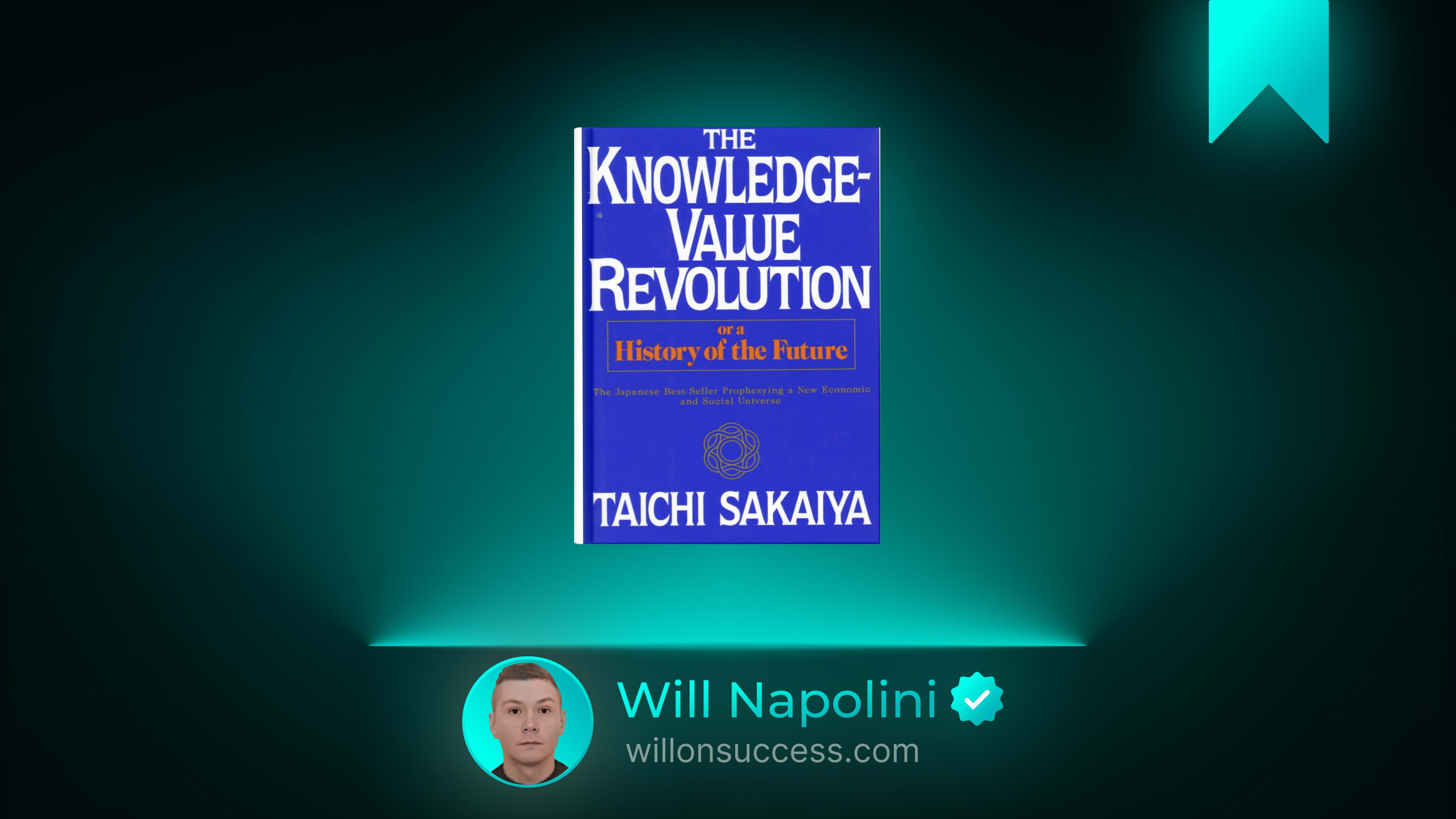
Taichi Sakaiya’s The Knowledge-Value Revolution (also published as A History of the Future) captures this shift with remarkable clarity. Sakaiya, a visionary Japanese economist and futurist, observed decades ago that we are transitioning into a society where knowledge, creativity, and human insight are the primary sources of wealth.
If you are feeling stuck, exhausted, or uncertain about your professional future, this book offers a profound change in perspective. It is not about working harder. It is about recognizing where true value is created today, and positioning yourself to create it.
The Big Idea: The Factory Is in Your Mind
The central thesis of Sakaiya’s work is both simple and liberating: we have moved beyond the industrial economy, where wealth was built on physical machinery and manual labor, into a “knowledge-value society.”
In the old model, capital and labor were separate. The factory owner held the capital; the worker provided the labor. Today, that separation is collapsing. In the knowledge economy, your knowledge, experience, and sensitivity are the means of production.
You are no longer just a pair of hands renting out your time. You are the capital.
This is not a fluffy motivational concept. It is a structural reality of the modern world. When the primary driver of profit is intangible—ideas, relationships, problem-solving, and innovation—the person who holds that knowledge holds the leverage. The question is no longer “How hard can I work?” but rather “How well am I cultivating and applying my unique knowledge?”
The Shift from Mass Production to Creative Synthesis
To understand why this matters, consider how society used to operate. The twentieth century was optimized for standardization. Success meant doing the same thing, repeatedly, with minimal error. Schools, corporations, and governments were built like assembly lines, designed to produce predictable, uniform results.
Sakaiya points out that clinging to this model is now a liability. The systems we meticulously built for mass production are ill-equipped for a world that demands customization, agility, and continuous innovation.
In a knowledge-value society, creative labor is the major factor of growth. The economy increasingly rewards intellectual enterprises where the entrepreneur and the scientist, the strategist and the executor, are often the same person. Value is no longer generated by merely moving physical objects from point A to point B. It is generated by synthesizing information, recognizing patterns, and designing better ways for people to live and work.
Your mind is not a warehouse to be filled with facts. It is a workshop where raw information is forged into value.
The Major Principles of the Knowledge-Value Era
You Are the Capital
In traditional economics, capital refers to tangible assets: buildings, machines, and raw materials. Sakaiya expands this definition to include intangibles like patents, processes, and, most importantly, human capability.
When your skills and insights are the primary drivers of your output, you must treat yourself like a vital, appreciating asset. This means investing in continuous learning, protecting your mental energy, and recognizing that your unique combination of experiences cannot be easily replicated by a machine or a cheaper labor market.
Attention and Decision-Making Are Your True Bottlenecks
One of Sakaiya’s most insightful observations is about the hidden constraints of the information age. We often assume that having more information leads to better outcomes. In reality, as information proliferates infinitely, the bottleneck shifts.
The constraint is no longer access to data. The constraint is human attention and the “decision-making cost” of processing that data. When every direction offers a new stream of information, the ability to filter, focus, and make clear decisions becomes the ultimate competitive advantage. Value is destroyed not by a lack of information, but by an overload of it.
Concept Innovation Outweighs Raw Technology
It is tempting to believe that adopting the latest software or tool will solve our problems. Sakaiya warns against this technological determinism. Technology is merely an enabler.
True wealth creation comes from “business concept innovation.” This means rethinking the underlying purpose of your work, the structure of your teams, and the way you serve your customers or community. A brilliant tool in the hands of an outdated concept will only help you fail faster. The breakthrough happens when you redesign the concept itself.
Why This Matters on an Ordinary Tuesday
You might be wondering how a macroeconomic theory applies to your daily life. It matters because it explains the quiet frustration so many people feel.
You may be checking every box, arriving on time, and completing your tasks, yet wondering why you are not advancing. The industrial model rewards compliance. The knowledge-value model rewards initiative and synthesis.
When you apply Sakaiya’s principles, you stop asking your manager for permission to learn a new skill. You start auditing your own “hidden assets.” You stop measuring your day by how many emails you answered, and start measuring it by how many meaningful problems you solved. You realize that protecting your focus is not a luxury; it is a professional necessity.
Practical Application: Building Your Knowledge Capital
Understanding this shift is only the beginning. Action is what makes it real. Here is how you can translate these principles into your daily routine.
1. Audit Your Hidden Assets Take thirty minutes this week to write down your unique knowledge stack. What do you know that others find difficult to learn? What problems do people consistently bring to you? What experiences have given you a perspective that is rare? Your value lies at the intersection of these answers.
2. Treat Your Attention as a Finite Budget You cannot manage what you do not measure. For three days, track where your attention actually goes. Notice how often you switch contexts or react to low-value notifications. Then, create a daily “focus block” of just forty-five minutes where you work on your most important, knowledge-intensive task with zero interruptions. Guard this time fiercely.
3. Shift from Execution to Architecture Choose one recurring task you complete every week. Instead of just checking it off your list, spend fifteen minutes asking: “How can I systematize, automate, or elevate the knowledge aspect of this task?” Your goal is to spend less time doing the repetitive work and more time designing the system that does it.
Who Should Read This Book
The Knowledge-Value Revolution is an essential read for professionals who feel trapped in routine work and are looking for a framework to break out. It is highly valuable for entrepreneurs, leaders navigating digital transformation, and anyone who wants to understand the macroeconomic forces shaping their career.
However, if you are looking for a quick, tactical “hack” to get rich overnight, or a step-by-step manual on using a specific software tool, this book will frustrate you. Sakaiya is offering a philosophical and structural lens, not a shortcut. It requires you to take responsibility for your own intellectual growth.
One Small Step
Do not wait for a grand epiphany to change your trajectory. A small decision becomes a direction, and a direction repeated long enough becomes a life.
Today, identify one routine task you normally postpone or rush through. Before you begin it, pause and ask yourself: “What is the knowledge or relationship value I can extract from this, rather than just the completed output?”
Then, do the task with that new intention. You are no longer just a worker completing a checklist. You are an architect building your future, one deliberate choice at a time.