Mastering the Hidden Laws of Reality: A Mentor’s Guide to The Kybalion
There is a quiet, persistent frustration that follows many of us through life. It is the feeling of being a leaf caught in the wind, blown about by circumstances, moods, and the demands of others. You work hard, you make plans, and yet you often feel as though life is happening to you, rather than through you.
If we were sitting across the table from each other right now, and you told me you felt stuck on this endless treadmill of reacting to whatever crisis the day brought, I would not tell you that you need more motivation. I would not tell you to simply work harder.
Instead, I would tell you that you are playing the game of life without knowing the rules of the board.
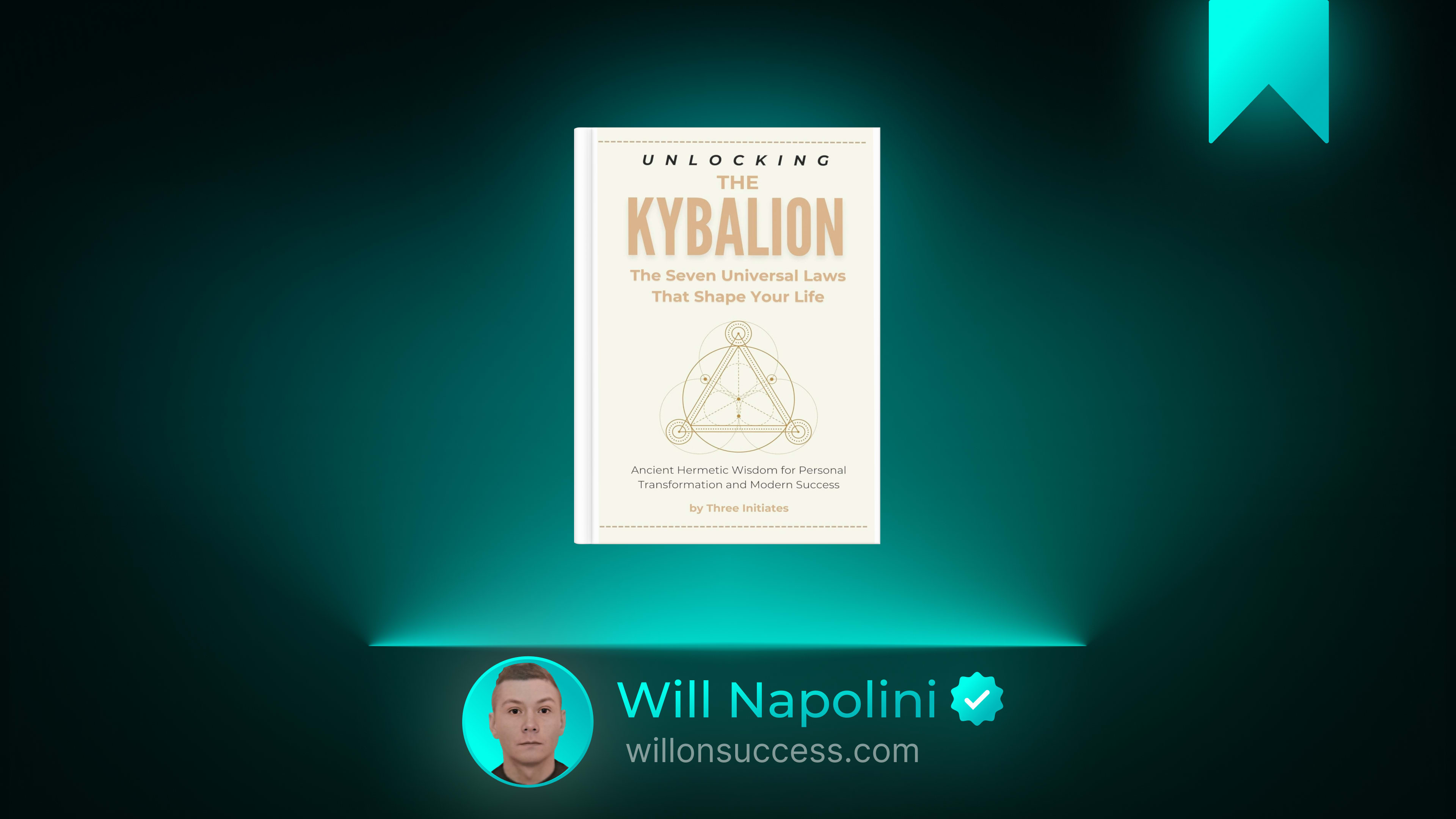
More than a century ago, a mysterious group of authors known only as the “Three Initiates” published a slender, unassuming book called The Kybalion. It claimed to pass down the ancient teachings of Hermes Trismegistus, a legendary figure whose name is synonymous with the hidden architecture of reality.
What I discovered when I first opened this book was not a collection of mystical parlor tricks. I found a rigorous, uncompromising system of mental and spiritual physics. The Kybalion teaches that the universe is not a chaotic accident. It is governed by immutable laws. And when you understand these laws, you stop being a pawn on the chessboard and finally become the player.
Here is what I want you to understand: You are either a conscious creator of your life, or an unconscious effect of your environment. Mastery begins the moment you decide which one you are going to be.
The Big Idea: The Mastery of Mental Alchemy
The central thesis of The Kybalion is that true power does not come from manipulating the physical world directly, but from mastering the mind that perceives and shapes it.
The ancients spoke of alchemy—the desire to turn lead into gold. But the Hermetic masters were not interested in metallurgy. They were interested in Mental Alchemy. They wanted to know how to transmute the “lead” of fear, apathy, and victimhood into the “gold” of courage, purpose, and agency.
The book outlines seven universal principles. These are not mere suggestions or poetic metaphors. According to the text, they are the underlying code of reality. When you align with them, life gains a profound sense of flow and momentum. When you ignore them, you experience friction, exhaustion, and repeated failure.
Let us walk through the principles that will fundamentally alter how you navigate your days.
Your Reality is a Projection of Your Mind
The first principle is the Principle of Mentalism. It states: “The All is Mind; the Universe is Mental.”
Before you can change your habits, your bank account, or your relationships, you must understand the soil from which they grow. Everything you see in your physical reality began as a thought, a belief, or an assumption in the mental realm.
I have watched people try to change their lives by purely mechanical means. They buy a new planner, they force themselves into a grueling routine, they try to hustle their way out of a rut. But if their underlying mental paradigm is rooted in scarcity, unworthiness, or cynicism, the external changes will eventually collapse. The mind is the architect; the physical world is merely the brick.
You cannot heal a chaotic life with a chaotic mind. If you want to change the output, you must change the source code.
The Mirror of Your External World
This brings us to the Principle of Correspondence, famously summarized as: “As above, so below; as below, so above.”
This principle is the ultimate diagnostic tool for your life. It tells you that there is a direct harmony and agreement between the internal, invisible planes of your mind and the external, visible planes of your reality.
Look at your desk. Look at your calendar. Look at the balance in your accounts and the depth of your closest relationships. These are not random occurrences. They are mirrors. Your external environment is a direct correspondence to your internal state.
If your mind is cluttered, anxious, and undisciplined, your environment will reflect that chaos. People often ask me how to fix their overwhelmed schedules. I tell them to start by organizing their physical space, because by bringing order to the “below,” you create a correspondence that brings order to the “above.” The mirror works in both directions.
If you do not like the reflection in the mirror, it is useless to yell at the glass. You must change the face looking into it.
The Power to Change Your Frequency
The Principle of Vibration states: “Nothing rests; everything moves; everything vibrates.”
Modern science confirms what the Hermeticists wrote in 1908: everything is in motion. But The Kybalion applies this to your mind and emotions. Your thoughts, your moods, and your beliefs are not static objects. They are vibrations.
Have you ever walked into a room after two people had a bitter argument? Even if they were sitting in silence, the air felt heavy. That is vibration.
More importantly, your emotional states operate on a spectrum of vibration. Apathy is a low, dense, sluggish vibration. Anger is a higher, faster, more chaotic vibration. Joy and purpose are high, harmonious vibrations.
Here is the practical truth: You are not a victim of your vibrations. You can change your mental state by an act of will. When you catch yourself spiraling into a low-vibration state of resentment or despair, you have the power to consciously shift your frequency. You do this not by suppressing the emotion, but by deliberately directing your attention toward a higher ideal, a memory of gratitude, or a compelling vision of the future.
The Illusion of Opposites and the Art of Sliding the Scale
Of all the teachings in the book, the Principle of Polarity is perhaps the most immediately useful for daily life. It states: “Everything is dual; everything has poles; everything has its pair of opposites; like and unlike are the same; opposites are identical in nature, but different in degree.”
Think about a thermometer. Where does “hot” end and “cold” begin? There is no absolute point where one stops and the other starts. They are the exact same thing—temperature—just at different degrees on the scale.
The Hermetic masters apply this to human emotion. Hate and love are not two entirely different things; they are the same emotional energy at different degrees on the pole. Fear and courage are the same. Sorrow and joy are the same.
This is a profound realization. It means you do not need to “destroy” your fear to find courage. You cannot destroy it, because it is the raw material of courage. You simply need to slide the scale. You transmute the emotion by changing its degree.
When I work with people who are paralyzed by the fear of starting a business or having a difficult conversation, I do not tell them to banish the fear. I tell them to recognize the energy in their chest. That rapid heartbeat, that heightened awareness—that is raw energy. By shifting their focus from what they might lose to what they might build, they slide the scale. The fear polarizes into excitement. The energy remains, but its nature is transformed.
Courage is not the absence of fear; it is fear that has been moved along the scale.
Riding the Pendulum Instead of Being Crushed by It
The Principle of Rhythm states: “Everything flows, out and in; everything has its tides; all things rise and fall; the pendulum-swing manifests in everything.”
Seasons change. Markets rise and fall. Empires expand and collapse. And your moods, your energy, and your motivation will swing like a pendulum.
The greatest mistake I see ambitious people make is believing that the upward swing is the “real” them, and the downward swing means they are failing. When the pendulum swings forward, they are highly motivated, waking up early, and crushing their goals. But inevitably, the pendulum must swing back. A Tuesday arrives where they feel tired, uninspired, and heavy. They panic. They think they have lost their edge.
The Kybalion offers a profound remedy called the Law of Neutralization. The master cannot stop the pendulum of rhythm, but they can refuse to swing with it.
How? By polarizing yourself at the higher pole. When the downward swing of mood or circumstance begins, the master anchors their identity in their deeper purpose rather than their temporary feelings. You learn to say, “I feel the fatigue, I feel the downward pull, but my will remains anchored at the higher pole.” You let the pendulum swing beneath you without allowing it to drag your consciousness down into the mud.
Escaping the Trap of “Chance”
The Principle of Cause and Effect is the great equalizer: “Every Cause has its Effect; every Effect has its Cause; everything happens according to Law; Chance is but a name for Law not recognized.”
There is no such thing as an accident. There is only a cause whose origin you have not yet traced.
When you operate at a low level of consciousness, you are entirely an effect. You are an effect of the economy, an effect of your upbringing, an effect of the news cycle, an effect of the moods of the people around you. You live in a state of perpetual reaction.
Mastery is the deliberate decision to become a cause.
This requires a brutal level of honesty. It means looking at the areas of your life that are failing and asking, “What chain of causes did I set in motion to create this effect?” It is the end of victimhood. It is the moment you take absolute, uncompromising responsibility for your reality. Circumstances matter, yes. But the master focuses entirely on the causes they can control: their thoughts, their decisions, and their daily actions.
The Necessity of Both Action and Receptivity
Finally, the Principle of Gender states: “Gender is in everything; everything has its Masculine and Feminine Principles.”
Do not confuse this with physical sex. The Hermeticists are speaking of the fundamental energies required for creation. The Masculine principle is the energy of will, direction, logic, and outward action. The Feminine principle is the energy of imagination, nurturing, receptivity, and the generation of new ideas.
Nothing of lasting value is created without the harmony of both.
If you operate purely in the Masculine, you become a relentless force of execution with no soul, no creativity, and no vision. You burn out. If you operate purely in the Feminine, you are filled with brilliant ideas, deep empathy, and vivid imagination, but you never build anything in the physical world. You remain a dreamer.
To build a meaningful life, a thriving business, or a deep relationship, you must learn to dance between these two energies. You must know when to sit quietly and receive inspiration, and you must know when to stand up and forcefully execute the plan.
Why This Matters on an Ordinary Tuesday
You might be wondering how ancient Hermetic philosophy applies to your life right now. Why does this matter on a rainy Tuesday when you are staring at a mountain of emails and feeling behind on your goals?
It matters because without these principles, you are fighting reality.
When you do not understand Polarity, you waste hours trying to suppress your anxiety instead of transmuting it into focused energy. When you do not understand Rhythm, you beat yourself up for having an unproductive afternoon, not realizing you are simply experiencing the natural backward swing of the pendulum. When you do not understand Cause and Effect, you blame your boss, the market, or your bad luck, entirely giving away your power to change the outcome.
The Kybalion shifts your identity. It moves you from a person who is desperately trying to survive the week, to an architect who is consciously designing a life.
Practical Application: The Art of Mental Transmutation
Understanding is valuable, but understanding without action changes nothing. If I could give you one practice to take away from the Hermetic masters, it is the daily practice of Mental Transmutation.
Here is how you do it.
Tomorrow, when you feel a negative emotion rising—perhaps frustration in traffic, anxiety before a meeting, or resentment toward a colleague—do not act on it immediately. Do not suppress it, either.
Instead, pause and apply the Principle of Polarity.
- Name the emotion. (e.g., “I am feeling deep frustration.”)
- Identify the opposite pole. (e.g., “The opposite of this frustration is calm resolve and understanding.”)
- Slide the scale. Consciously shift your focus. Ask yourself, “What is one thing about this situation I can control? What is the lesson here?”
- Act from the new pole. Respond to the situation not from the frustration, but from the calm resolve you have deliberately cultivated.
You start small. You stay consistent. You let time do its work. What you repeat in private eventually becomes visible in your life.
Who Should Read This Book
The Kybalion is a foundational text for anyone deeply interested in the roots of modern personal development, cognitive reframing, and the philosophy of mind. If you are tired of superficial “life hacks” and want to understand the deep, underlying mechanics of human agency, this book is a masterkey. It is essential reading for those drawn to philosophy, psychology, and the esoteric traditions that influenced much of the 20th-century New Thought movement.
However, I will be honest with you: it is not for everyone. The language, written in 1908, can feel formal and archaic. It is dense, philosophical, and entirely unconcerned with modern corporate jargon or quick-fix business tactics. If you are a strictly materialist reader who requires peer-reviewed clinical trials for every claim, or if you are looking for a step-by-step guide to optimizing your morning routine, this book will likely frustrate you. It is a book of principles, not a manual of tactics.
One Small Step
We have covered the architecture of reality, but a door only opens when you turn the handle.
Here is what I want you to do today. I want you to identify one area of your life where you have been playing the “effect.” It might be your physical health, your financial savings, or the distance between you and a loved one.
Take out a piece of paper and write down this question: What chain of causes have I set in motion to create this effect?
Do not write down excuses. Do not write down the faults of others. Trace the effect back to your own daily habits, your own unexamined beliefs, and your own decisions.
Owning the cause is the first step to changing the effect.
You do not need to be a victim of the pendulum, the tides, or the circumstances around you. The laws of reality are not here to trap you; they are here to be used by you. The universe is mental, the mirror is waiting, and the scale is in your hands.
Now, go slide it.