Breaking the Cycle: How to Heal Inherited Family Trauma with It Didn't Start With You
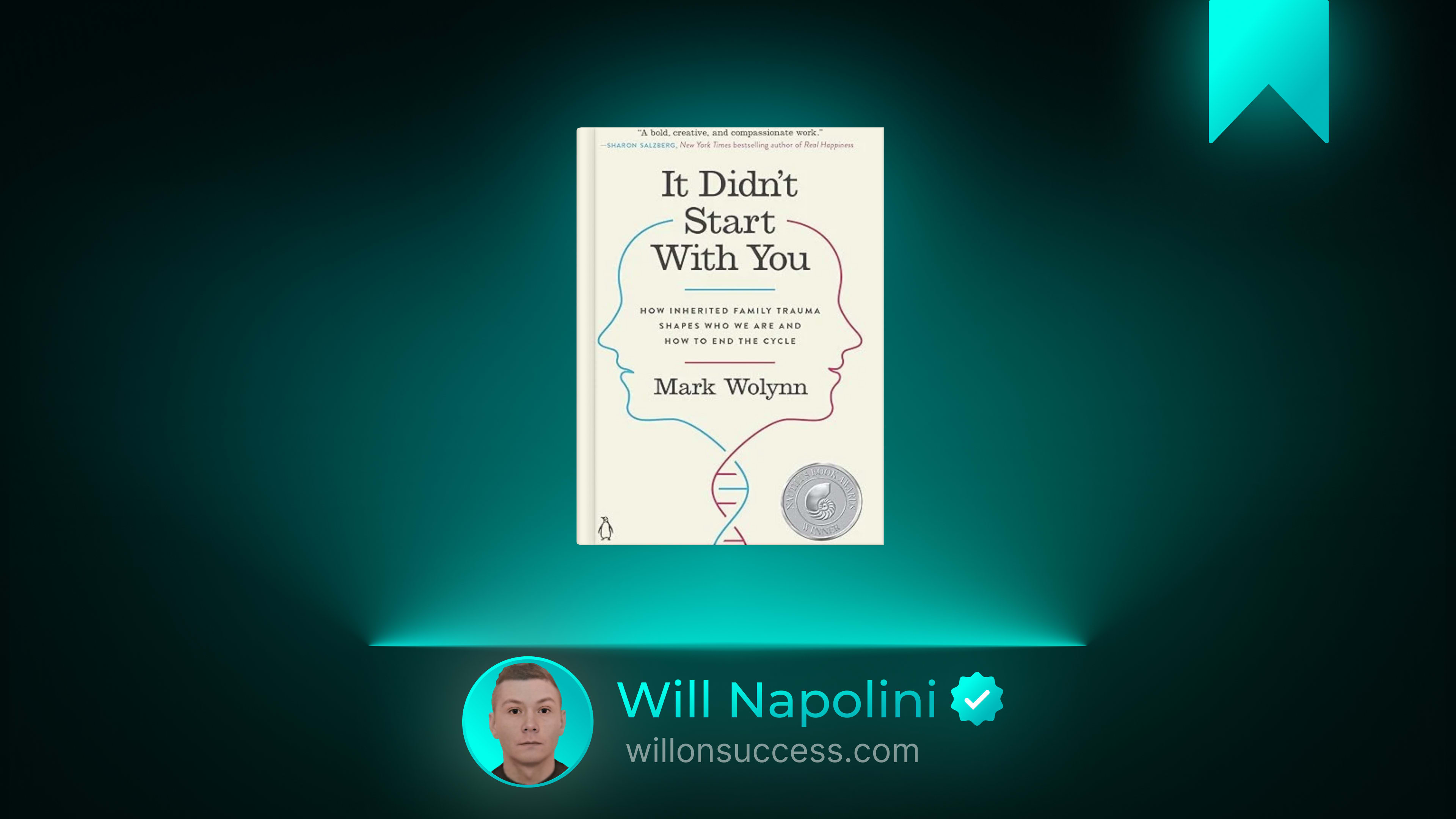
What if the fear that keeps you awake at night does not actually belong to you?
What if the depression that has shadowed you for decades is not a chemical imbalance or a personal failure, but an echo of a grief your grandmother was never allowed to mourn? What if your unexplained panic, your chronic pain, or your self-sabotage is simply your body faithfully carrying a burden that was placed upon it before you were even born?
This is the unsettling, liberating premise of Mark Wolynn’s It Didn’t Start With You. As someone who has walked alongside many people in their healing journeys, I have seen how exhausting it is to treat symptoms as if they originated entirely within us. We go to therapy, take medication, read books, and meditate—and while these tools are vital, something often remains untouched. Wolynn suggests that what remains is the invisible inheritance of unresolved family trauma.
If you have ever felt like a stranger in your own emotional life, or if you sense that your suffering has roots deeper than your own biography, this book offers both validation and a map. It tells you: You are not broken. You are loyal. And loyalty can be redirected.
The Big Idea: Your Symptoms Are a Language, Not a Sentence
The central thesis of It Didn’t Start With You is that inherited family trauma lives in our bodies and minds as unconscious loyalty to those who came before us. Through advances in epigenetics, neuroscience, and attachment research, Wolynn demonstrates that traumatic experiences can alter gene expression and be passed down biologically and psychologically across generations.
But biology is not destiny. Wolynn’s Core Language Approach provides a practical method for making the unconscious conscious. By listening to the specific words, images, and sensations of our deepest fears, we can trace them back to their source in our family history.— title: “Breaking the Cycle: How to Heal Inherited Family Trauma with It Didn’t Start With You” description: >- Mark Wolynn’s Core Language Approach reveals how unexplained anxiety, depression, and fears may belong to your ancestors, not you. This summary offers a compassionate, practical guide to identifying inherited trauma and reclaiming your own life through language, visualization, and conscious separation. date: 2026-08-17 00:00:00 +0800 categories: [book-summaries, personal-development] tags: [ inherited-trauma, epigenetics, healing, family-patterns, mark-wolynn ] image: “IMAGE_URL” alt: “A person standing peacefully beside a faded family tree, symbolizing healing across generations” pin: false fallback: —
What if the fear that keeps you awake at night does not actually belong to you?
What if the depression that has shadowed you for decades is not a chemical imbalance or a personal failure, but an echo of a grief your grandmother was never allowed to mourn? What if your unexplained panic, your chronic pain, or your self-sabotage is simply your body faithfully carrying a burden that was placed upon it before you were even born?
This is the unsettling, liberating premise of Mark Wolynn’s It Didn’t Start With You. As someone who has walked alongside many people in their healing journeys, I have seen how exhausting it is to treat symptoms as if they originated entirely within us. We go to therapy, take medication, read books, and meditate—and while these tools are vital, something often remains untouched. Wolynn suggests that what remains is the invisible inheritance of unresolved family trauma.
If you have ever felt like a stranger in your own emotional life, or if you sense that your suffering has roots deeper than your own biography, this book offers both validation and a map. It tells you: You are not broken. You are loyal. And loyalty can be redirected.
The Big Idea: Your Symptoms Are a Language, Not a Sentence
The central thesis of It Didn’t Start With You is that inherited family trauma lives in our bodies and minds as unconscious loyalty to those who came before us. Through advances in epigenetics, neuroscience, and attachment research, Wolynn demonstrates that traumatic experiences can alter gene expression and be passed down biologically and psychologically across generations.
But biology is not destiny. Wolynn’s Core Language Approach provides a practical method for making the unconscious conscious. By listening to the specific words, images, and sensations of our deepest fears, we can trace them back to their source in our family history. Once identified, these patterns can be acknowledged, honored, and released—not by rejecting our ancestors, but by completing what they could not.
This matters because so much of personal development assumes we are starting from scratch. But we are not blank slates. We are living sequels to stories we never chose to write. Healing begins when we stop treating ourselves as isolated problems and start seeing ourselves as part of a larger narrative that deserves completion.
The Science That Validates Your Intuition
For years, people sensed that family pain lived inside them, but lacked scientific language to describe it. Wolynn grounds his work in credible research. Epigenetics shows that environmental factors—including trauma—can chemically modify DNA without changing the genetic code itself, affecting how genes are expressed in subsequent generations.
One landmark study cited in the book involved mice conditioned to fear a cherry blossom scent through electric shocks. Not only did the original mice develop heightened sensitivity to the smell, but their offspring and grandchildren exhibited the same fear response and brain changes—despite never experiencing the shock themselves. Humans share significant biological similarities with these models, suggesting that emotional and behavioral legacies can travel through sperm and egg cells across multiple generations.
Neuroscience further explains why talk therapy alone sometimes fails. Traumatic memories are often stored as implicit, non-declarative memories—felt in the body rather than recalled as facts. This is why your anxiety may feel wordless, or why certain situations trigger reactions that seem disproportionate. Your nervous system is remembering what your mind cannot narrate.
Understanding this removes shame. Your symptoms are not character flaws. They are biological and psychological signals pointing toward unfinished business in your lineage.
The Core Language Map: Four Steps to Uncover Your Inheritance
Wolynn’s method is not abstract theory. It is a structured, experiential process designed to translate bodily sensation into ancestral insight. The Core Language Map consists of four interconnected elements.
Your Core Complaint Is a Breadcrumb Trail
Your Core Complaint is the persistent issue that disrupts your peace—the fear, symptom, or pattern that feels larger than your current circumstances. It might be “I’ll never find love,” “Something terrible is always about to happen,” or “I’m destined to disappoint everyone.”
Do not analyze this complaint. Listen to its language. Which words carry unusual intensity? Which phrases feel alive in your body? These are not random. They are fragments of someone else’s unspeakable experience echoing through you.
Write it down without editing. Scan for emotionally charged vocabulary. That language is your first clue.
Your Core Descriptors Reveal Unconscious Loyalties
How you describe your parents—especially what you blame them for—often mirrors dynamics from earlier generations. When you say “My mother was cold and withholding” or “My father was absent and unreliable,” you are not only describing your childhood. You may also be articulating a rupture that began long before you arrived.
These descriptors matter because rejection or merger with a parent creates fertile ground for inheriting ancestral trauma. If you rejected your mother due to her emotional distance, you may have unconsciously aligned with a grandmother who was similarly abandoned. If you merged with your father’s sadness, you may be carrying a grandfather’s unprocessed grief.
Be honest. Do not soften your words to be polite. The rawness of your description is precisely what points toward the wound.
Your Core Sentence Names the Deepest Fear
Ask yourself: “What is the worst thing that could happen to me?” Then ask: “And if that happened, what would be the worst part of that?” Keep asking until you reach a sentence that resonates in your bones.
Examples include:
- “They’ll lock me away.”
- “I’ll vanish and no one will notice.”
- “I’ll become exactly what they feared.”
This Core Sentence is rarely about your present reality. It is often a direct quotation from an ancestor’s inner world. When you speak it aloud and feel recognition rather than confusion, you have likely touched the source.
Bridging Questions Connect You to Your Lineage
Once you have your Core Sentence, ask bridging questions to locate its origin. Has anyone in my family been disowned, imprisoned, or separated? Did anyone die young, lose children, or endure betrayal? Was there early separation between parent and child? Did someone carry guilt or shame silently?
You are not looking for perfect historical accuracy. You are listening for resonance. Sometimes the answer comes as a memory, a family story, or simply a bodily knowing. Trust that knowing.
Healing Is Separation With Honor
Identifying inherited trauma is only half the journey. The other half is releasing it without betraying your family.
Wolynn emphasizes that healing does not require confrontation or cutting ties. In fact, reconnection—even symbolic—is often essential. One powerful practice involves placing a photograph of a parent or ancestor where you can see it daily, then speaking healing sentences such as “I honor your pain, but I do not need to carry it” or “You are remembered, and I am free to live my own life.”
Visualization practices help rewire neural pathways. Imagine receiving love from a parent who could not give it in life. Picture an ancestor standing behind you with support rather than sorrow. Light a candle in their memory while affirming your right to joy.
These are not magical rituals. They are neuroplastic interventions. By creating new internal images, you create new possibilities in your body and relationships.
Crucially, healing requires distinguishing your emotions from theirs. Ask: “Is this feeling mine, or am I holding it for someone else?” Then consciously return what is not yours. Say inwardly: “This belongs to you. I release it with respect.” This is not abandonment. It is the highest form of reverence—to let the dead rest so the living can breathe.
Why This Matters for Your Daily Life
You may be wondering how this applies to your Tuesday morning commute or your difficult conversation tonight.
Inherited trauma does not announce itself dramatically. It hides in ordinary moments: the disproportionate rage when your partner forgets to text back (echoing a great-aunt’s abandonment), the chronic fatigue that worsens around holidays (mirroring a grandmother’s seasonal depression), the financial self-sabotage just as success nears (repeating a grandfather’s belief that prosperity invites danger).
When you recognize these patterns as inherited, you stop fighting yourself. You stop asking “What’s wrong with me?” and start asking “Who is speaking through me?”
This shift transforms your relationships. Instead of blaming your partner for triggering you, you can say: “This reaction is older than us. Let me tend to it.” Instead of resenting your parent for their limitations, you can see them as links in a chain of survival. Instead of fearing your children will inherit your pain, you can actively complete what was left undone.
Growth before achievement means becoming someone who can hold complexity without collapsing. Character before circumstances means choosing awareness over automaticity, even when the pattern feels inevitable.
Practical Application: Begin Your Core Language Inquiry Today
Understanding is valuable, but understanding without action changes nothing. Here is one concrete step drawn directly from Wolynn’s method:
Complete the Core Sentence Exercise Tonight
Set aside fifteen minutes in a quiet space. Have paper and pen ready.
- Write: “My worst fear, the worst thing that could happen to me is…”
- Complete the sentence without censoring.
- Below it, write: “And if that happened, the worst part would be…”
- Continue asking “And then what?” until you reach a sentence that makes your body respond—a tightness, a tear, a sigh, a shiver.
- Sit with that sentence. Place your hand on your heart. Whisper: “I hear you. You are not alone anymore.”
Do not force connections to family history yet. Simply acknowledge the sentence as valid. Over the next week, notice when this fear arises in daily life. Journal any memories, dreams, or family stories that surface spontaneously.
This is not a one-time exercise. It is the beginning of a dialogue with your lineage. Return to it gently, without pressure. Truth reveals itself in its own time.
Who Should Read This Book
It Didn’t Start With You will resonate deeply if you:
- Experience anxiety, depression, or physical symptoms that defy conventional explanation
- Sense that your struggles are tied to family history, even without clear evidence
- Have done extensive personal work but still feel stuck in repetitive patterns
- Are interested in the intersection of science, spirituality, and ancestral healing
- Want practical tools, not just theoretical frameworks
It may be less useful if you seek quick fixes, purely cognitive approaches, or narratives that minimize the role of individual agency. Wolynn honors both inheritance and choice. He does not reduce you to your ancestry, nor does he pretend you exist outside of it.
Read this book if you are ready to listen to the whispers beneath your symptoms. Read it if you trust that healing is possible, even when the wound predates your birth.
One Small Step Toward Freedom
Before you close this page, choose one word from your Core Complaint or Core Sentence.
Say it aloud three times, slowly.
Then place your hand over your heart and say: “This feeling has a history. I honor that history. And I am allowed to write my own future.”
Do this once today.
Because freedom does not come from erasing the past. It comes from acknowledging it fully enough to set it down.
You are not responsible for the trauma you inherited, but you are capable of completing it.